
By Mary F. Willson
Animal-pollinated plants typically make a flower to attract visiting animals. A straight-forward example is a salmonberry flower, familiar to all of us. There’s a circlet of pink petals surrounding a yellowish center composes of male (stamens) and female (pistils) parts. In other cases, Mother Nature has designed a more complex arrangement of colorful petals, as in lupines or orchids.
Turn the salmonberry flower over and look at its underside, where it attaches to the stem. There is a more-or-less cup-like structure (the calyx), composed of several elements called sepals, which are usually green. The calyx covered the developing flower bud and often remains behind an open flower, providing support.
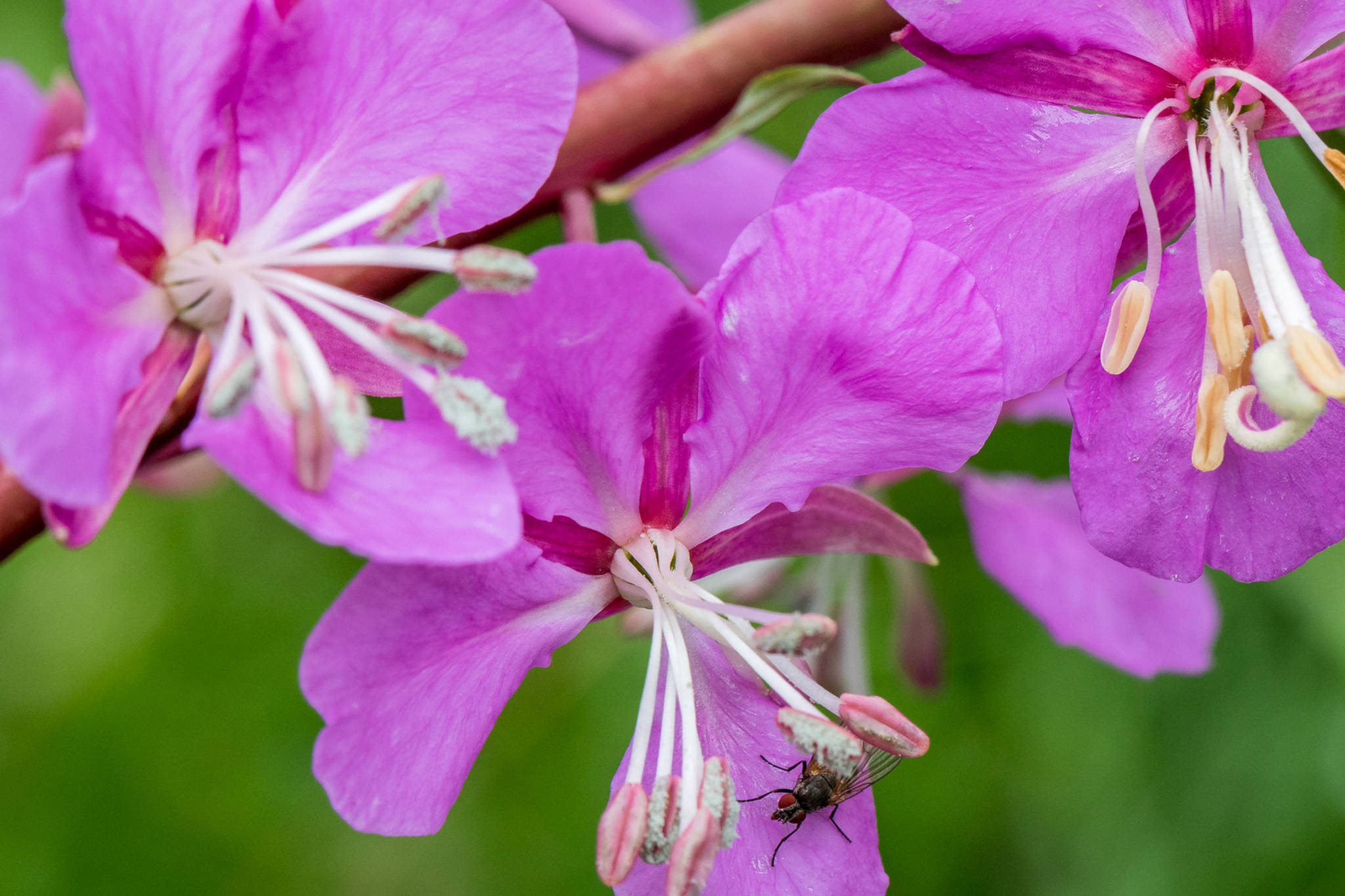
In some species; however, the sepals have become part of the flower—they are colorful and not hidden behind the petals. The fireweeds are good examples: the four wide, pink (sometimes white) petals alternate with narrow, darker pink sepals. Three-leaf goldthread, common in subalpine meadows, has several white sepals surrounding stamens, pistils, and some golden petals, shaped like tiny trumpets, that are serving as nectaries.
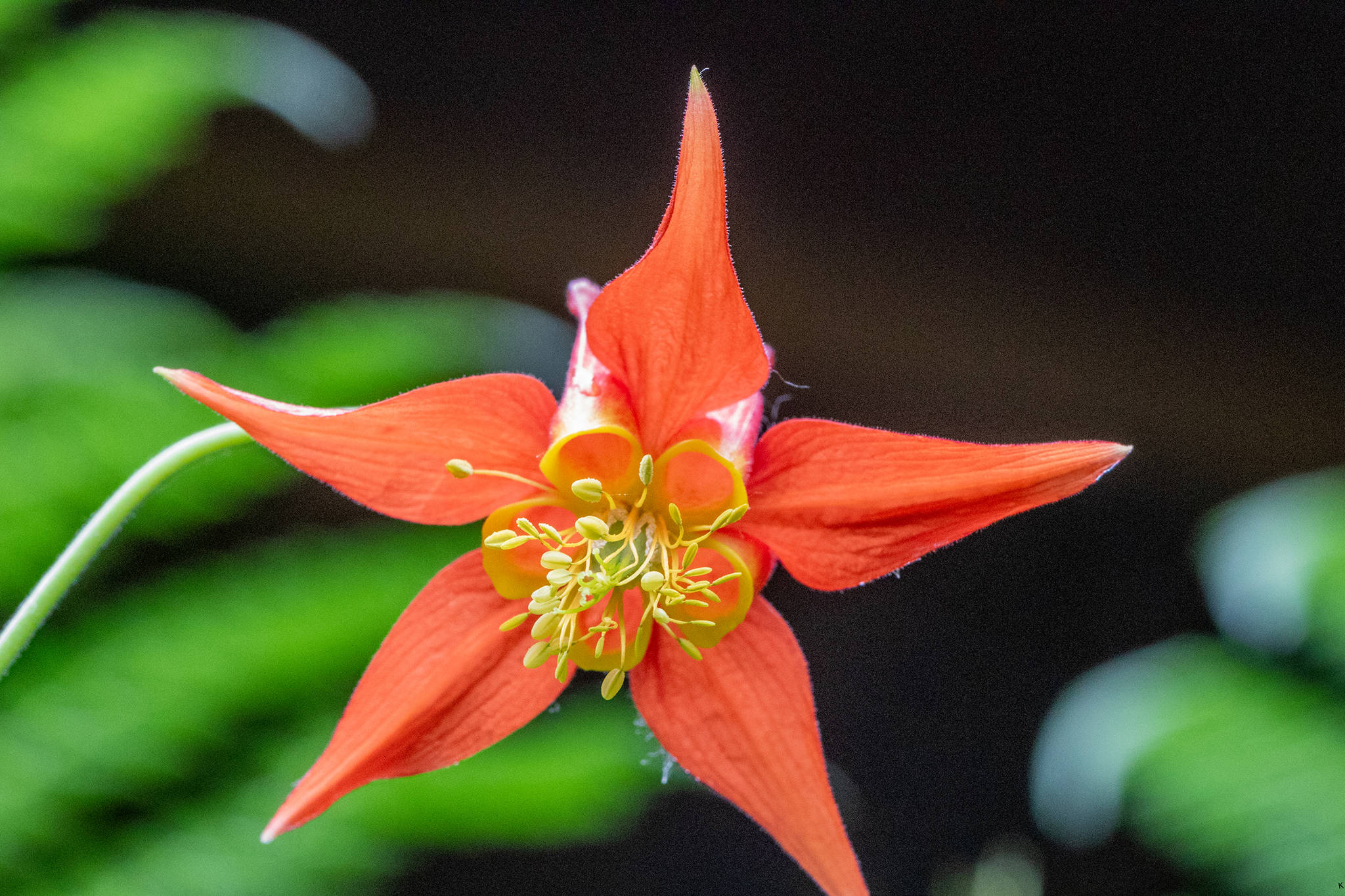
Red columbine is a more complex example. Here, the petals are the five yellow funnel-like structures that have long, reddish nectar spurs projecting from the other end of the flower. The five red, flaring wings are the sepals.
The wild iris goes still further — the three drooping, purple pieces are the sepals, comprising the main part of the flower. The petals are very small, just visible between the bases of the purple sepals. In domestic, horticultural irises, the petals have become much larger, standing up above the sepals (assuming that the ancestor of domestic irises was similar to our wild iris, horticulturalists presumably have selected for greater petal size over a number of generations).
Some plants have abandoned petals altogether, making a flower of showy sepals: marsh marigold, narcissus anemone, Sitka burnet. So, if you look at the back side of those flowers, you see no sepals.
However, one cannot conclude from an observation of “no sepals” that the sepals are in the flower somewhere. That’s because some species drop their sepals fairly early in floral development; baneberry and some buttercups do so.
Attractive displays sometimes incorporate elements that are not, technically, part of the flower. I’ve previously mentioned dwarf dogwood with its white bracts (modified leaves) around the central flowers. Perhaps the best known plant using bracts to make a conspicuous display are the horticultural poinsettias so commonly sold for winter holidays. The sometimes rather colorful but very small flowers are clustered in the middle of all those gaudy bracts.
Do all those details of botanical anatomy matter? Not to those for whom flowers are just part of the scenery. At a trivial level, attention to such details as a bit like a game, a jigsaw puzzle, accounting for all the pieces and fitting them together. At another level, the various contrivances that make a “flower” suggest questions about the relationships with pollinators (and other possible factors) and thus (eventually) to understanding more about the lives of these plants. Here are a few such questions (and no answers, although they could be addressed by experiments or, in some cases, by close examination of the evolutionary history):
— Are fireweed flowers with colored sepals between the petals more attractive to pollinators than those that lack them?
—Colored bracts or sepals around a flower can make the display larger. How does that affect pollinator behavior?
— Horticultural irises, with their tall petals, are (presumably) more attractive to humans than the wild forms with the tiny petals. Although gardeners may not care, do the pollinating insects such as bees react differently?
— Does converting showy petals to nectaries (albeit colorful ones), as in three-leaf goldthread, allow more nectar to be produced or favor visits by certain kinds of insects?
— In the case of columbines, the elongated petals make a nectar spur that can only be accessed properly by long-billed birds or long-tongued insects, effecting pollination. Many other species in the buttercup family have showy petals bearing small nectaries. The nectary development and specialization in columbines included making the petals less conspicuous, except when the sepals are fully reflexed or when viewed from below the pendant flower. Did that development make it useful for the sepals to be so showy?
— And why do some plants just drop their sepals, while others have no petals but only sepals in the ‘flower’.
As usual, asking questions leads to still more questions. But if curious naturalists didn’t keep asking, there are many things we’d never know.
• Mary F. Willson is a retired professor of ecology. “On the Trails” appears every Wednesday in the Juneau Empire.
