
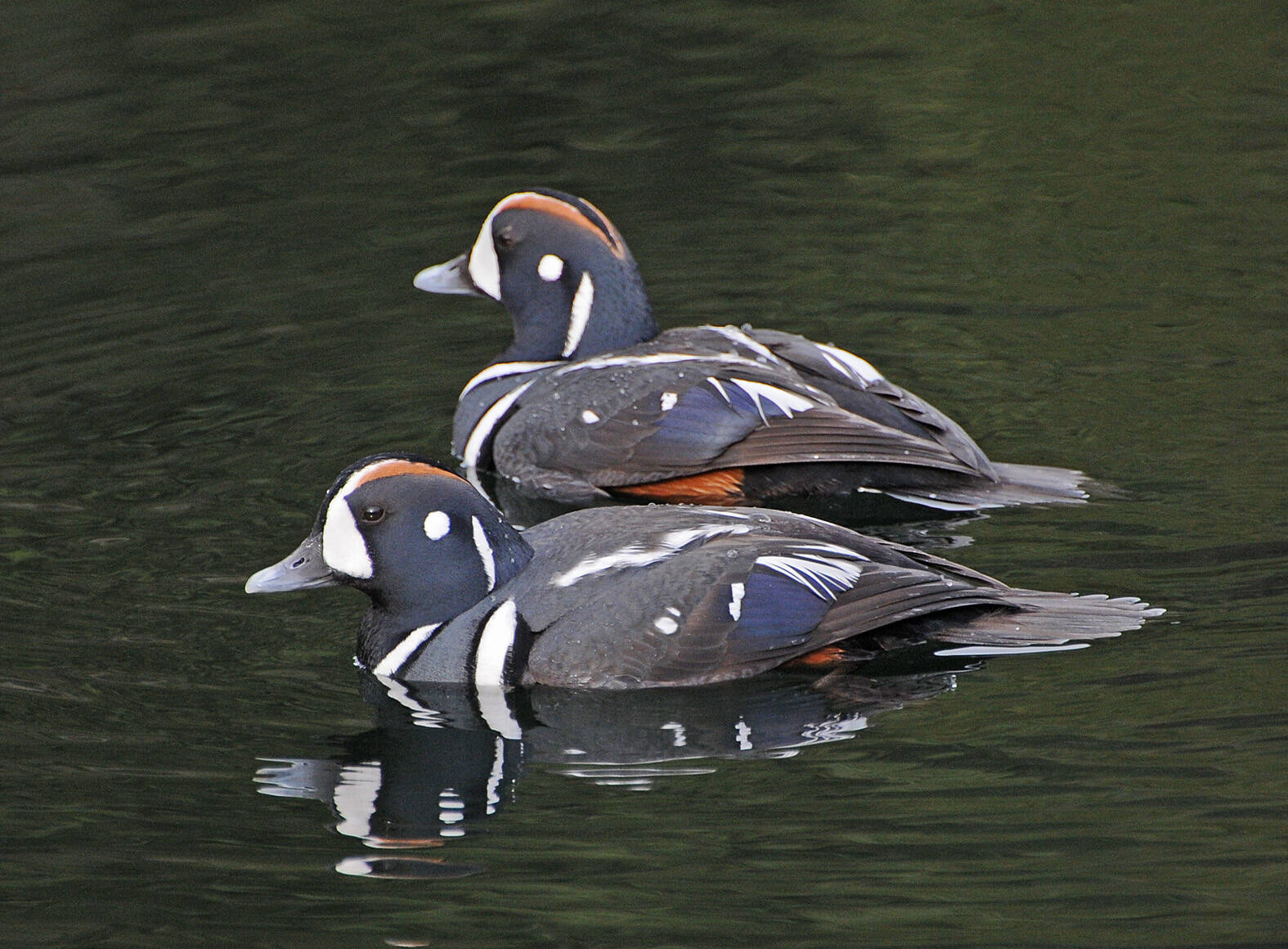
On a cold, windy day in late November, I wandered out to Point Louisa. A strong, cold north wind had a mixed gang of scoters and goldeneyes clustered in the lee of the point. Right along the edge of the protected shore, some harlequin ducks were pottering about in the shoreline rocks. We often see such groups hanging out near rocky points.
The scientific name for harlequin ducks is Histrionicus histrionicus, from the Latin word ‘histrio’, meaning ‘actor’. In the Italian commedia dell’arte of the 16th century, that word got expanded to mean specifically a certain kind of actor, who initially was something of a joker or trickster or mischief-maker, but became a high-spirited, clever servant, dressed in a patchwork of colorful fabrics. The bright patchwork of color on male harlequin ducks probably earned them that name.
Etymological note: Despite the similarities, the origin of that name is not to be confused with the old Greek word ‘hystrix’, meaning porcupine, nor with the Greek word ‘hystera’, meaning uterus (thus leading to words such as hysteria, originally used as a term for a supposed neurotic disease of females, imagining that it was caused by uterine troubles. Later, the term was expanded to refer to anyone’s excessive, uncontrolled emotions). Furthermore, the nickname for this duck is ‘harley’, but that’s not to be confused with a certain kind of motorcycle.
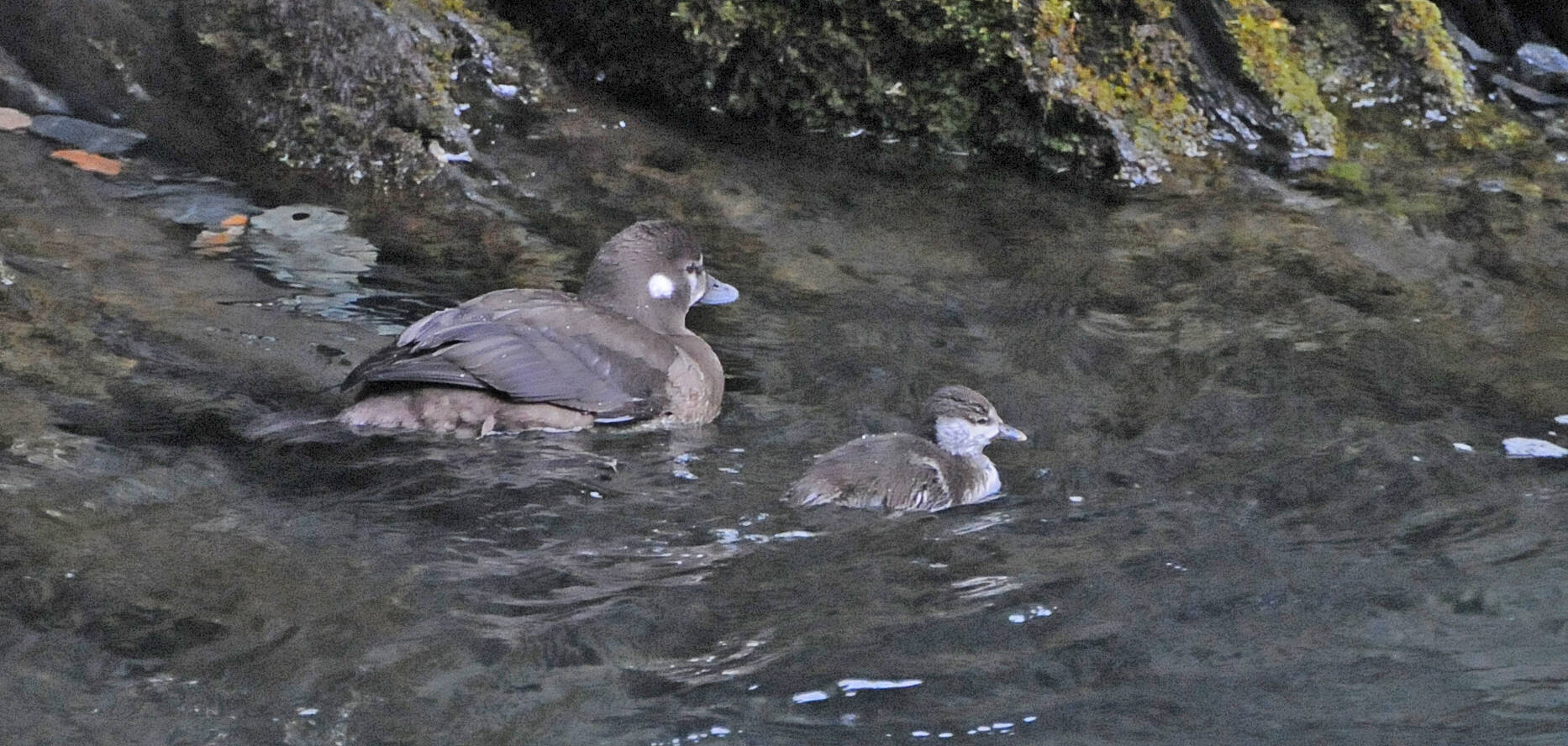
A female harlequin accompanies a chick downstream on the way to the sea.
We most often see harlequins near salt water shores, where they commonly forage. They eat all sorts of intertidal and subtidal invertebrates — crabs, amphipods, periwinkles, mussels, chitons, barnacles, and so on. They commonly pick small prey items from rocks or gravel. The bill must have lots of touch sensors, so they can detect kinds of prey and precise locations for grabbing them. Sometimes they feed from a position on the surface, poking the head under the water or tipping the whole body with the head down. Sometimes they paddle their feet to disturb bottom sediments and grab prey from the resulting muddy plume. And they often make shallow dives, usually of less than half a minute in duration. Sometimes they feed on fish roe; herring spawn is a favorite in some places.
Harlequins have a wide distribution, nesting in Iceland, southern Greenland, the east coast of Canada, eastern Siberia, and northwestern North America. Breeding is not restricted to coastal areas; inland mountains offer good nesting habitats along whitewater creeks and rivers (and in some cases, the birds then may migrate to salt water for the winter). They are very adept at swimming in rough water and strong currents.
These ducks commonly keep the same mate every year; long-term monogamy is the rule, if both members of the pair use the same wintering area. Established pairs don’t engage in elaborate courtship rituals; the association is one of mate-guarding usually by males but sometimes also by females. However, divorces and extra-pair copulations are said to be rare. New pairs are formed by mate-less individuals in winter, when the birds are on salt water.
Come spring, pairs move from salt water into fast-moving streams, where the females choose their nest sites. They walk along a stream bank and gravel bars, looking for something suitable. Nest sites are variable, but always on or near the ground (on cliff ledges, in rock crevices or tree cavities, on stumps, under logs, etc.), not far from the stream. Females do the incubating, often lining the nest with down, while the male goes back to sea to molt, temporarily loosening the pair bond. An egg is laid at one to three day intervals, usually in clutches of five to seven eggs. The females incubate for about four weeks, sometimes a bit more, and all the chicks hatch on approximately the same day. Hatchlings can feed themselves immediately; larval insects (e.g., of blackfly and midges) are often a favorite kind of item. They can dive when they are three or four weeks old, and fly not long after.
Females sometimes abandon their broods, letting them find their own way down to the sea. But mothers often accompany their young ones downstream; that’s when we sometimes see them floating down a mountain creek. However, the offspring are on their own when they get to the sea.
Survival of the ducklings is highly variable, often depending on the food supply in the stream. On average, annually, usually less than 50% of females are successful in rearing a brood. The average brood size at fledging is two to four young ones. Mortality is due not only to starvation, but also to various predators, such as eagles, mink, and otters.
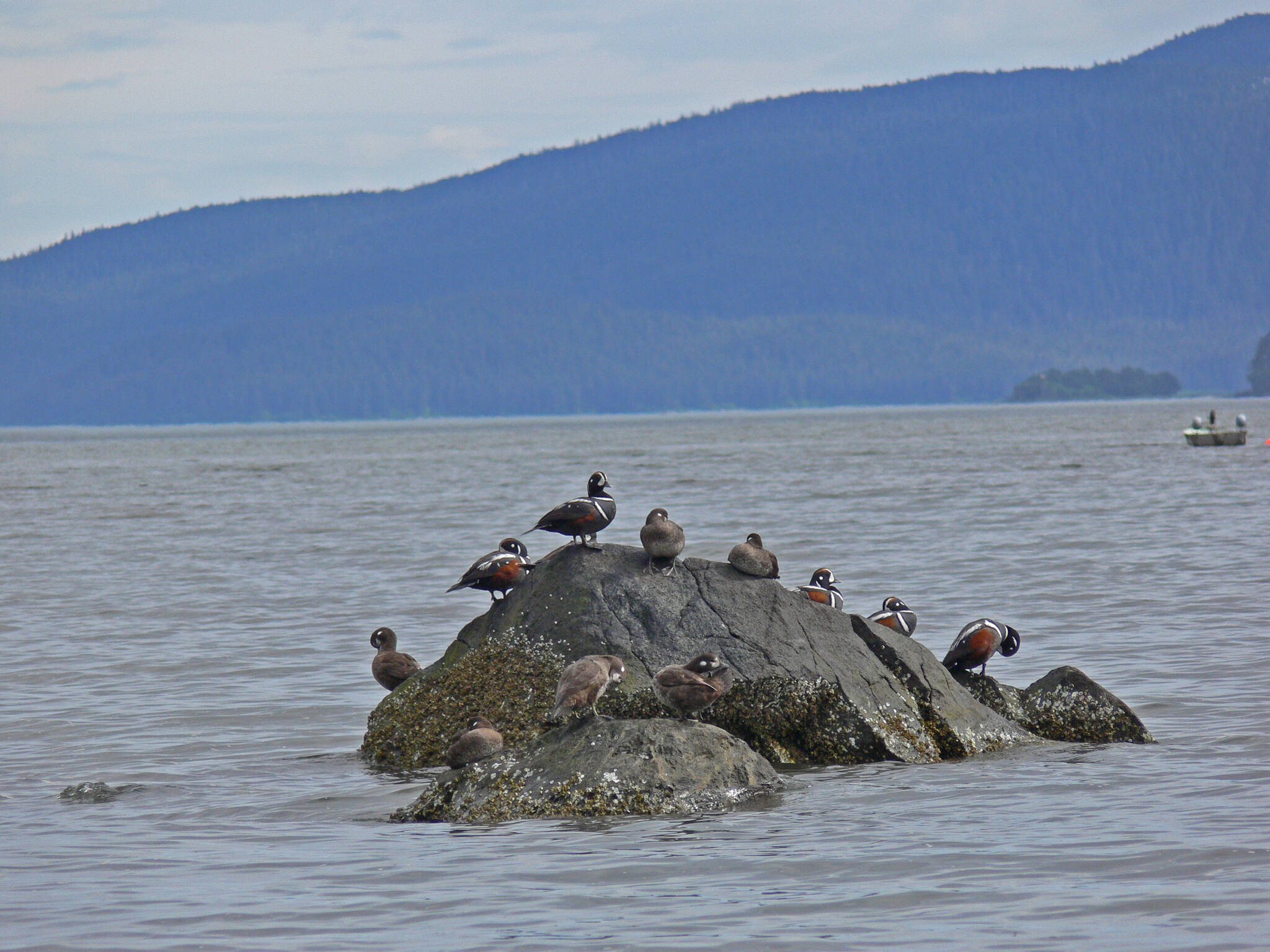
In the off-season, harlequins congregate near shore, males and females together. (Courtesy Photo / Bob Armstrong)
Although occasional females mature and breed at age one or two years, they usually form their first pair bond at age three or more. In any one year, some females do not breed at all. Males, too, seldom breed before age three or so. If we see males and females loafing about together at the shore in spring and summer, those females have failed to raise a breed or failed to breed at all. Harlequins are not globally threatened, but some populations have declined seriously.
Sexual dimorphism of this species is pronounced: males are far more colorful than females. In some studied cases, this kind of difference is related to sexual selection: competition among males for breeding rights, favoring distinctive displays, and choices by females about whom to have as a mate, favoring elaborate plumage of males. In harlequins, that kind of activity probably would be most intense among young birds (or widows and widowers) just starting to form long-term pairs, when they are congregated on salt water in winter. But I have not found detailed studies of mate choice and initial pair formation, so this hypothesis is untested, apparently. And perhaps there are other explanations?
• Mary F. Willson is a retired professor of ecology. “On the Trails” appears every Wednesday in the Juneau Empire.
