
By Mary F. Willson
For the Juneau Empire
Just before the summer solstice, a little group of friends walked out onto Cowee Meadow. Although it was raining in town, out there, the sun was shining. The meadows were a blaze of color: pink shooting stars, yellow buttercups and blue lupines covered acres with floral glory. While those species were dominant in the meadows, we counted over 60 species of flowers on our walk (not counting grasses and sedges). We did include the irises, which were just starting to bloom; in another week or two, irises will be the main show.
Among all the blue lupines were three or four individuals with pink flowers, and we’ve sometimes seen very pale shooting stars. On the upper beach, there’s the usual blue-flowered oysterplant, with a few white-flowered individuals — and even one plant that apparently made both blue and white flowers. Rare white-flowered geraniums and beach peas are also reported among the usual purplish ones, and some chocolate lilies have yellow (instead of brown) flowers. That made us wonder about the fate of these mutants — do they get visited by insects or are they reproductive failures?
While cogitating about flower color, we also commented that white flowers seem to characterize more of our native, local flowering species than any other color, although many of those white flowers are small and inconspicuous. There’s a fair number of species with blue/purple, yellow, or pink flowers, but red, orange, and green flowers are rare. However, white may not predominate in our alpine zones—It might be interesting to compare the frequency distribution of floral colors in different habitats and contemplate possible relationships with the available pollinator fauna (or other factors).
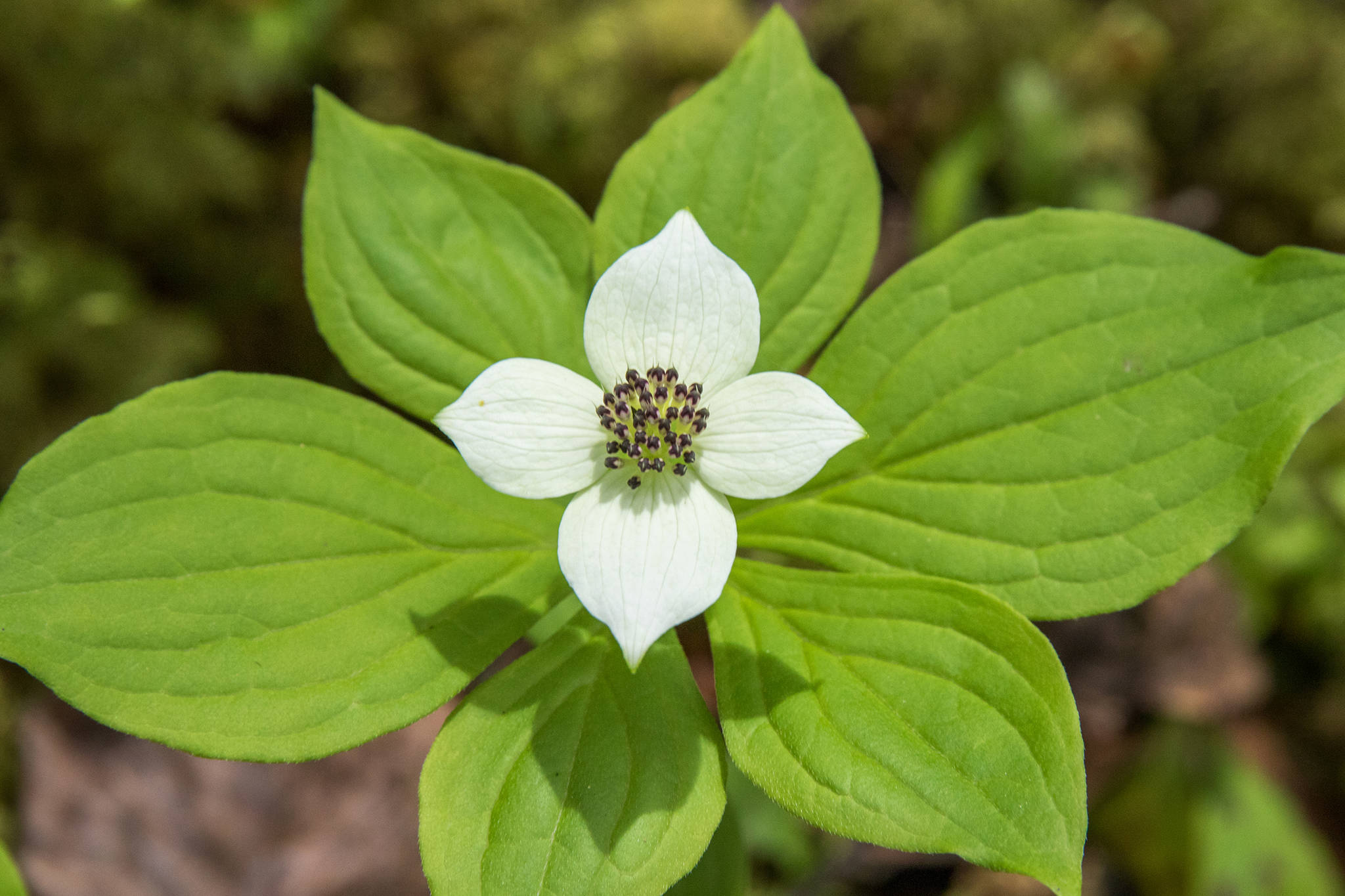
A common white flower on the Cowee Meadow trail is dwarf dogwood (bunchberry). It’s so common and familiar that it often escapes notice! That ‘flower’ is really an inflorescence composed of four whitish bracts surrounding a tight central cluster of actual flowers. There were many other things to look at on that hike, so I didn’t take time to inspect those dogwood inflorescences closely.
However, a few days earlier, I had done so on the Eaglecrest Lower Loop — higher in elevation, so the dogwoods were then less advanced and I could observe the seasonal progression of floral development. Some dogwood inflorescences were just opening and the bracts were small and green; the floral buds in the center were dark and tightly closed over the male and female parts inside. On more advanced inflorescences, the bracts were bigger and greenish-white, while the floral buds were still dark and closed. Then the bracts get bigger and whiter, and by the time they are fully mature, the floral buds are starting to open, exposing the sex organs to visiting insects. The flowers ultimately can open by themselves, but studies have shown than an insect visit can trigger floral opening and an explosive release of pollen. In either case, stamens catapult pollen vertically for several centimeters at very high speed, onto an insect or into the breezes. The pollen grains are not sticky, so high-speed release is thought to be necessary for adhering the pollen to an insect. Whether by wind or by insect transport, pollination is only successful when pollen arrives from a different dogwood individual, because this species is self-incompatible. After pollen is ejected, the pollen-capturing surface of the stigma increases, ready to receive incoming pollen. However, fruit-set generally seems to be low.
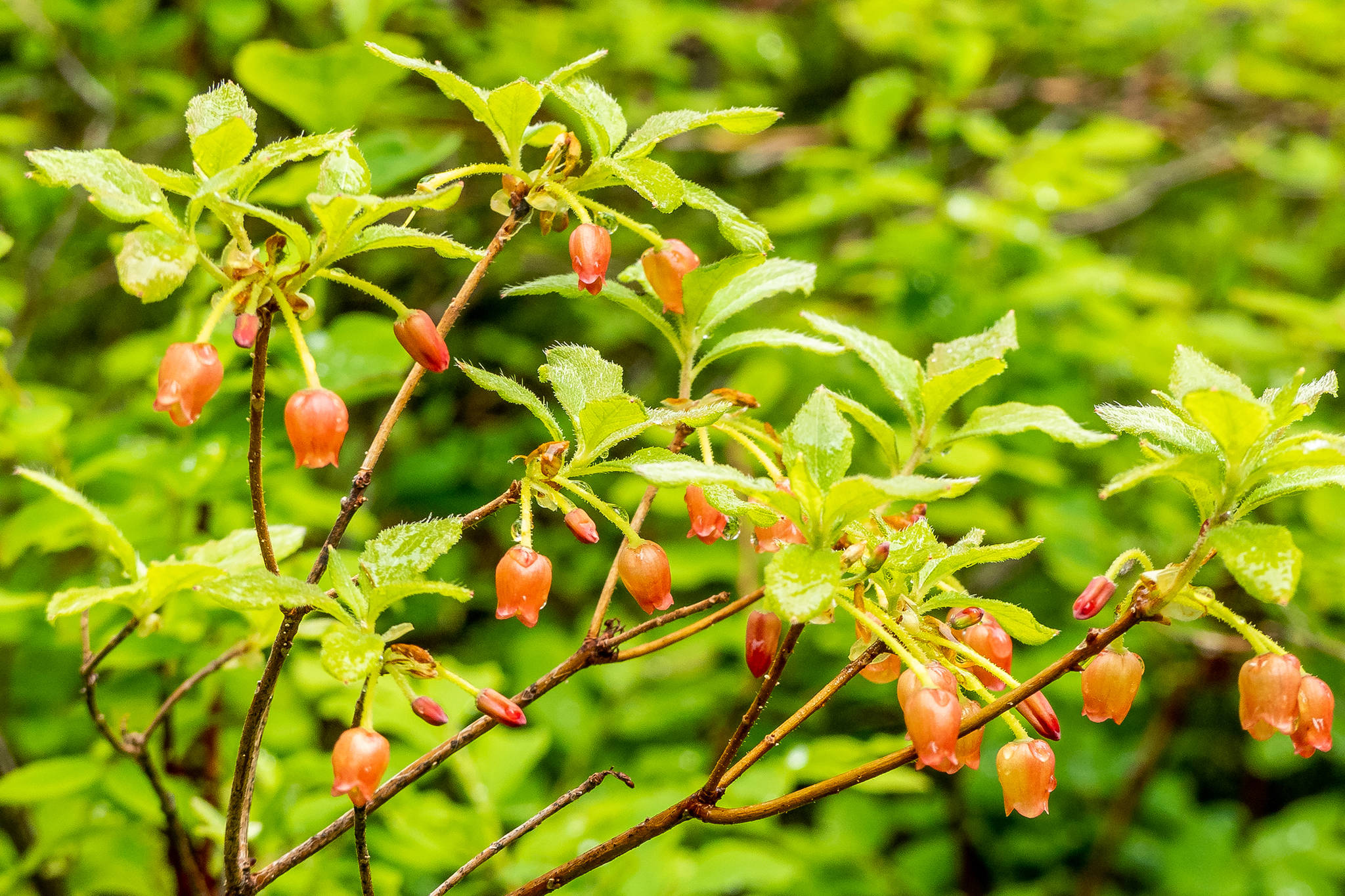
The flowers of rusty Menziesia are orange, a rare flower color here. (Courtesy Photo / Kerry Howard)
Another white-flowered plant was blooming profusely in the meadow along the Lower Loop trail: three-leaf goldthread. This flower looks nothing like the flower of the related fern-leaf goldthread that mostly grows in the forest. The flower is comprised of several white sepals surrounding the sex organs and five (sometimes six) tiny golden trumpets that are modified petals offering nectar to visiting insects. Although I saw no insects visiting a group of open flowers, I watched a small fly working assiduously for several minutes, trying to gain entry into an almost-open bud.
There must be good stories behind the evolution of flower colors and shapes; I wish I knew them!
• Mary F. Willson is a retired professor of ecology. “On the Trails” appears every Wednesday in the Juneau Empire.
