
By Mary F. Willson
For the Juneau Empire
My home pond has been rather quiet lately. Two or three unemployed male mallards loaf around companionably while their females are egg-sitting. Sometimes, just one male is there, a female (a late-nester or re-nester) visits briefly, and they forage side by side. But if she comes when two or three males are there already, all companionability disappears and there are serious battles between males. On a sunny day, after many days of rain, little fish were rising to the surface; a roving kingfisher swooped down to take one away. Up in the trees, the big treat was seeing a juvenile junco and a juvenile nuthatch, well-feathered, flying, fully competent, but each one still being fed by an attending parent. And out my kitchen window, I saw two really tiny squirrels, frisking about on the tree trunks.
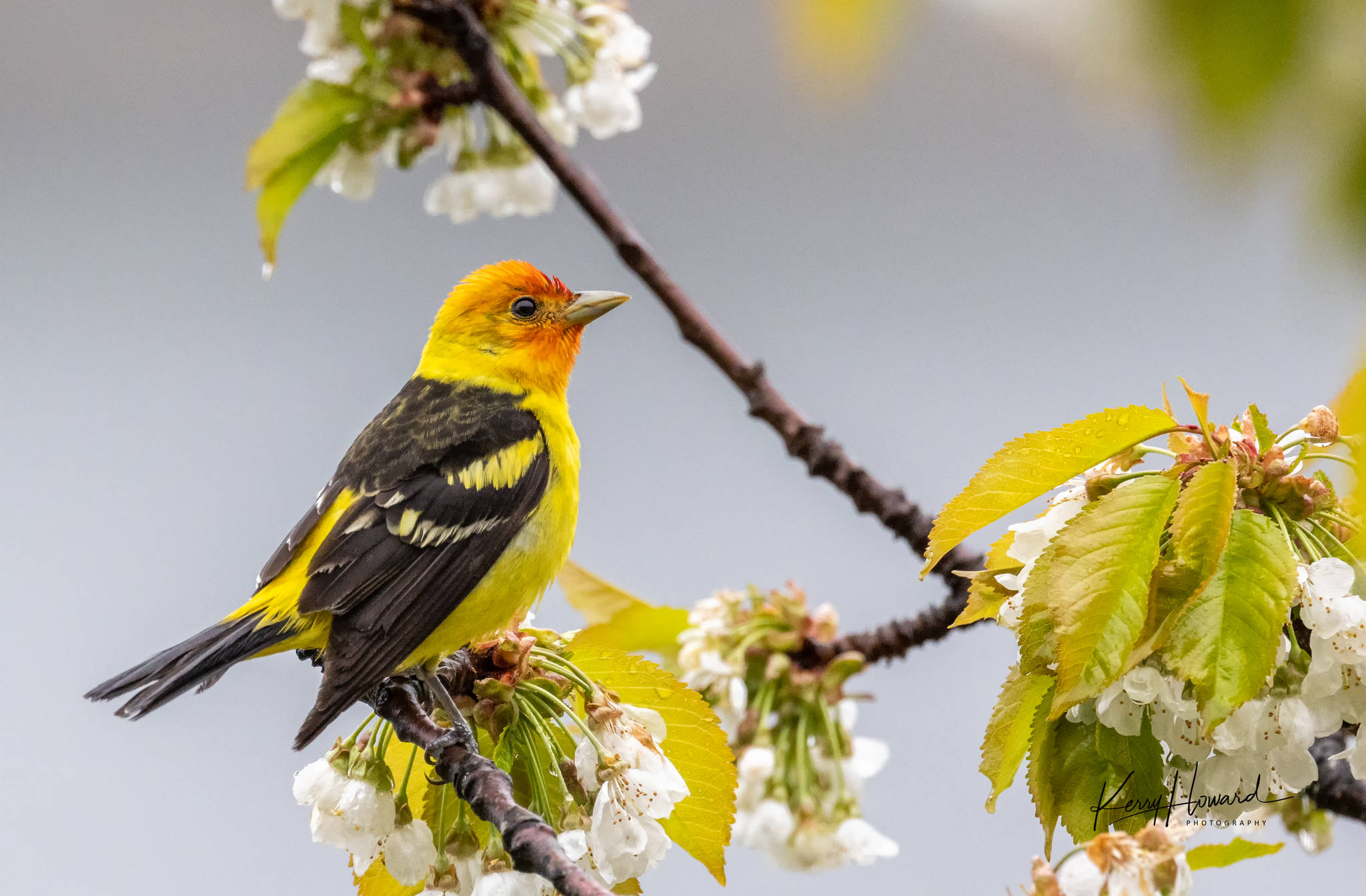
A lucky friend stepped out of her door one day and saw an unusually colorful bird—a male western tanager. The fairly gaudy yellow and black body is topped by a head that’s red or red-orange. I haven’t done a proper analysis but it seems to me that we have fewer really colorful birds than does the eastern deciduous forest, with its grosbeaks, orioles, cardinals, and (yes) tanagers. Western tanagers are not common here. Years ago, my field crew and I were thrilled to find a nest in a thicket at the head of one of the small bays on the west side of Glacier Bay (if I recall correctly).
[On the Trails: Diving into seaside flowers]
We live near the northern limit of the western tanager range. They nest all over the mountain west and winter in Mexico and Central America, feeding on insects and fruit. On the nesting ground, they are territorial; both male and female chase away intruders. First-year males can breed but are subordinate to older males, so they don’t get first choices of where to set up a territory. Pairs are socially monogamous; extra-pair activity is little studied. Females build their cup-shaped nests (twiggy on the outside, lined with grass, hair, rootlets, etc.) often on a conifer branch but sometimes in deciduous trees. Males accompany their mates during nest-building and egg-laying, presumably as a guard against possible philanderers. A clutch of three to five eggs is incubated for almost two weeks by the female, who may sometimes be fed by the male. Chicks stay in the nest about eleven days, fed by both parents. Very young chicks are fed mashed up bugs regurgitated by the mother, while the male apparently brings in small whole insects; older chicks get bigger insects. There is usually just one brood per season.
The red, orange, and yellow colors come from carotenoid pigments. This tanager makes its red plumage pigment directly, probably from insects in the diet, in contrast to other North American tanagers, which make their red plumage by converting yellow pigments that are also derived from their food. The intensity of the red on the head varies, perhaps as a result of differences in insects eaten. It is apparently not known if females choose their males in part on the basis of coloration. Many other studies of western tanager life history are reported to be under way, so stay tuned.
Out on the upper tide flats, we commonly see a plant called silverweed. The common name derives from the silky white hairs that cover the underside of the leaves. I found no information on possible functions of those hairs, although it seems possible that they might retard evaporative water loss by protecting the leaf surface. Be that as it may, silvery leaves upturned by the wind made a field of pink shooting stars even more spectacular.
Silverweed flowers are yellow; they may or may not be self-fertile (depending on what source you read). The flower has nectar and is visited by bees, flies, and beetles. It also has stolons or runners that spread out over the ground, and new plants can grow from nodes on the runners.
The Latin name for silverweed is either Potentilla anserina or Argentina anserina — the proper genus is debated. My interest was caught by the diverse explanations for the long-standing species name ‘anserina’. ‘Anser’ means goose in Latin. One suggested reason for relating the plant to geese that the leaves may have reminded someone of a goose’s foot marks. This strikes me as ludicrous, because I see no resemblance whatsoever. Another explanation is that by growing in rock crevices, the plant is safe from grazing geese (graylag geese in Europe). This notion wouldn’t apply here, because the plant grows mainly on flat sediments that offer no protection from geese. The third explanation is that the plant was used (in Europe) to feed geese. This is getting closer to something real—on our upper intertidal meadows, Canada geese regularly dig up and eat the roots. So we find small pits scattered over the flats where goose bills have grubbed up the roots.
One final note: near the mouth of Fish Creek, a group of strolling friends found several spots where the ground was littered with dozens of fresh, bright green spruce tips. We had no good way to account for that — a natural phenomenon, maybe wind, or just kid stuff?
• Mary F. Willson is a retired professor of ecology. “On the Trails” appears every Wednesday in the Juneau Empire.
