
By Mary F. Willson
I usually write about some observation that sparked my interest along the trails. This time, the connections between the observation and the writing is more indirect. I went to Steep Creek to check on the sockeye spawning run and found that the run seems to be quite small this year (so far, anyway). That simple observation led to one of those quick-time thought-chains that our brains do when we are not looking. In this case, it led to who eats sockeye (bears, otters, eagles), particularly the eggs and juveniles (mergansers, Dolly Varden, dippers); and from there to dippers eating fish of other types, including little starry flounders. I have seen dippers catching very small starry flounders in Sheep Creek delta and in Switzer Creek.
Then my ignorance asserted itself and announced that I know next to nothing about starry flounders and perhaps I should learn a bit about their life history. So here goes:
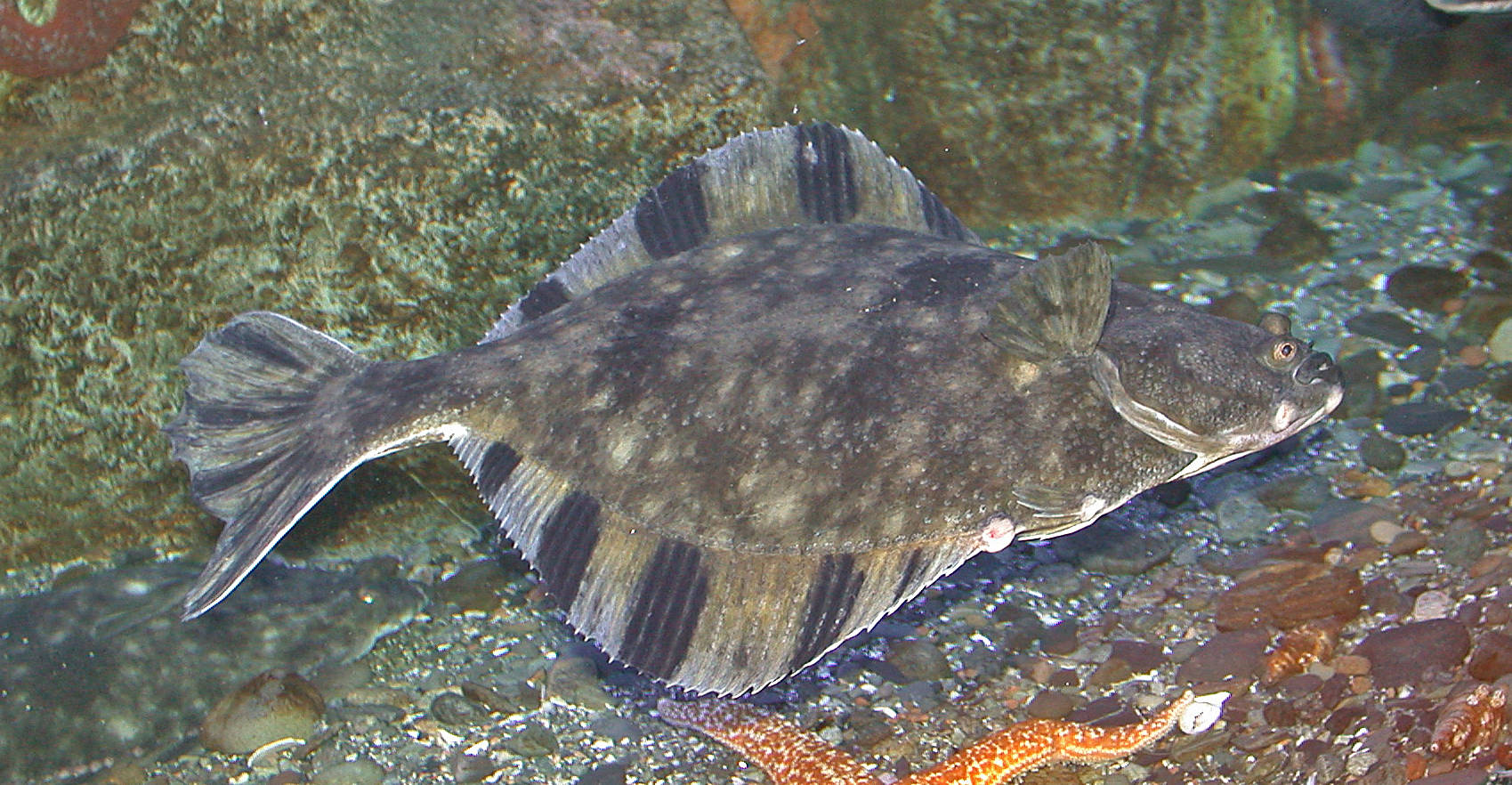
Starry flounders live in the North Pacific, Bering Sea, and the Arctic Ocean along the north coast of Alaska and western Canada. They are near-shore fish, living in relatively shallow salt water (but sometimes over 300 meters deep) as well as brackish water. Sometimes, however, they (especially the juveniles) are also found in fresh water, even many kilometers from the sea.
Starry flounders may live seven or eight years (or up to twenty-four years, according to some sources), spawning once a year. They spawn in salt water, seasonally. Other flatfish have a very brief courtship; then male and female swim together while the eggs and sperm are extruded. Presumably starry flounders behave similarly (I have not found a direct account).
A female flounder can produce millions of floating eggs each season. After the eggs are fertilized, larvae develop, hatching in three to five days; development time varies with water temperature—faster at warm temperatures. When a larva hatches, it’s about two millimeters long. This tiny fish thrashes its way out of the egg and begins to swim. Its bulging yolk sac feeds the larva for four or five days while its mouth and jaws become functional. At five days old, the yolk is used up and a larva can start feeding on plankton.
When a larva reaches about 7 millimeters in length (not counting the tail), the magical metamorphosis begins. The larva transforms from a typical, rounded, streamlined fish to a flat fish. The young fish tilts more and more to one side (either right or left in this species). One eye migrates to the other side of the head. The dorsal and anal fins now are on the sides of the flat form. The body becomes dark on top and pale below. By the time the fish is about fifteen millimeters long, the eyes have finished migration and the body is flat. The process may take about a month, going more rapidly at warmer temperatures. The scales on the upper side of the body (and a few other places) now begin to acquire their unusual shape; by the time the young fish is about 250 millimeters long, they are no longer smooth but are lumpy and stellate (star-shaped—giving the fish its common English name), so the fish is rough to the touch. (That makes me wonder about possible advantages of these special scales…).
When at rest, the now-flat fish often stands on the two big fins on the edges of the body, keeping the body off the substrate. The fish can change color and pattern to match a dark or light substrate and flutter its fins to cover the body with sand when it wants to hide. Swimming is accomplished by a sort of rowing/rippling motion of the big fins.
Starry flounders can be almost a meter long. Female starry flounders grow a bit faster and tend to be larger than males of similar age. Females mature at age three, but males mature at age two years and a length of roughly thirty five centimeters. As the fish grew and matured, the jaws and teeth became better developed and the diet then can include more hard-bodied prey. Flounders can crunch up clams, bite off the siphons of bigger clams, and pull worms from their burrows. Big flounders also eat fish, brittle stars, and crabs.
This species is no doubt prey for various marine fish-eaters, as well as dippers, river otters, and humans.
River Otter Eats Starry Flounder and from Bob Armstrong on Vimeo.
Thanks to Bob Armstrong for the video.
• Mary F. Willson is a retired professor of ecology. “On the Trails” appears every Wednesday in the Juneau Empire.
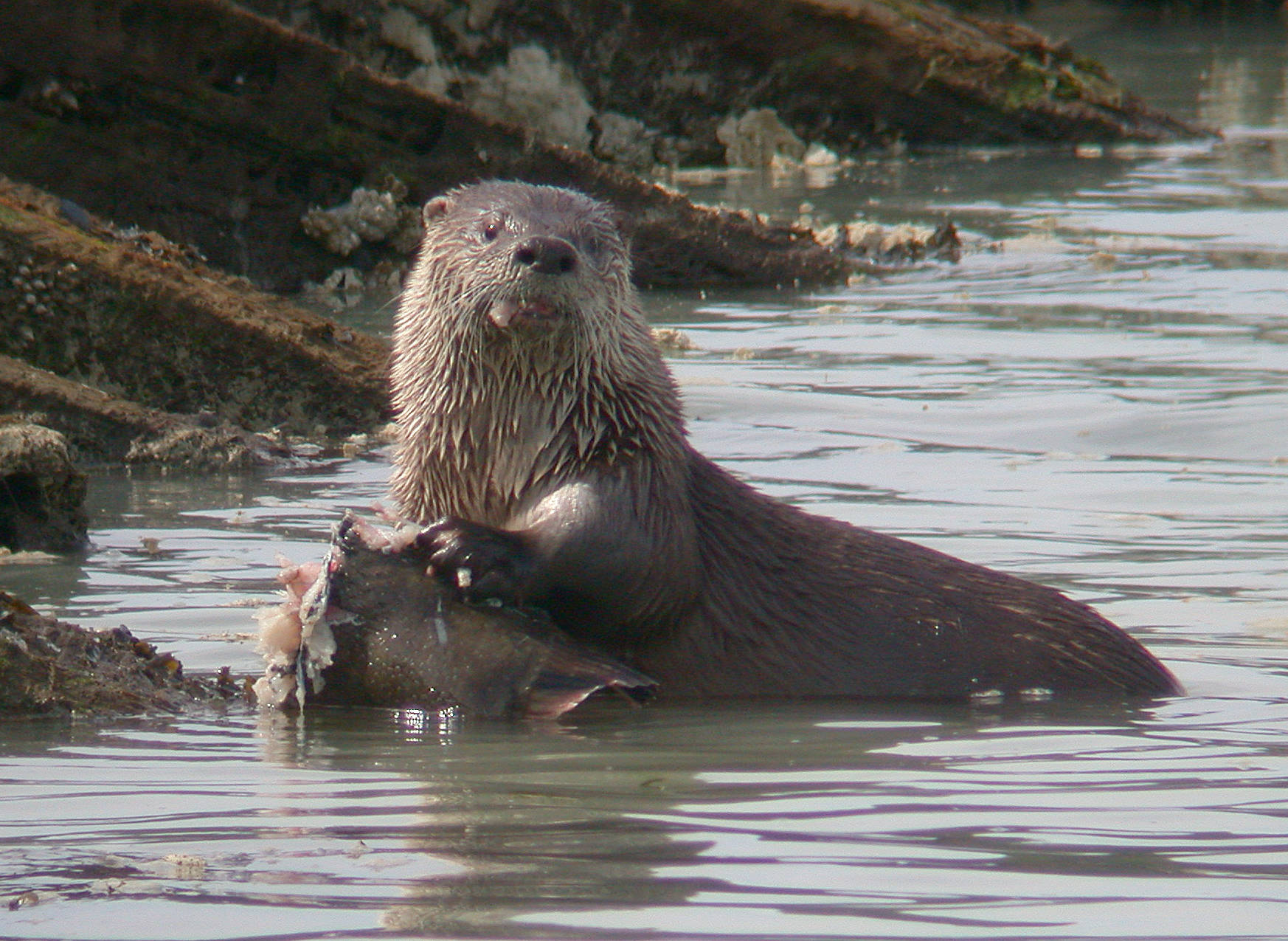
A river otter dines on a starry flounder. (Courtesy Photo / Bob Armstrong)
