
Most of us have favorites among the very showy flowers, such as the fireweeds, or white bog orchids, or columbine, or wild iris, or we look for uncommon species, such as frog orchids. These may be the stars of the show, but we may neglect some lesser lights that are interesting in their own right. I’ve picked out just few of these here, simply because I’ve seen them recently on July walks.
In one of the meadows on the way up to Spaulding Meadow, the density of sundews is remarkable—there’s almost a carpet of round-leaf sundew (Drosera rotundifolia) over the mosses, and long-leaf sundew (aka great sundew, D. anglica) grows mostly on the muddy edges of pools. Sundews are insectivorous, supplementing what they can draw from their nutrient-poor habitat by digesting insects captured on the leaves (and they may have ways to avoid capturing potential pollinating insects). I noticed that very few of the sundews had produced flower buds at this time. Because flower (and eventually seed) production costs energy and nutrients, I wondered if these sundews were not capturing many insects to help fuel flower production. Was there a seasonal low in insect availability or maybe just not enough bugs to feed so many sundews or possibly (as found in one study) too much competition from spiders that want bugs too? Or something else?
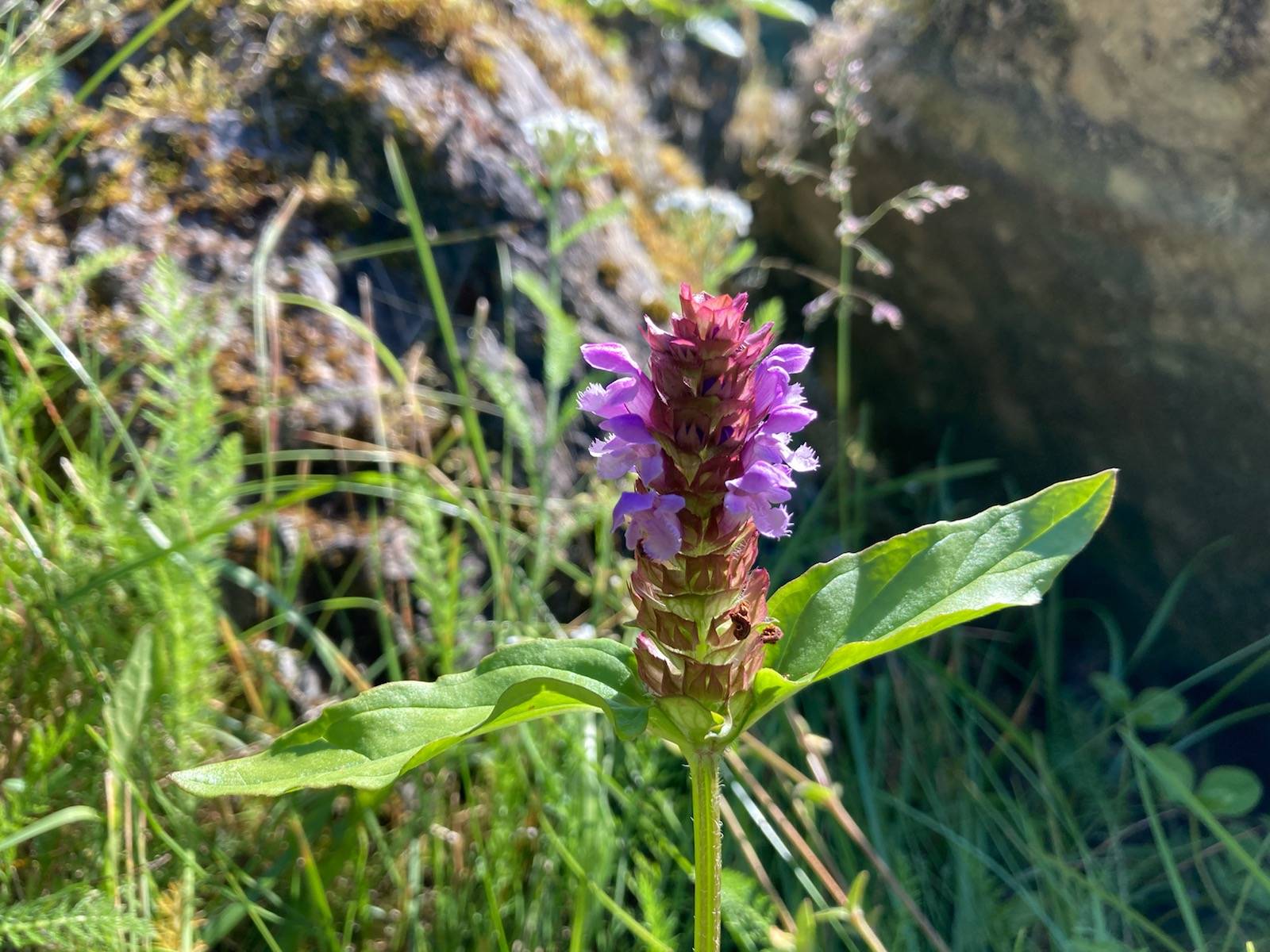
Mary F. Willson / For the Juneau Empire Self-heal flowers have a fringed lower lip and a hood above the stamens and pistil
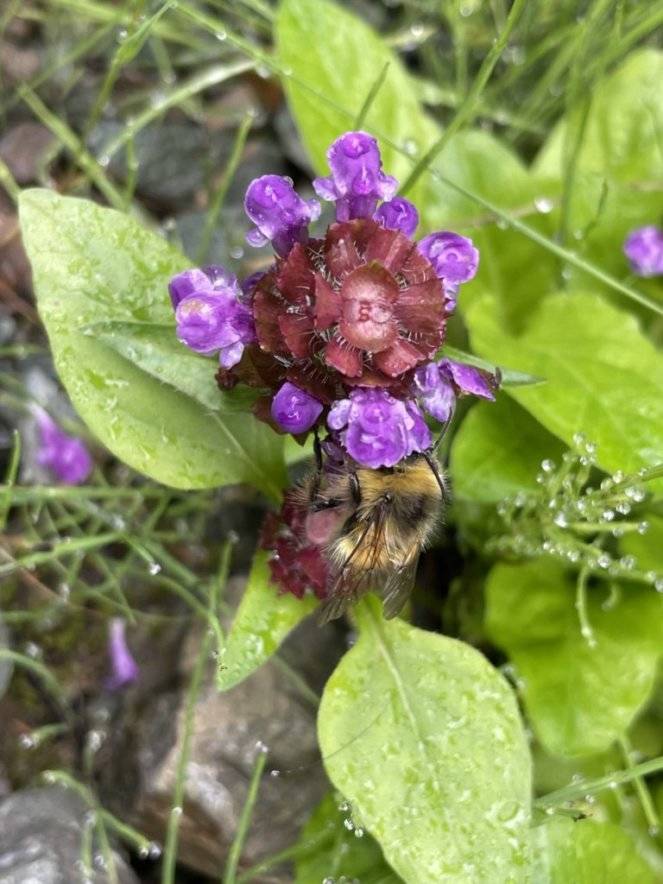
Along the road to the Salmon Creek powerhouse, the hiking group found common harebells and lots of a small, purple-flowered perennial plant called self-heal (Prunella vulgaris). It’s native across the northern hemisphere and introduced everywhere else. There are multiple flowers in each inflorescence. The flower has a fringed lower lip and an upper hood over the stamens and pistil, but in some cases the pistil extends out in front. Flowers with the pistil inside the hood tend to have bigger and fewer flowers, less pollen, less nectar, and lower visitation rates. Although the flowers may self-fertilize if few pollinators are available, they are primarily bee-pollinated. I watched a bumblebee unsystematically visit nearly every flower on one inflorescence, poking its head deeply into some of them to get the nectar and passing quickly over others (perhaps the nectar had already been taken).
Studies of self-heal in Japan have shown that the size of the flower in different ecological settings varies with average tongue length of the bumblebees in those settings: bigger flowers in areas with long-tongued bees. In other words, there are local adaptations of flower size to the abilities of the available bees. Other factors, such as altitude or robustness of the plant, did not account for the observed correlation. The size-match of tongue length and flower size affects both male (pollen removal) and female reproductive success (pollen receipt and seed set).
I’ve noticed a small goldenrod on the East Glacier Trail near the cliff that sports purple mountain saxifrage in spring and offers a lookout toward what’s left of the glacier. Called northern goldenrod (Solidago multiradiata), it tends to favor rather dry areas in meadows, on rocky ridges, or gravel bars. The yellow flower heads occur in more or less flattened clusters. This plant is much shorter than the Canada goldenrod, which likes disturbed areas and bears its many flowers in large, tapered inflorescences. The small flowers of goldenrods are visited by butterflies, bees and many other insects, but which ones are the good pollinators and which are just thieves?
Near that same cliff, I saw several common harebells (a.k.a. bluebells of Scotland; Campanula rotundifolia). Found in open areas, rocky or grassy, this perennial is seen in many places around Juneau. The flowers are purple-to-blue, borne singly on each branch, but some plants have several branches on their wiry stems and may have several flowers.
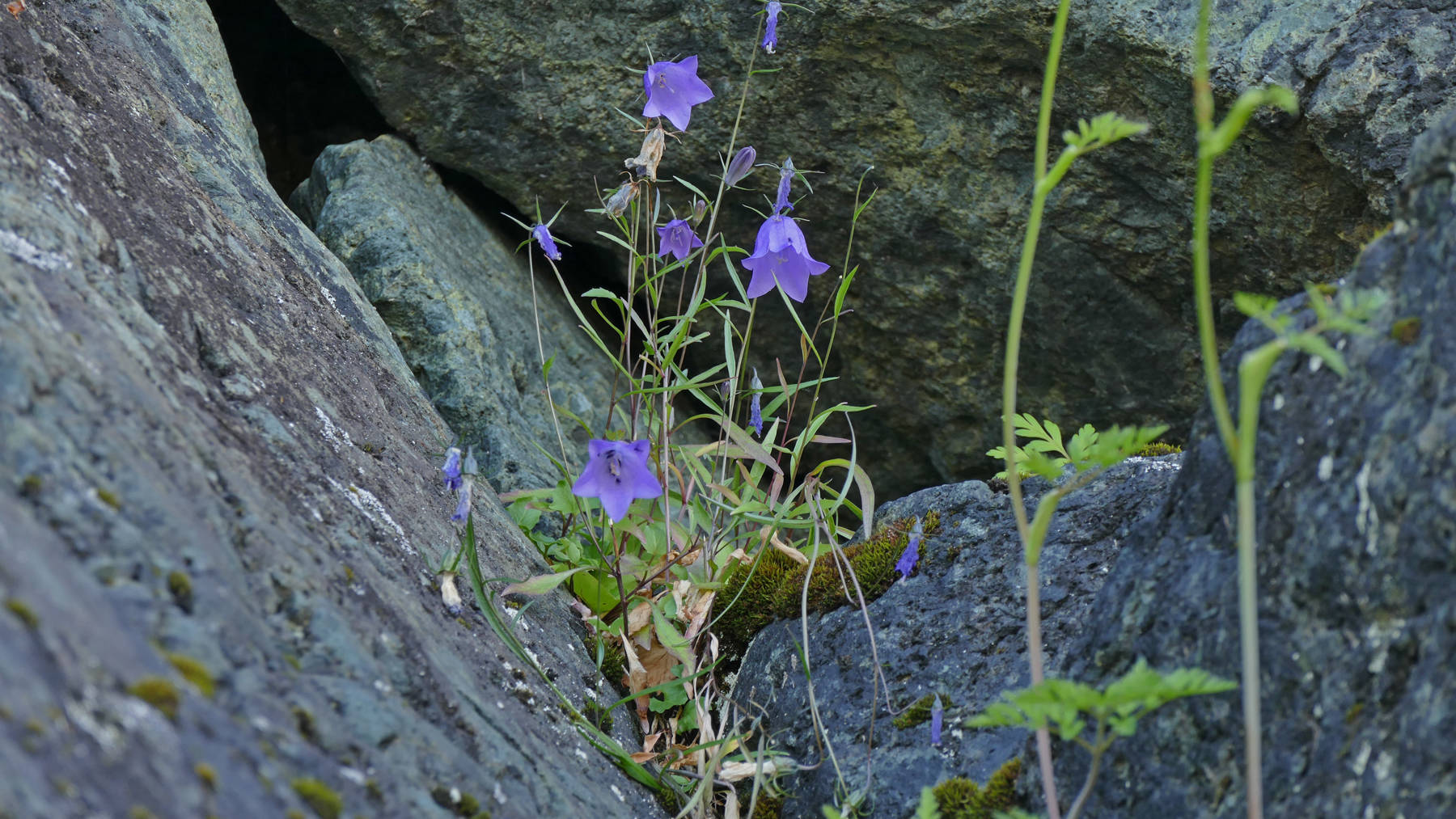
Courtesy Photo / Bob Armstrong Common harebell often grows in open, rocky places
Common harebell has a broad geographic range over Europe, where it originated, and North America. It survived the advances of the glaciers, which temporarily isolated populations in different areas. Harebells in many of these populations became polyploid, having two or more complete sets of chromosomes, which is likely to affect many floral traits, perhaps in different ways in different populations (as found for other species), but this question has not been investigated for this species (as far as I have found). Despite its species’ name (rotundifolia), the round basal leaves disappear early, often before flowering, and the stem leaves are not round.
Harebells are pollinated mainly by bees. The flower is protandrous, meaning that when the flowers first open, they are male, with pollen ready to disperse. Later, when the receptive stigma is mature, the flowers are mostly female. The flowers are self-compatible (as found in experiments), at least in some populations, but self-pollination results in fewer seeds than cross-pollination; in the wild, protandry prevents most self-pollination. Bees collect only pollen from male-phase flowers, but they collect both pollen and nectar from female-phase flowers. Flower size can vary from place to place, and so would the size of the main pollinating insects.
Common harebells (and probably other harebells too) form mycorrhizal associations with several species of fungi. One study found that this association had no effect on seed size or number but led (unexpectedly) to decreased growth and flower production. However, the seedlings of mycorrhizal harebells grew better than those from parents that were experimentally prevented from having that association. So the advantage of the fungal connection appeared only in the next generation. Interesting!
Perceptive readers may well generate lots of follow-up questions from these brief notes!
• Mary F. Willson is a retired professor of ecology. “On the Trails” appears every Wednesday in the Juneau Empire.
