
By Mary F. Willson
For the Juneau Empire
One day in early December, a friend and I set out to check part of the West Glacier Trail and the route along the lakeshore. It was raining, of course, as it had been for days seemingly on end, but the fierce winds had abated. We thought the several creeks that flow across the beach might be flooding (as a lot of other creeks were) and too deep to cross happily with just hiking boots on our feet. But the first couple of creeks were no problem; that was encouraging. We eventually got to a deep, wide creek that was too much for us, so we detoured up to the main trail, crossed a convenient bridge over that stream, and went right back down to the beach.
Walking along the cobbly beach allowed us to have what little light was available on that dark, dismal day. As we approached the north end of the beach, we began to see huge, thick plates of ice stacked up on the shore, perhaps the works of those terrific winds a few days earlier. In some places, the ice plates were stacked up four or five deep. Some ice plates, maybe shoved by the slabs arriving behind them, had plowed into the gravelly beach, raising a berm about a foot high.
[Wild Shots: Photos of Mother Nature in Alaska]
I know nothing about the physics of ice fracturing. Many of the slabs had well-defined corners; only a few were very rounded. It seemed that quite a few of those corners made a nearly perfect ninety-degree angle. That was probably just a random happening; I’d need a big sample to find out!
Lunchtime at the end of the beach, before straggling up the muddy cut-off trail to the main West Glacier Trail. It was very quiet out there — just the roar of Nugget Falls across the lake, the tapping of some rain drops on my cap, and an occasional clunk of one slab of ice lightly hitting another. We talked about what “quiet” means.
Those of us who live in town often think of our places as quiet. There are sounds of traffic on the roads, airplanes overhead, boats on the channels, the garbage truck dumping the trash can, sometimes people talking while passing by, not to mention the ordinary sounds of the fridge or the furnace turning on. We learn to tune out the noises that are familiar and ignore the temporary intrusions. And we call that “quiet.”
Although almost no place in the real world is totally silent, I thought it might be interesting to find out what we can hear in places and times when all human-caused noises are absent and no tuning out is needed. Fortunately, here in Juneau, we can find suitable places and times for this exercise rather easily. So I enlisted the aid of a couple of friends to do a little sampling. The “game” was to find a place and time devoid of anthropogenic sounds and then spend four or five minutes just listening. To do this requires some (brief) concentration, allowing no potential mental distractions, such as an eagle flying high overhead or a mink running across a beach or any worries you may have brought with you.
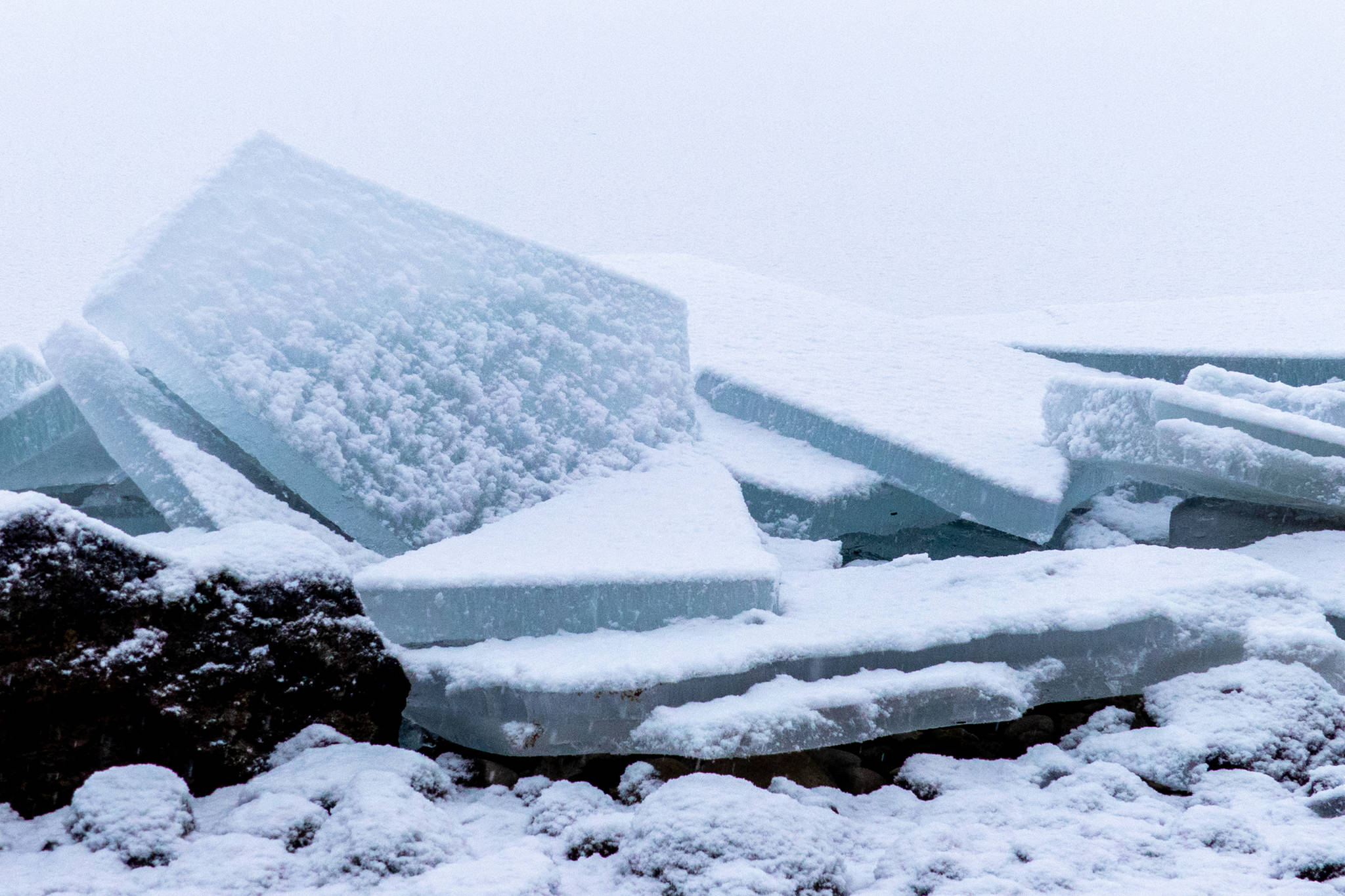
A week later, on Dec. 11, the ice plates are still there, now dusted with snow. (Courtesy Photo / Kerry Howard)
For the record, here are a few of the listening samples we obtained, in the middle daylight hours, in early winter.
—Eagle Beach: wind rushing through the tops of spruces while lower branches rustle more gently; rain drops plinking on the water surface and thudding on rocks, waves lapping the shore, a raven calling overhead, a red squirrel chattering in the woods.
—Boy Scout Beach: distant call of a gull, faint sound of gull wings just offshore, wavelets coming onto the beach.
—Nugget Falls Trail: roar of the falls, ravens calling from the slopes of Thunder Mountain, a gull’s call, sound of ice cracking on the lake surface.
—Basin Road: a flock of chickadees conversing in the trees, the creek rippling over rocks, a gentle breeze stirring spruce branches, raindrops on the observer’s hood.
—Auke Rec: surf, wind in the trees, rain hitting the rocks, raven calling, Barrow’s goldeneyes calling.
—Horse Tram Trail meadow (two observers): distant waterfall on Peterson Creek, distant water to north, ravens to west and north, unknown bird near the meadow, a crow, companion dog walking and breathing.
Not very exciting, eh? It was about as quiet as it can be, out there. That’s part of the point. A poet called such a time of conscious attention an ‘active stillness’. The exercise is a little like a short meditation, with the focus directed outward, but I find that the peaceful effect is internalized—a little relief from other concerns and whatever tensions were building. A moment of calm that, for me, is similar to the peace that comes with some well-loved pieces of classical music, with the addition that there is a feeling of connectedness to the natural world.
It’s not an exercise for everyone, of course. You have to be ready for it.
• Mary F. Willson is a retired professor of ecology.“On The Trails” is a weekly column that appears in the Juneau Empire every Wednesday.
