
By Mary F. Willson
Early in the month, a female mallard arrived on my pond with her late brood of three good-sized young ones, still wearing lots of down. A week later, they were well-feathered except for a distinguishing fuzzy patch of down on the rumps of the “kids.” At the end of the month, the kids were no longer fuzzy at all, but they still hung out with mom.
A trip with friends up to Cropley Lake in mid-August was a muddy one. But the meadows were studded with the flowers of swamp gentian and asters. Fish were rising in the lake; Dolly Varden are recorded to be resident in the lake, although a few might wash out downstream at high water. On the far side of the lake, we looked for the sky-blue broad-petaled gentian and found them on a gentle slope. The relatively rare yellow fireweed crowded a small drainage gully, a habitat it seems to like.
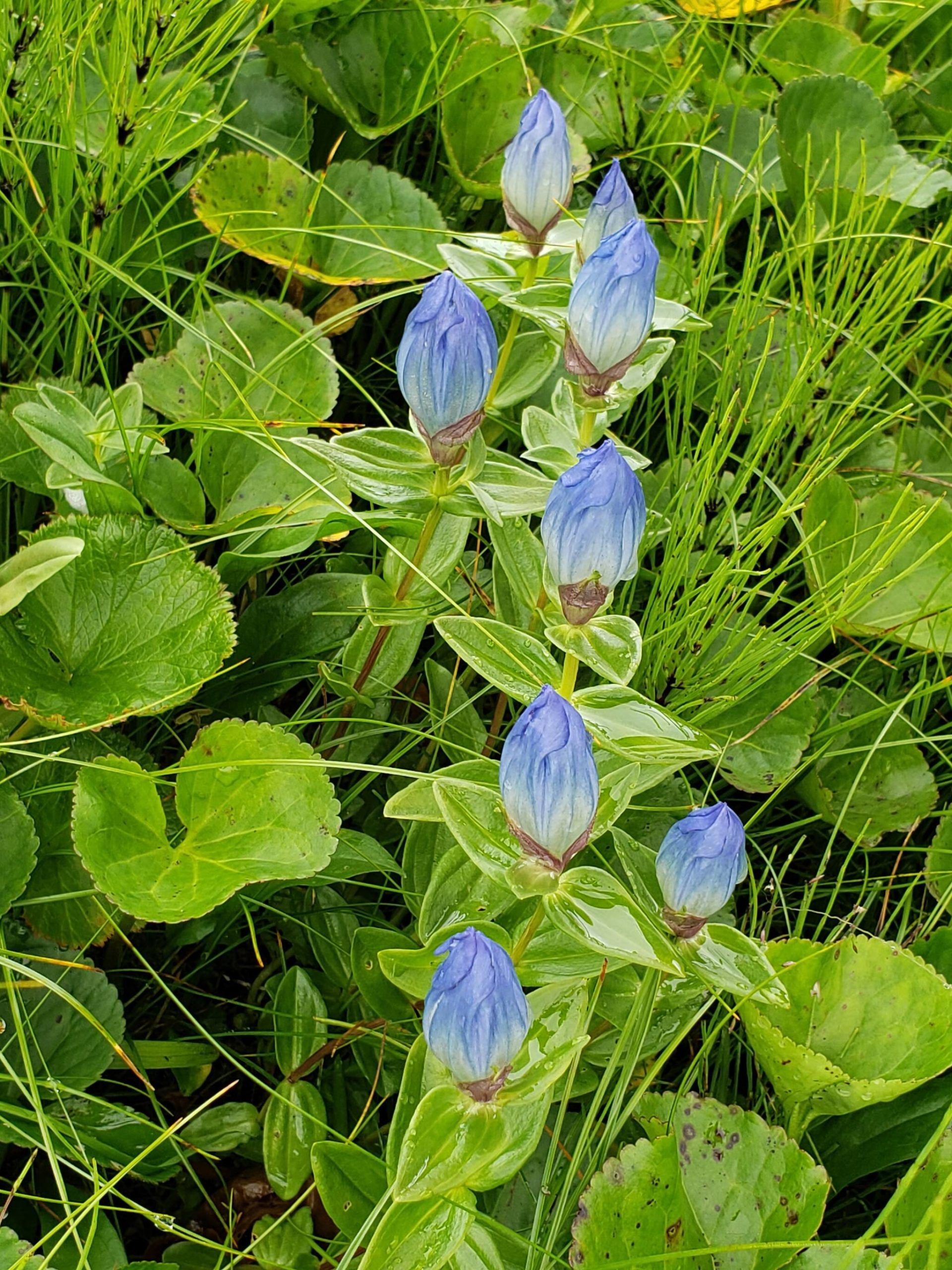
Broad-petaled gentians usually grow in subalpine meadows. (Courtesy Photo / David Bergeson)
The next day, I cruised around Amalga Meadows near the Eagle Valley Center. The parking area was crammed with cars, but all the people from those cars were either up on the Horse Tram Trail or at the new cabin. So, I had the meadow to myself. The grasses were so tall that walking was not easy, except where a bear(?) had stomped through. Nagoon berries were ripe, hidden down in the tall grass, but bog cranberries were still green. The seeds of cotton grass were dispersing in long streamers from the seed-heads. Sweetgrass was seeding well. In part of the meadow, I had to watch my feet closely, so as not to step on the many tiny toadlets that scuttled to safety as they dispersed from their natal ponds.
Not long after that, I perched on a hillside on the way to Hilda meadows at Eaglecrest. There I watched a tiny red mite, not even a millimeter long, wander up and down over the petals of a swamp gentian, exploring the depths of the flower. From the perspective of such a wee beastie, even those small flowers have depth! Eventually it settled briefly in the deepest part of the flower, perhaps finding something usable there (?).
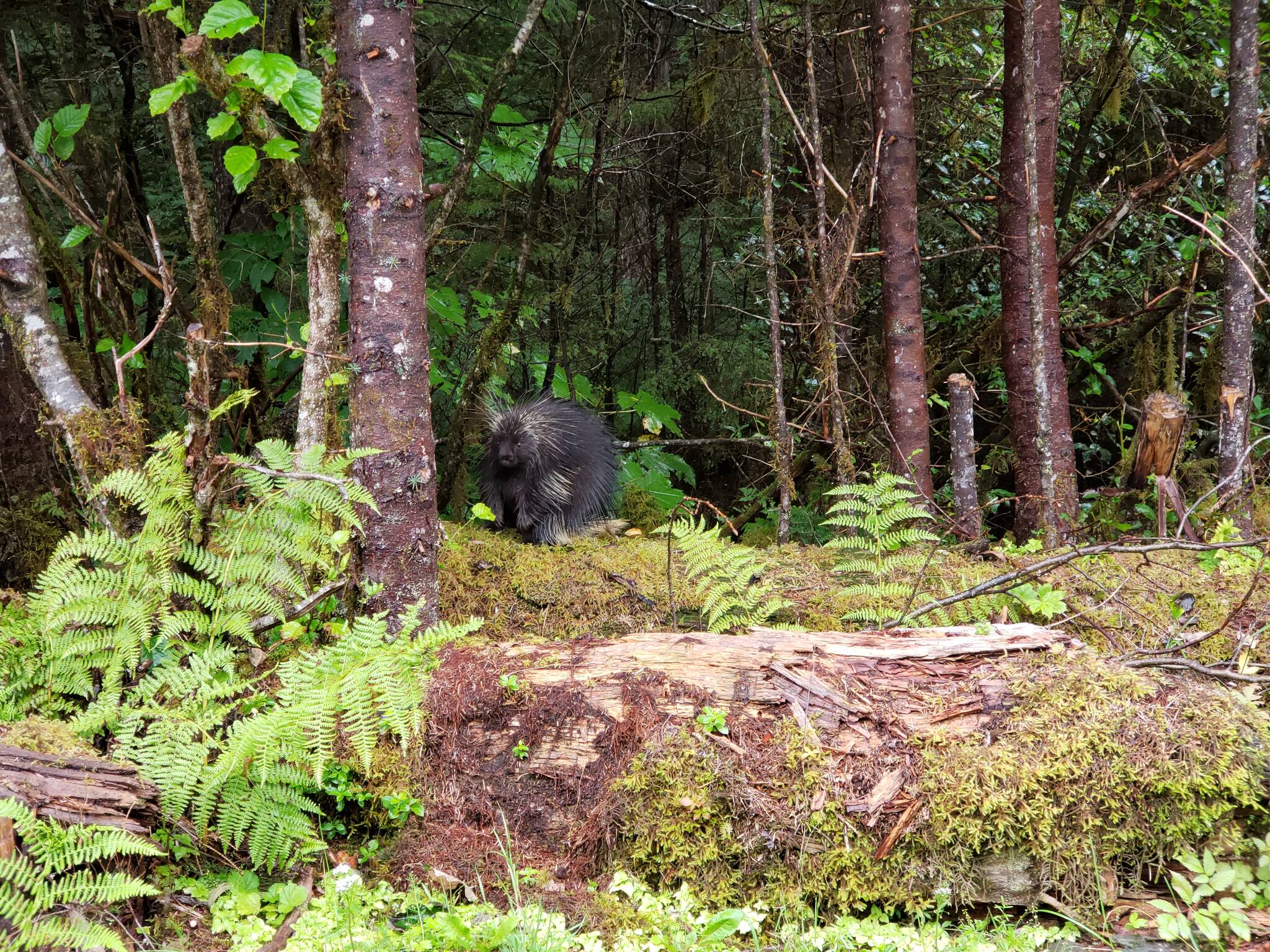
A walk up the Salmon Creek road with friends found that the some of the many self-heal plants, seen in bloom on a previous walk, were setting seed. By the side of the road, we found several quite handsome, large beetles with reddish-brown carapaces (I think I used to know a name for them). On the way up, we all simultaneously spotted a porcupine trundling along the side of the road ahead of us, and we stopped to watch it. Moving away from us at first, it turned around and began snacking on some roadside greenery. We tried to slither by, but it scuttled into the brush, just a little way, where it sat watching us and shaking its wet fur. We went on, and it came right back to its green lunch. As we came back down the road later, it was still there and made a repeat performance. That must have been a particularly nice meal, not to be abandoned. Near the water tower, we spotted two deer, looking smooth and sleek; one of them stayed to watch us pass by, ears up like flags.
The next day, I went with a friend to the junction of Eagle and Herbert rivers, a spot that has been fun to visit in other years. This time, however, the sketchy little trail was greatly overgrown—only suitable for those less than three feet high at the shoulder, and sometimes it disappeared entirely. On a spruce tree ahead of us, the trunk looked like it had lots of dark spots the size of a fifty-cent piece (remember those?); close-up, those spots turned out to be places where busy woodpeckers had flaked off bits of the scaly bark. Out at the point, otters had romped in the sand.
Two ravens spotted us immediately but were too shy to come in for the (obviously expected) offerings we tossed out onto a sandy ledge. On the way back, we found several bear scats full of blueberry remnants and three strange, yellowish deposits composed of short chunks of plant stem and a few devils club seeds. These had presumably been deposited with a lot of fluid, because they were spread thinly and flat on the ground.
I’d sure like to know what plant had been eaten and what occasioned those deposits.
• Mary F. Willson is a retired professor of ecology. “On the Trails” appears every Wednesday in the Juneau Empire.
