
By Mary F. Willson
For the Juneau Empire
Organisms that can’t run away or hide from would-be predators often defend themselves with some sort of armor that deter access to the soft bodies inside. Clams, cockles, and mussels are enclosed in hard shells. Turtles and armadillos wear hard body-armor. Butternuts and black walnuts are famously tough nuts to crack. In some cases the armor is not a hard shell but a covering of sharp spines. But for every armored defense, there is a countermeasure that allows some predators to get at the edible parts inside.
The sharp teeth of rodents can gnaw a hole in the side of a seed. Years ago, I sometimes used cherry pits as bait in live traps for mice: the mice could neatly carve a hole in the side of that seed and extract the nutritious nugget inside. Fox squirrels in the eastern deciduous forest harvest and cache black walnuts for later consumption, gnawing open the tough shell (note: these are not the domestic thin-shelled “English” or Persian walnuts we buy in the store). Brazil nuts are notoriously hard-shelled, but agoutis can open the big enclosing fruit and extract the very hard seeds, which they cache, to be opened and eaten later.
[There are many ways to carry a lunch in the animal kingdom]
The strong bill of a blue jay can hammer open an acorn. Oystercatchers sometimes pound on a mussel shell to break it, then sever the shell-closing muscle, allowing the shell to open. However, our black oystercatcher is said to prefer just to jab its long bill into open shells and then sever that muscle.
Hard shells can be smashed by dropping then onto a hard surface. This seems to be a popular method for a variety of predators. Crows and gulls often do this with shellfish—carrying the prey high above a rocky beach and letting it fall, then coming down to extract the flesh from the broken housing. Sometimes it takes several drops. And there’s often a sneaker nearby who’ll try to snatch the meat before the original bird descends. Some gulls are reported to select hard surfaces for dropping big clams but can use softer mudflats for smaller clams.
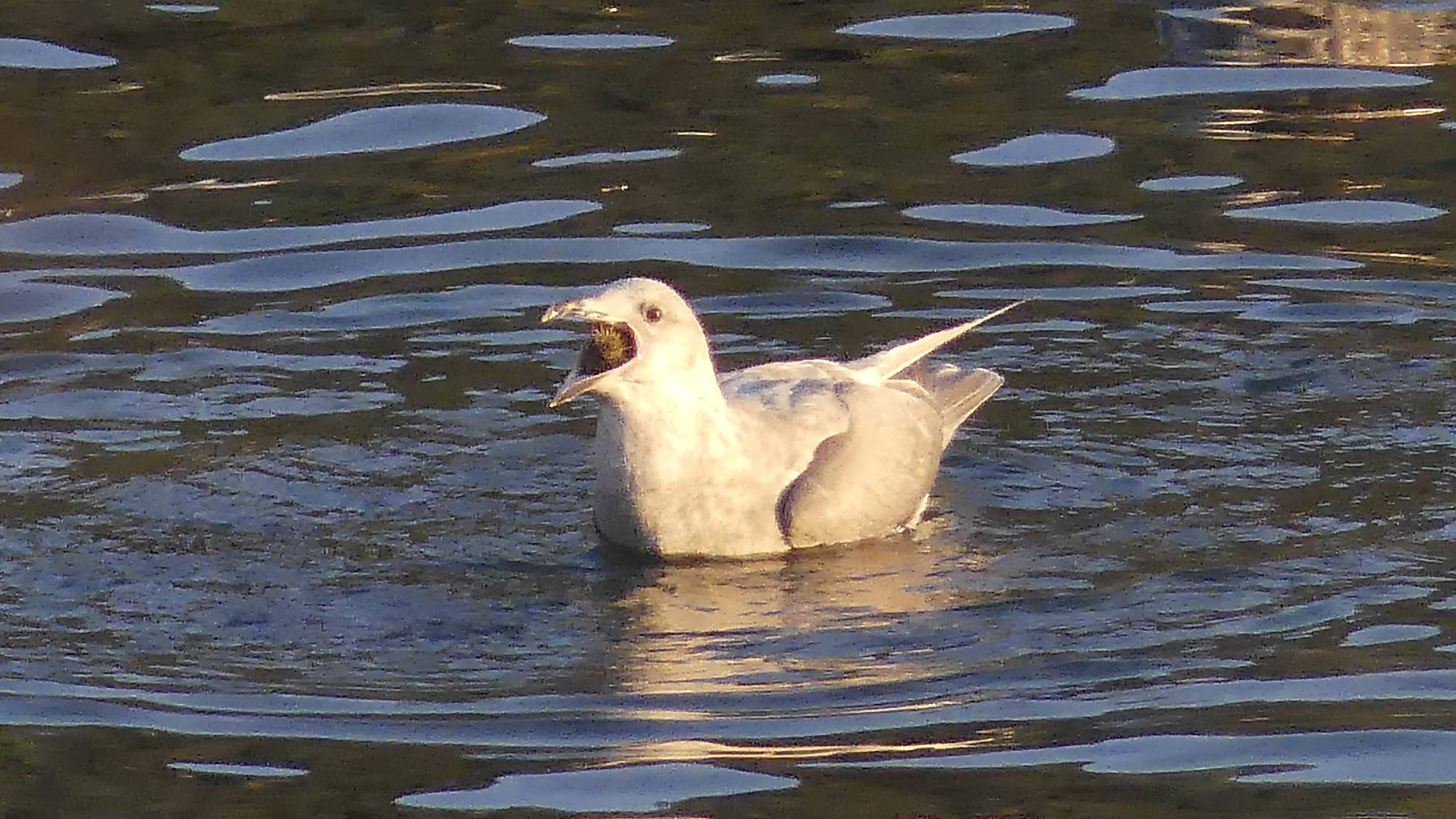
A glaucous-winged gull is about to swallow a small sea urchin.(Courtesy Photo / Bob Armstrong)
Several kinds of eagles are said to carry turtles aloft, then letting them fall onto rocks and smash open. New Caledonian crows drop candlenuts onto anvil stones; then they pry out the edible nut. Coconut crabs eat many things, but when a coconut is on the menu, the crab may climb a tree and drop the large nut to crack it, then finish the job with its big claws.
Sometimes, a tool is used as a hammer to open a food item in a hard shell. Chimpanzees (and a few other primates) are well-known for this behavior, teaching the method to their offspring. Sea otters hold a shelled prey on their chests as the float about, using a rock to beat on and crack the shell. Egyptian vultures may crack ostrich eggs by throwing stones at them.
Or maybe you get somebody else to do it for you. There’s the famous situation in Japan, in which carrion crows have learned to exploit traffic patterns to open hard-shelled walnuts. The crows are reported to wait for a traffic-stopping red light and then place walnuts in the roadway before the light turns green. When the traffic moves on again, the vehicles pass over and crack the nuts, and the crows zip down to grab the kernels. They are also said to drop the nuts in front of moving cars. Similar behavior has been reported for American crows in California, except that there the behavior is not timed to the traffic patterns.
Octopuses have at least two means of opening clam or mussel shells. One method is using the suction cups on the arms to pull the two shells apart. Another method is to drill through the shell (octopuses have two kinds of drills for this purpose), sometimes injecting a venom that relaxes the shell-closing muscle. Different kinds of octopuses have their favorite points of where on the shell to drill. Sometimes an octopus uses its beak to chip off thin parts of a shell, giving access for injection of venom.
Whelks are big, carnivorous snails that drill through shells to get at the meat, using the file-like radula. Lots of insects also can drill through hard seed coverings. Weevils provide good examples; the females of one kind of weevil bore into acorns of various species of oak, chewing channels with mouthparts at the end of the long snout. They then lay eggs in the acorn and eventually the larvae feed on the nutritious material inside (which the oaks intended for their seedlings).
Pinching can do the trick too. The big claws on crabs and lobsters can crack the shells of other crabs and some molluscs. The hefty bill of a grosbeak can crack hard seeds and beetle carapaces.
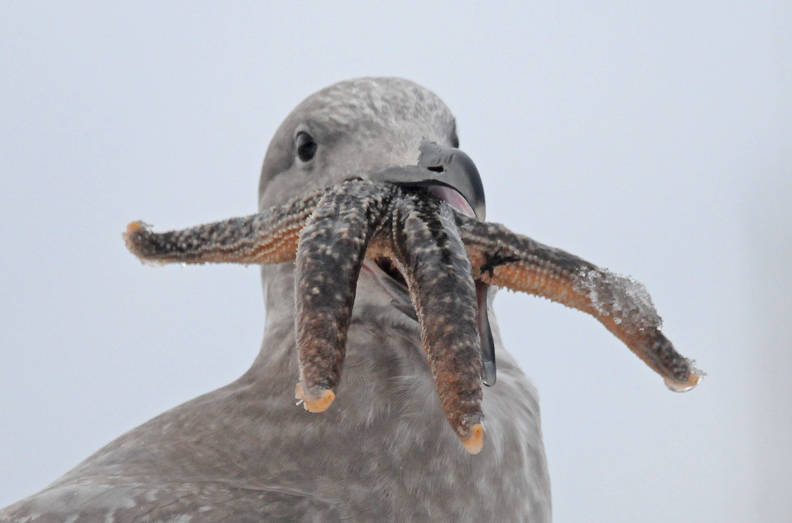
The ultimate insult to armored or spiny defenses might be just ignoring them and swallowing the prey whole. Gulls and crows gulp down small molluscs and cough up the shells later. These birds can also swallow small sea urchins, somehow sliding that spiny body down their gullets (see photo). Hard, prickly sea stars can be crammed down a gull’s gullet too (photo). Ouch?
A few vertebrates are defended by armor plates or spines. How do predators deal with these defenses? Armadillos carry a suit of hardened plates, and one kind of armadillo can roll up into an armored ball. How predators gain access to the vulnerable parts isn’t clear—perhaps a cougar or bear just gives the victim a big swat with a paw to tip it over and disorient it, exposing the vulnerable underparts?
When threatened, European hedgehogs roll up into a ball, erecting their spines to present a predator with a spiky mouthful. European badgers can wedge open the spiny ball and get at the tender belly. Foxes eat hedgehogs too, but they are said to be less successful in attempts to disarm them.
The spines of an American porcupine are a formidable defense—the beast turns its back with raised spines, brandishing its spiny tail. Many an ignorant or over-eager dog can attest to its effectiveness. If it can, the porcupine hides its face between tree roots or its paws. For good reason! A fisher commonly attacks a porcupine by grabbing and injuring its unprotected face, then flipping the damaged victim over to attack the belly and kill it. Other carnivores can use these techniques too.
There is no perfect defense.
• Mary F. Willson is a retired professor of ecology.“On The Trails” is a weekly column that appears in the Juneau Empire every Wednesday.
