
By Mary F. Willson
For the Juneau Empire
Winter finally arrived sometime in early February, with good snow on the ground and very cool temperatures.
I’ve lived here for three decades, so I’m quite well acquainted with Juneau’s local microclimates — it’s often warmer,wetter and windier downtown than it is in the upper Valley where I live. But, I recently saw what seemed to be an extreme case.
As I drove Out the Road one morning, I left my house at a temperature of minus six degrees, then the car thermometer registered plus thirteen, dropped quickly to minus two, and rose again to plus fourteen degrees. That’s a 20-degree span in fewer than 20 minutes. Extraordinary.
Along the way, I passed a place where a thin blanket of white mist lay over an estuary and shallow inlet. We often see this phenomenon in cold weather and sometimes call it ‘sea smoke’ or ‘steam.’ But it’s not stea.
Steam is hot water vapor, and it’s not really smoke, either — not full of organic particles and carbon dioxide. Whatever the right name is, the cause is well-known. Liquid fresh water cannot be colder than 32 degrees(or it would become ice). So the surface of the estuary was warmer than the frigid air and water was evaporating. When that rising water vapor encountered the cold air, which holds less water than warm air does, it condensed into small droplets that hung over the water surface in thin mist. I met a friend at the Point Bridget Trailhead, and we set off to see what we could find.
The best find was the trail of an otter, bounding and sliding over flat ground and out onto the frozen beaver pond. Even on the flat, this otter was sliding as much as eight feet before gathering itself for another bound and slide. Wouldn’t that be fun to do!
Blowing snow had drifted into some other tracks, but we found those of porcupine, moose and a deer or small moose; red squirrels had made new highwaysundersome of the trees. A stiff breeze was churning Lynn Canal into a froth and big waves were roaring onto the beach where we look out at Lion’s Head.
By the time we got there, it was afternoon and the wind was increasing, as it often does then. So the beach log where we often perch for lunch was not very hospitable. Even behind the beach berm, the wind was making the emergent tall grasses lie almost flat on the snow. So we found a windbreak in a sunny spot for a comfortable lunch. Home again, with temperatures a relatively balmy plus 16 degrees.
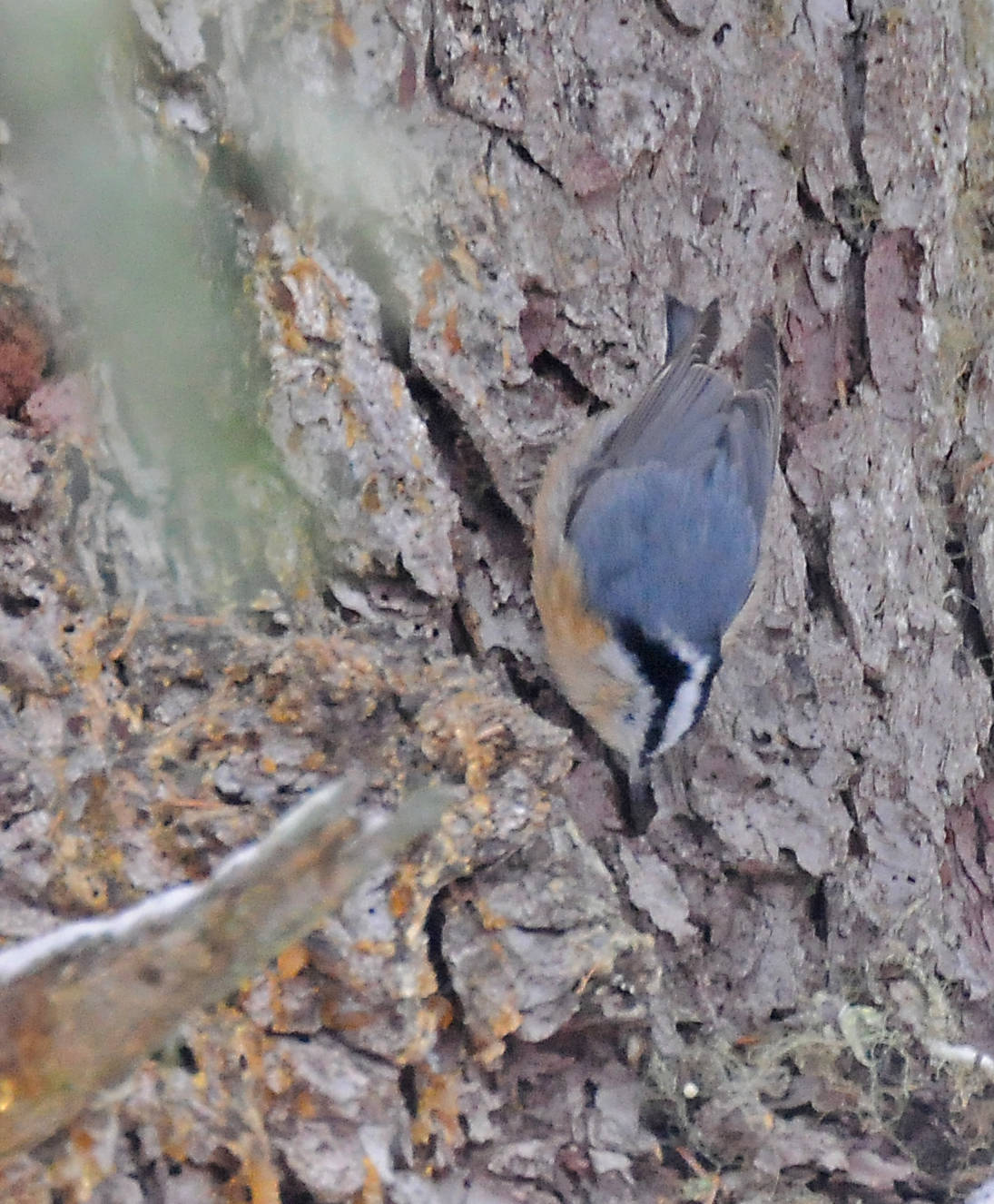
The birds were active on the feeders, among them ‘my’ pair of red-breasted nuthatches. They brought two youngsters to the feeders one day last summer, but they have apparently stayed on their territory for the winter. Each pair is socially monogamous; there apparently have been no studies of extra-pair matings,which are common in many other birds. Nuthatches defend their territories from other nuthatches; the male is especially vigorous in defense when the pair is excavating a nest in a dead tree. They also defend the nest cavity from red squirrels, which are potential predators of eggs and chicks.
Nuthatches have the odd habit of putting sticky conifer resin around the opening of the nest cavity. It is thought that this helps deter predators. One study found that more resin was placed around the nest entrance right after a face-off with a squirrel. Rarely, however, this tactic backfires, and one parent gets inextricably stuck in the resin and dies. After the nest is built, females incubate five to eight eggs, and the male brings her food. Incubation takes about 12 days and chicks stay in the nest for almost three weeks. Sometimes the male joins the female in the nest during incubation and brooding very small chicks.
[On The Trails: Calling owls and shrikes]
After the chicks fledge, the parents feed them for another two weeks and then the youngsters sometimes stay with the parents for many weeks, or they may become independent and disperse. Most nuthatches probably live only a few years the maximum known lifespan is just over seven years. Nuthatches forage by walking up and down and around tree trunks and big branches, especially in winter,presumably because dormant arthropods lurk in the crevices.
They can walk head-first down a tree trunk and even walk upside down underneath a branch.They have a very short tail, not usable for bracing against the wood as woodpeckers and creepersdo. Having a relatively long hind toe helps them Scamper down and sideways.
Outside of the winter season,they also forage on twigs and leaves,even on the ground sometimes, and occasionally catch insects out of the air. Captured food is often cached in holes and crevices, sometimes covered with bits of lichen or bark. A big item is wedged into a crack and then hacked into smaller bits (unlike chickadees, which hold such items in their feet). In fact, their English name may have originally been nut-hacker. At a seed feeder,nuthatches can be very choosy,carefully selecting the largest and heaviest items.Little appears to be known about how they manage in extremely cold weather.They do join mixed- speciesforagingflocksin winter,along with chickadees, kinglets, and other small birds. Presumably their insulation is quite good, but they don’t seem to roost communally or have elevated metabolic rates then (as some other birds do). More questions to be answered!
• Mary F. Willsonis a retiredprofessor of ecology. “On the Trails” appears every Wednesday in the Juneau Empire.
