
By Mary F. Willson
A little group of friends strolled out to the ‘island’ at the mouth of Fish Creek. On the berm along the way, we found swathes of pink shooting stars, showy yellow buttercups and blue lupines — a carpet of color. Out at Cowee Meadows this month, we’ll make an annual pilgrimage to enjoy the fields of wild iris, dotted with chocolate lilies and other flowers, and the banks of wild rose. These flamboyant favorites get most of our attention and appreciation.
It occurred to me, however, that there is an unsung gallery of flowers on beaches and intertidal meadows. These flowers are generally smaller and less showy, but surely they would have some interesting stories to tell. So I did a bit of digging and found surprisingly little detailed information about their life history. In some cases there were contradictory reports, which might mean either that certain reports are simply wrong or that the habits of a species vary from place to place. The bottom line is that there’s plenty of room for some detailed study of pollination, seed dispersal and germination, survivorship and longevity and all the facets of life history.
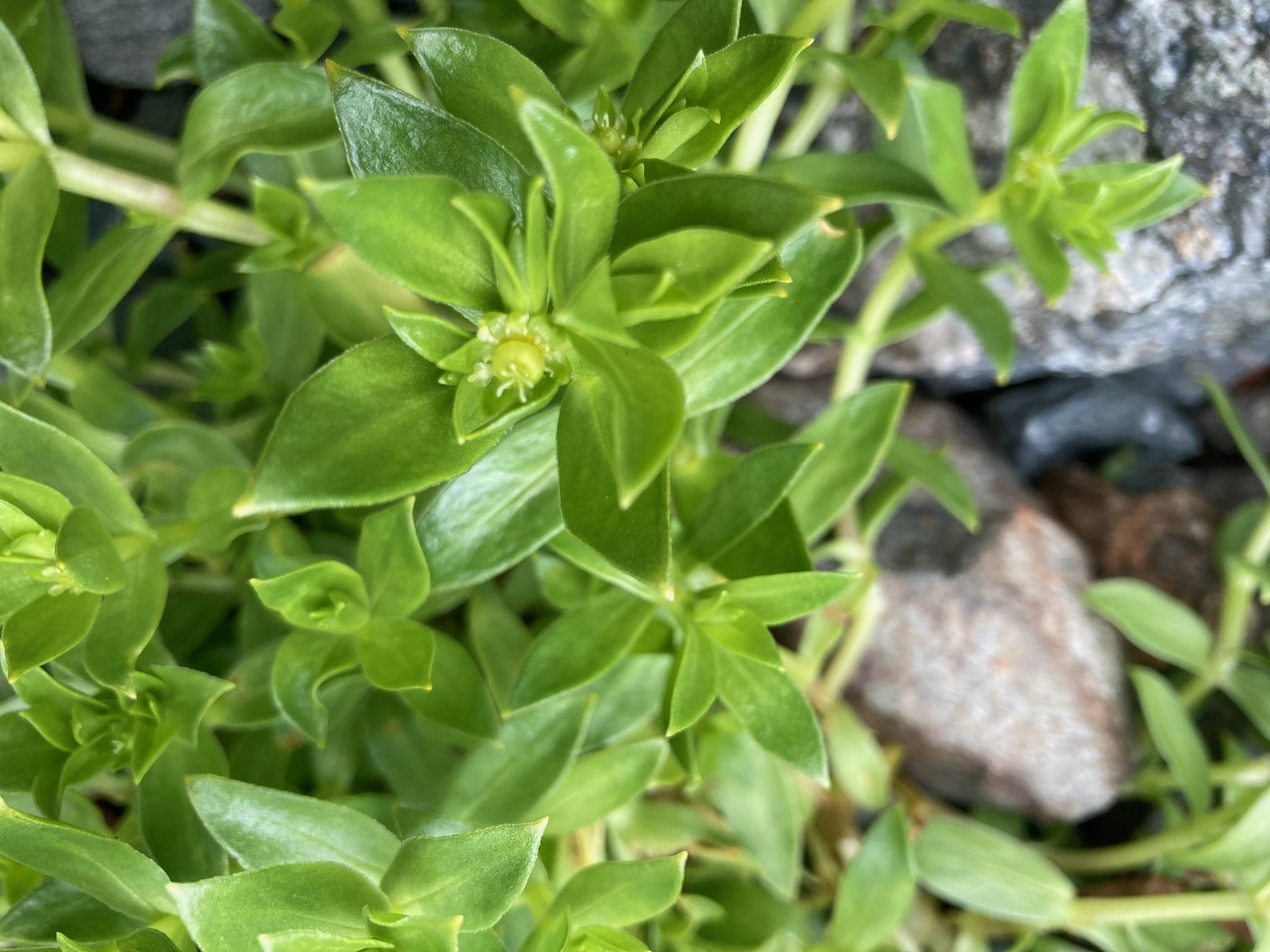
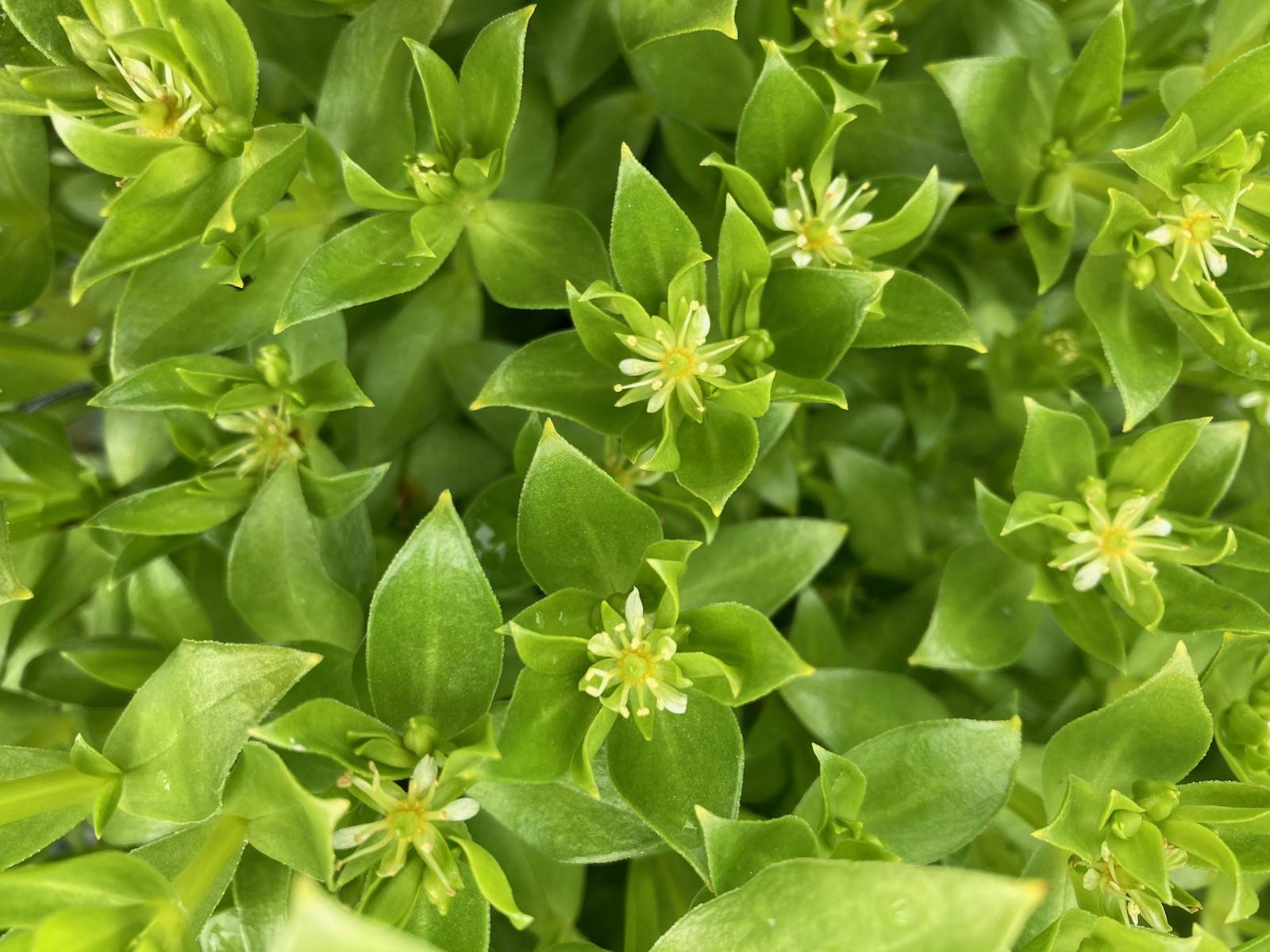
Female flowers of beach greens have tiny petals and no male parts. (No stamens are visible) (Courtesy Photo / Mary F. Willson)
In the meantime, here are a few gleanings about some of the seaside flowers—with all the above caveats plus the confusions of alternative scientific and multiple common names (too many to list, in some cases). Most of these species are widespread perennials in the northern hemisphere.
[On the Trails: Early fall in Cowee Meadows]
—Sea milkwort (Glaux maritima or Lysimachia maritima): Small, white flowers, pinkish at the base, grow from the junctions of leaves and stem. There are no true petals; the flower is formed of sepals that have taken on the role of advertising for pollinators, presumably small insects, although the flowers might be self-fertile. This species can also reproduce vegetatively, from buds on rhizomes (underground stems). It’s very salt-tolerant; salt glands on leaf surfaces excrete excess salt and the leaves can store fresh water. Milkwort reportedly makes mycorrhizal connections to the roots of other plants. Common on our beaches and other coasts, it also grows in saline habitats in the interior.
—Sea sandwort or seaside sandplant or (locally) beach greens (Honckenya peploides): Clumps of this plant dot upper sandy beaches. Its branches spread over the ground and most reports indicate that it can spread vegetatively, by rhizomes. The flowers have nectar and are said to be honey-scented and pollinated by a variety of insects; I saw several kinds of small flies on the flowers. Some of the flowers have very small white petals, no male parts, and are strictly female. Others have white petals about as long as the sepals; these are hermaphroditic, having both male and female parts. Many of the reports that I read confusingly called these simply ‘male’, but they are self-fertile to some degree, perhaps setting fewer seeds than the fully female flowers. Females reportedly grow more slowly than hermaphrodites. I recently searched some of our beaches for examples and found three clumps with wide-open female flowers on all the stems and several all-hermaphrodite clumps. I was fascinated to read that clumps with many flowering stems may be comprised of several genotypes but somehow all have the same sex-expression; this needs some elucidation.
—Oysterleaf or oysterplant (Mertensia maritima): Rather showy flowers are pink at first, turning blue; we’ve also seen rare individuals with white flowers. Although they are sometimes visited by insects, they are said to be mostly self-pollinating. The stems spread out on the surface, originating from a big taproot. The fruit is a ‘nutlet’ that can float in sea water for two weeks or more, and the seeds can be dormant for several years.
—beach pea (Lathyrus japonicus): The flower is usually pink or red at first, turning blue-purple at maturity; occasionally, all-white flowers are produced. The flowers absorb UV and nectar guides then become visible. It’s a complex flower that has a lower keel surrounding the sex organs and two spreading wings that are generally paler than the rest of the flower. It’s pollinated by bees, and I expect that (as happens with lupine) the bees have to pry open the flower to do the job.
Pollen is shed into the keel and stays viable until the stigma becomes receptive. The seeds float and are viable in saltwater, although the plant can also spread by rhizomes. Bruchid beetles often bore through the hard seed coat, breaking dormancy, which would enhance the germination rate unless the beetle larvae eat too much; wasp parasites that kill the larvae reduce damage and allow good germination. Beach pea (like lupine and other legumes) has root nodules containing Rhizobium bacteria that fix atmospheric nitrogen into a form usable by plants.
—Beach lovage (Ligusticum scoticum): The small, white or pinkish flowers in a cluster on top of the plant can be pollinated by flies and other generalist flower-visiting insects. The plant is tolerant of salt spray. We have observed that bears commonly dig up and eat the root, but the possible effect of this activity on the lovage population is not known. One report suggests that perhaps it can regenerate from root fragments.
—Glasswort or pickle weed or sea asparagus (Salicornia virginica): Hermaphrodite flowers are tiny, in groups of three, sunk in hollows at the stem joints on a spike. They may self-pollinate. This plant is considered to be a perennial but may be annual in some places. In California, it responds to the addition of nitrogen and phosphorous even in estuaries with high nutrient levels. It provides essential habitat near San Francisco for the endangered salt-marsh harvest mouse.
With apologies to the rest of the beach flora that was left out of this essay.
• Mary F. Willson is a retired professor of ecology. “On the Trails” appears every Wednesday in the Juneau Empire.
