
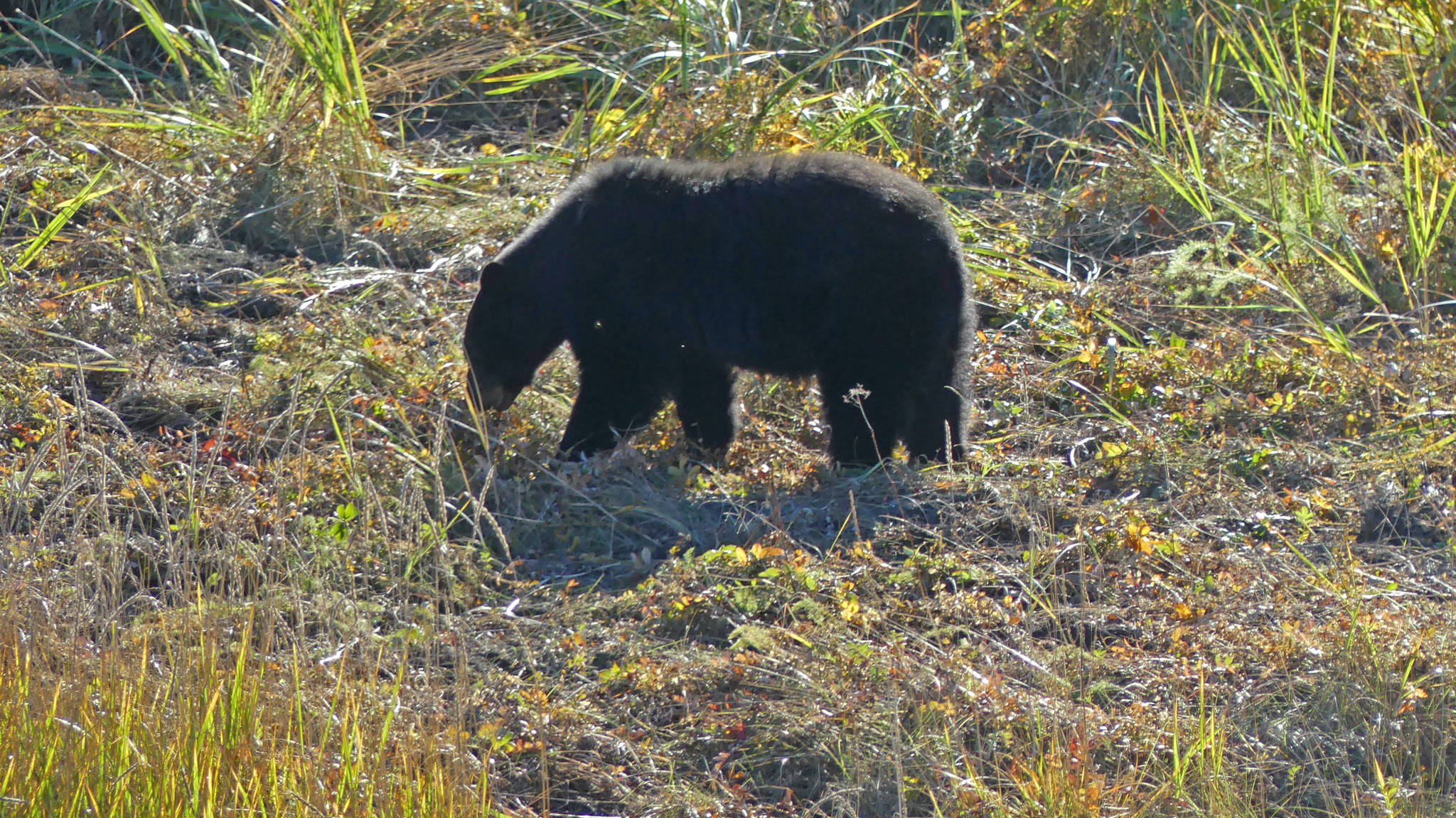
In fall, bears prepare for hibernation by eating prodigiously (the technical term is hyperphagia). When times are good, caloric intake in late summer and fall may be two or three times what it is in spring and early summer, and body weight increases dramatically. For example, a 300 pound bear might weigh 400 pounds, or even more, after fall hyperphagia. For females, laying down fat in fall is essential to successful reproduction. Fat females can produce more milk and it may be of higher quality. Well-fed, fat females give birth earlier and are able to nurse their young cubs for a longer time than slimmer females. As a result, the number of cubs, their size and their survival when they leave the winter den is significantly better. Lactating females lose a lot of weight during hibernation, virtually all of it as fat laid down in fall.
The process of preparing for hibernation begins in late summer and early fall. In Southeast, two major sources of food at this time are fruits and fish. Blueberries, salmonberries, currants, highbush cranberries and devil’s club are among the species that provide carbohydrates; they are common in the diet and the seeds show up in the scats. Salmon provide fat and protein, the species depending on timing of the spawning runs into the creeks where bears can catch them readily. Late sockeye or chum runs may be on the fall menu in some areas, and in some places coho salmon provide the last good meals before the bears enter their dens for hibernation. Other food items, such as northern ground cone or certain herbs provide a bit of variety.
But what happens to bears in years when food sources are poor? This year seems to be one of them in at least parts of Southeast. Berry crops were generally poor, although there were occasional ‘hotspots’. In at least some streams, the sockeye runs were unusually small. A long, dry spell in early fall meant that many creeks have very low water levels, so the adult coho can not move into their usual creek channels to spawn until late rains raised the water levels.
One thing that happens when food is scarce is that bears are likely to wander beyond their usual haunts and turn up in uncustomary places. For example, the city arboretum attracted an unusual number of bears this fall, drawn by fruit crops on the European mountain ash. And the young bear eating rose hips at the hospital door (triggering the automatic door, thus admitting the bear to the hospital) was probably roaming more widely than would be expected when food supplies are good.
Another important thing that happens is that females in poor condition are more likely to abandon their cubs sometime during hibernation; the newborn cubs die of starvation. The advantage to the mother is that she has not invested much in making milk (cubs in the hibernation den get only a small proportion of the total milk they might consume; most of their milk, and with a higher protein content, would be obtained after hibernation) and, by cutting her energy losses, she would be ready to mate again the next summer and try again to have cubs.
In October, observers noted a number of bears foraging in the big meadow at Eagle Beach State Park. Over a period of perhaps two weeks, they dug hundreds of shallow holes, apparently harvesting the roots of hemlock parsley (Conioselinum pacificum), a member of the carrot family. Across the river near the Boy Scout camp, bears had been digging too; great swathes at the edge of the meadows had been torn up by thousands of shallow pits. One of the food plants was another member of the carrot family called seawatch or seacoast angelica (Angelica lucida), a plant that bears normally dig up in this area, but in previous years the number of pits was small. The bears were probably getting more than angelica, but I often could not tell from the remains exactly what plant was chosen. In some cases, rice-root (a.k.a. chocolate lily) had been dug up but not eaten, apparently rejected in favor of something else. A sizable patch of red berries of mayflower (so-called false lily of the valley), adjacent to some of the digs, was ignored entirely, although bears are known to consume these berries upon occasion. Every one of the many bear scats I found there were full of well- macerated plant fibers.
Unfortunately, there are no studies of the nutritional value of the roots of either hemlock parsley or angelica. It is likely that they provide mainly carbohydrates; the thick tap roots are storage organs for the plants. We can make a few informed guesses, however. Studies with captive bears have shown that root vegetables, such as carrots, have a lower proportion of dry matter (i.e., more water) per gram than deer or fish and this plant material is much less digestible than the meats, as well as containing much less protein. So a hungry bear, eating mostly roots, would have to eat a lot more than if it were eating meat, to get the same nutrition.
Mary F. Willson is a retired professor of ecology. Her essays can be found online at www.onthetrailsjuneau.wordpress.com
• Mary F. Willson is a retired professor of ecology. “On The Trails” is a weekly column and appears every Friday. Her essays can be found online at onthetrailsjuneau.wordpress.com.
