
Fall is here, whatever the calendar says: fireweed has gone to seed, sending parachuted offspring into the breezes. Geese are numerous on the wetlands, with more arriving from time to time; more flocks are landing in the big meadow near the Boy Scout camp. Some male mallards are showing signs of developing their breeding plumage. Robins are flocking up and most shorebirds have gone south. Cottonwood trees have a few golden leaves, which are released one by one to float gracefully to earth.
Most of the wildflowers at sea level have finished blooming. The tall stalks of cow parsnip stand sere and brown. Here and there I can find the very last flowers of lupine and beach pea, but yellow rattle and yarrow still have some fresh flowers, and yellow paintbrush looks good. Among the late bloomers are hemlock parsley and purple asters (not to be confused with the purple daisy, which usually blooms earlier at sea level). Marsh felwort is always late to appear.
The woods are showy with red berries: bunchberry, elderberry, baneberry, the native species of mountain ash, devil’s club, and a few red huckleberries. It has been a good year for high-bush cranberry too; the flexible branches droop with the weight of fruit.
Here are a few observations from the last half of August:
— We spotted two small Columbia spotted frogs near lower Dredge Creek; they are known to breed in this area and at the community gardens.
— As I drove Out the Road one day, I noticed severe alder defoliation over long stretches of roadside. The woolly alder sawflies, assisted by the green alder sawflies, have been busy skeletonizing the leaves.
— I recently learned a new plant—a non-native perennial that appears in spots around here. I noticed it in a big clump at the beginning of the Horse Tram trail near the Eagle Valley Center. I was pretty sure it wasn’t a native, so I took a specimen to the Arboretum for the expert horticulturalist to identify. It’s comfrey (Symphytum officinale), known to gardeners as an exotic, noxious weed that spreads itself by thick underground stems (and presumably by seeds, but I found no information about seed dispersal). The pink flowers are pollinated by nectar-gathering bees, which are said to shake loose the pollen by vibrating their bodies when they are inside the flowers, but some bees can be nectar robbers and not pollinators. It is reported to be poisonous, but it also has medicinal uses.
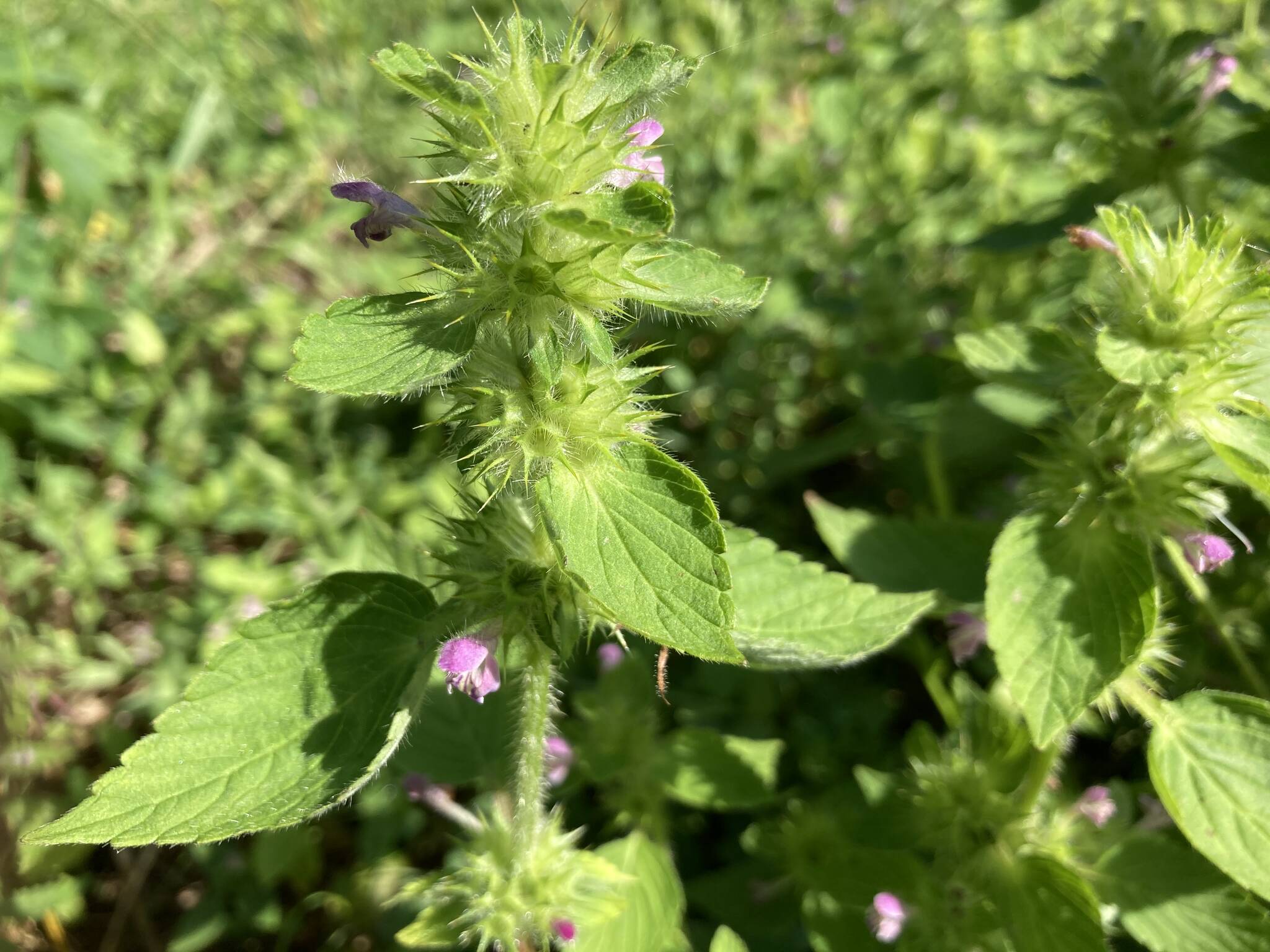
— Along the dike trail, on the lower section before the gazebo, we noticed large stands of another invasive, exotic plant: hemp nettle, native to Eurasia. There are several species in the genus (Galeopsis). The small pink flowers are sometimes bee-pollinated, but the species in our area may self-pollinate. This annual plant earns its nettlesome name by the fact that it is spiky all over (almost). The stem bears small sharp spines, the leaves are a bit bristly, and the narrow calyx that cups the base of the flower has major spines, several millimeters long. Even the flowers have small bristles! Woe betide any critter that bites or grabs this plant.
The seeds have no special device for dispersal and probably just fall to the ground, but they don’t remain viable for more than three years. A flower can make severaI seeds, which lie in the base of the cup formed by the calyx. Each plump seed is almost three millimeters long. I was fascinated to learn that, in Europe, the seeds of an unnamed species of Galeopsis are harvested and cached by Willow Tits and used for winter food. I wonder how they do that (assuming that the birds harvest the seeds directly from the plant and not from the ground). For the species we have here (G. tetrahit), the narrow calyx cup is six or seven millimeters deep, rimmed with five sharp spines about four millimeters long. If the hemp nettle species harvested by willow tits is similar, wouldn’t the birds get stabbed in the face? And I also wonder if ourchickadees will learn to do this!
— Another local naturalist observed some juvenile ravens at Eagle Beach. One of them carried a spruce cone, laid it down, and deftly extracted the seeds, one after another. Where did it get the idea? Maybe from watching some other critter? Had it done this before? In any case, this seems like unusual and interesting behavior.
Thanks to Elizabeth Graham, FSL-USFS, for info on alder sawflies, Ginger Hudson at the arboretum for identifying comfrey and showing me the hefty rhizomes, and Bob Armstrong for the raven observation.
• Mary F. Willson is a retired professor of ecology. “On the Trails” appears every Wednesday in the Juneau Empire.
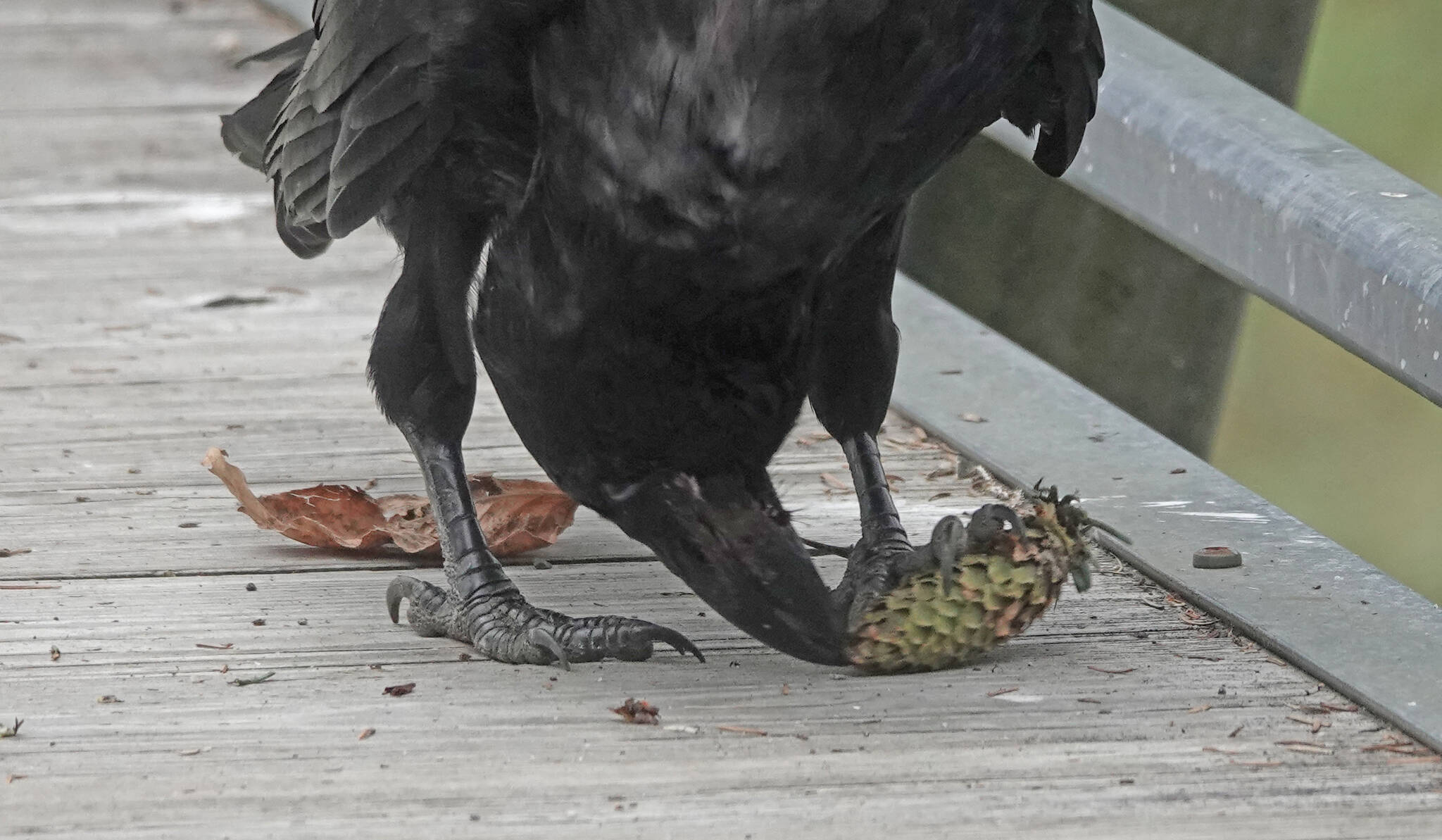
A young raven extracts seeds from a spruce cone (Courtesy Photo / Bob Armstrong)
