
By Mary F. Willson
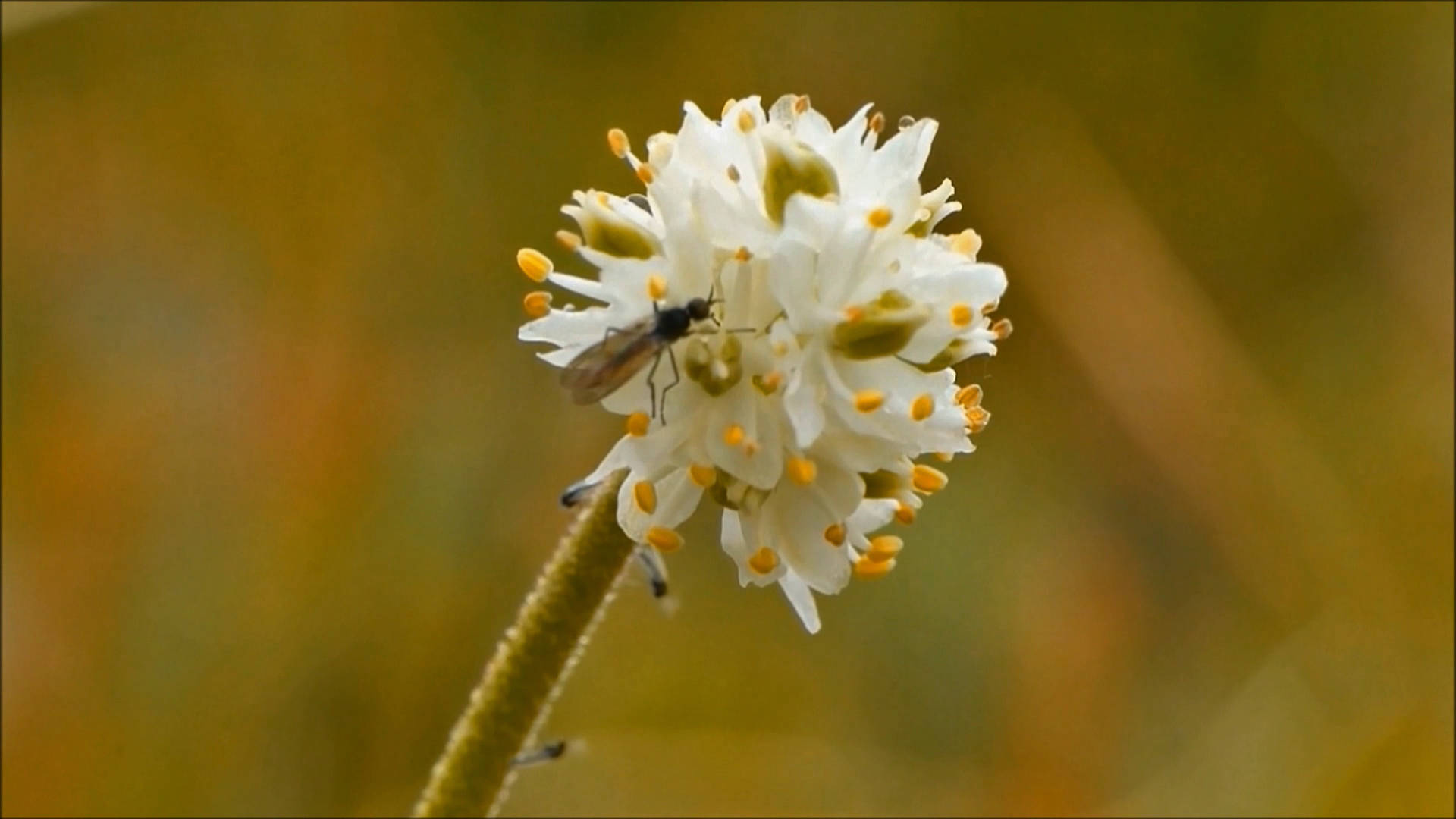
A pretty little perennial plant (Triantha glutinosa) grows in many of our muskegs. It’s sometimes called sticky asphodel, after the flowers that were said to grow in the Elysian Fields where the souls of the dead resided. The basis for this name-transfer from the myth to a tangible organism is not clear; I presume the original name-giver had not actually visited those mythical fields…
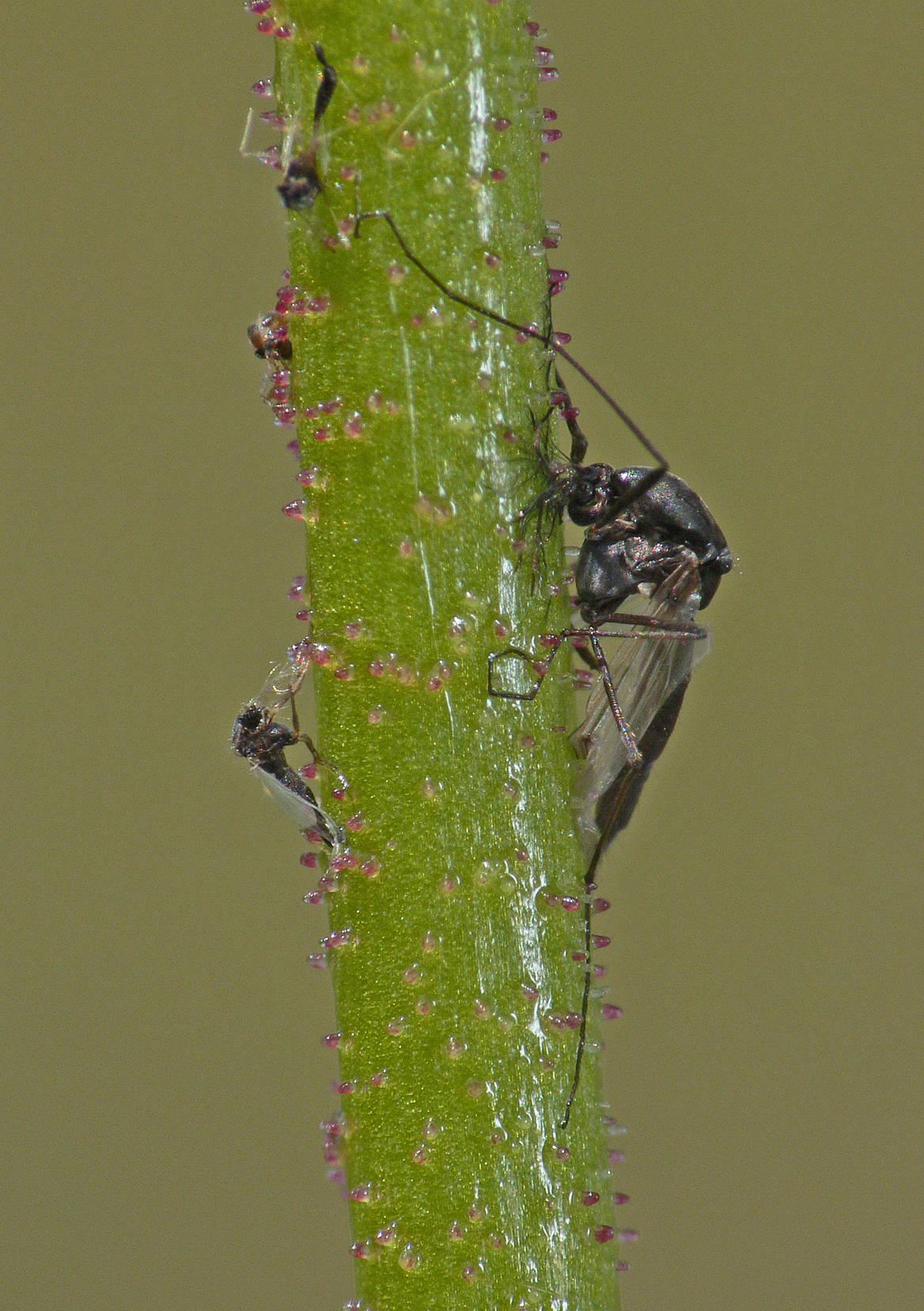
The stem of sticky asphodel earns its name by capturing tiny flies, which will be digested. (Courtesy Photo / Bob Armstrong)
It bears white flowers on a sticky stem that often catches small insects. Sometimes ten or twenty tiny insects are stuck to a stem, all of them less than two millimeters long and most of them less than one millimeter long. This observation led to questions: is this plant maybe insectivorous, like the sundews, or do the sticky hairs somehow protect the flowering stem from herbivores? My colleague and I sometimes observed geometrid moth caterpillars on these plants, where they eat the seeds out of the seed capsules. But the caterpillars are not deterred by the sticky hairs; when experimentally placed on a sticky stem, they usually marched right up to the seed capsules. So those hairs did not defend against that herbivore, at least.
Geometrid Caterpillar on False Asphodel.wmv from Bob Armstrong on Vimeo.
Could the sticky hairs perhaps digest the captured insects and thus gain nutrition for the plants? We labelled some fruit flies with an isotope of nitrogen and, in 2007, placed them on the stems while the plants were flowering. Weeks later, when the seeds matured, we looked for that isotope label in the seeds and in the roots — two places where nitrogen might be stored, either for the offspring or for future growth. But no isotope marker showed up there. In contrast, sundews happily took up the extra nitrogen from our fruit flies. We then, for various reasons, abandoned the project.
[On the Trails: Taking in the scenery on another level]
However, just recently — in 2021 — there came a fascinating published report that a closely related species (T. occidentalis) is indeed insectivorous. This species is so closely related to our local T. glutinosa, that it is likely that the findings of this study would apply here as well.
The researchers in that study applied isotopically labelled fruit flies to the flowering stems. Sampling the developing fruits, leaves, and stems a week or two later, they found the isotope marker in all those plant parts, indicating that nitrogen had been transferred from insect to plant. This resulted in an increase of nitrogen concentration, particularly in fruits and stems, but that increase was temporary. Apparently that nitrogen had been translocated, perhaps to roots (for future growth) or possibly to maturation of additional fruits that year. These possibilities were not measured, at least in this report.
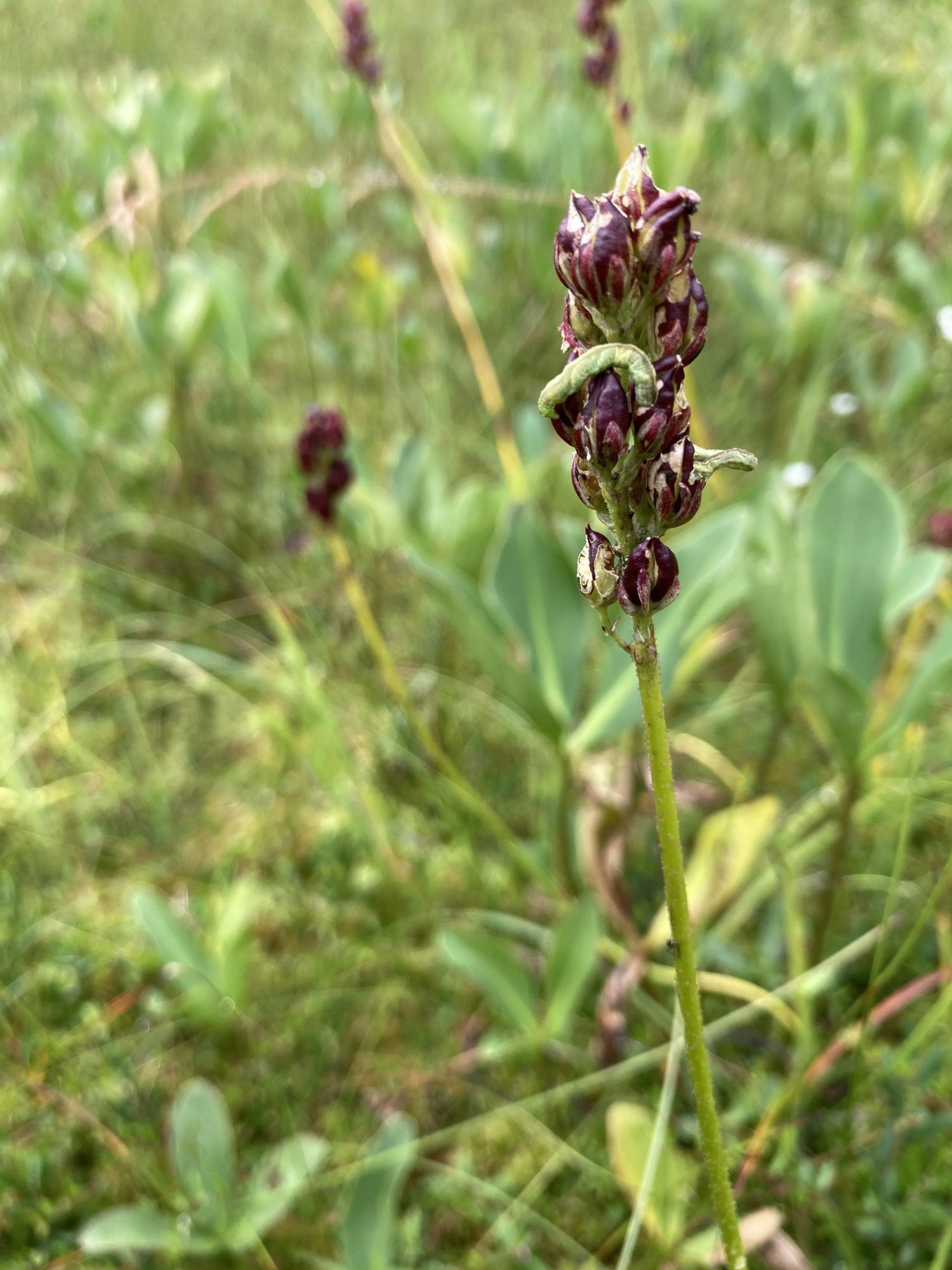
A moth larva called a looper investigates sticky asphodel capsules and will later eat the seeds. (Mary F. Willson / For the Juneau Empire)
However, as noted above, our little study did not find the marker isotope in roots or seeds. So we can hope that further research will resolve this issue.
Nevertheless, the new research clearly shows that, assuming our species is like the other, we have another local member of the insectivorous-plant clan, along with two species of sundew, bladderwort, and butterwort. I’m sure that more will be discovered, if we would just look!
Back in the 1980s, one of my PhD students showed that labelled nitrogen was taken up in sticky traps on the inflorescences of Penstemon digitalis and Cirsium discolor. In P. digitalis, sticky hairs occur on the flower itself and its stem; in C. discolor, the traps are on the outer involucral bracts just below the flowering head. The pollinators of penstemon (bees) are too big to get stuck on the traps, and the assorted pollinators of Cirsium approach the flowers from above, and so do not encounter the traps. No defensive function of those traps was found. Instead, the sticky traps had digestive enzymes and provided extra nitrogen and phosphorus to the plants, and this resulted in increased numbers of seeds by both species. Unlike most species that are known to be insectivorous, these two do not inhabit very nutrient-poor habitats such as bogs.
• Mary F. Willson is a retired professor of ecology. “On the Trails” appears every Wednesday in the Juneau Empire.
