
By Mary F. Willson
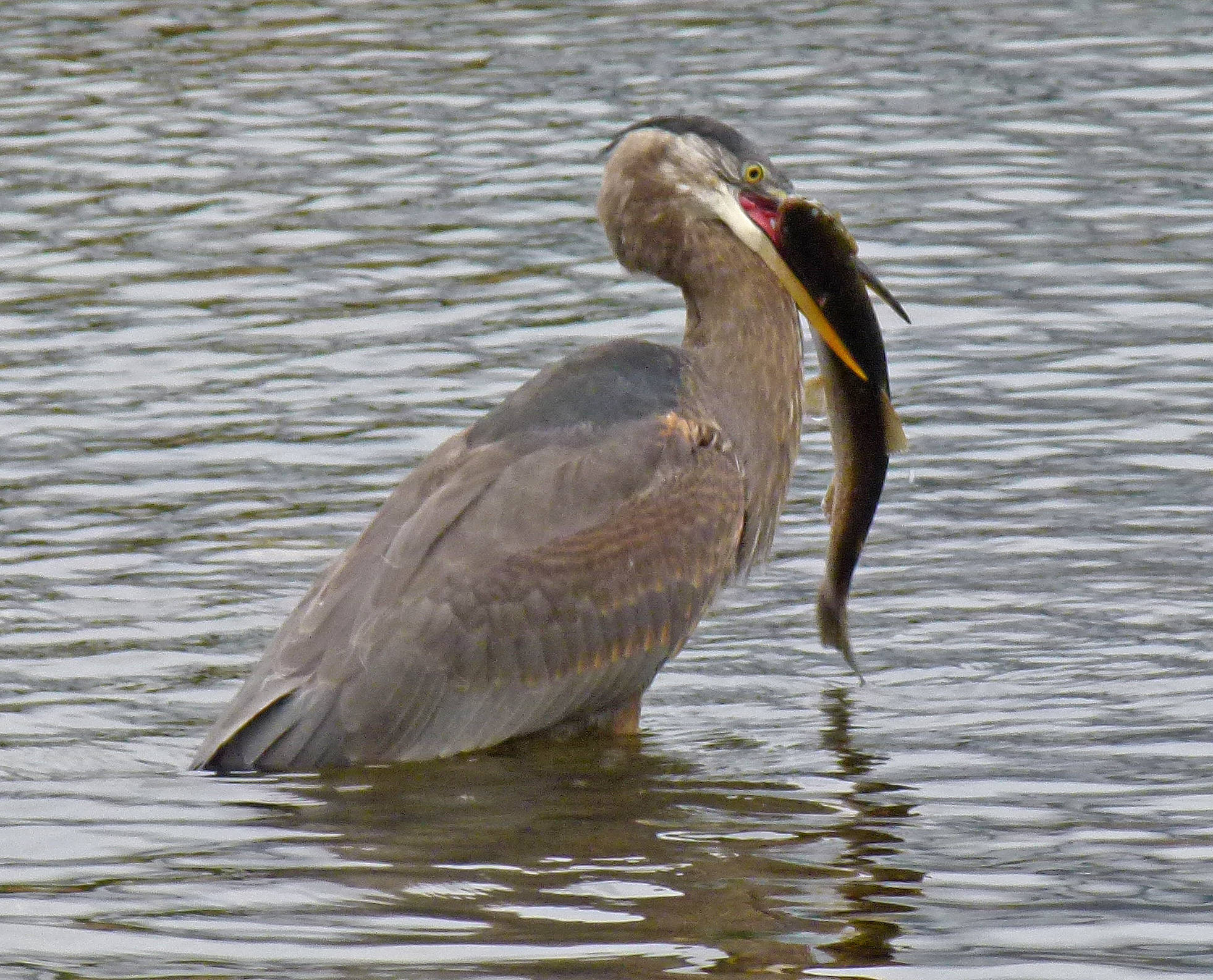
I watched a great blue heron glide down to the shore of a pond and slowly walk along the shore in its dignified and stately fashion. Suddenly, it darted its head into the pond and came up with a small fish, which went quickly down the hatch. Then, the heron moved on and out of sight.
A very ordinary sighting, but it made me think about birds that exploit shorelines and shallow waters. Many birds do that, but there are three particular local residents that do so regularly. All three capture prey with their beaks (not with their feet, as eagles and osprey do). All three can be found in both fresh water and saltwater habitats at times, and all include fish in their diets. Their body sizes are very different and their foraging behaviors are usually quite different.
The herons are fun to watch, if you have patience. They often stand motionless, with their feet in the water, just waiting and watching — a typical sit-and-wait strategy (or, rather, stand-and-wait). If nothing happens for a while, the heron may move to a different spot and wait again. At other times, a heron may stalk ev-er-so-slow-ly through the water, carefully lifting and placing its feet without a ripple; perhaps it sees a flash of underwater movement and tries to get closer. Or, like the one I watched that day, it may just slowly walk the shore, inspecting the shallows for a likely victim. Occasionally, they may hover and dive or float on the surface and grab a fish below.
Herons eat a lot of fish, of various sizes; a record might have been set by one that nabbed and somehow swallowed an adult Dolly Varden (see Bob’s photo). Across their geographic range, they also forage on invertebrates, frogs, snakes, ducklings and other birds, and, especially in agricultural country, on small mammals. They are said to have good night vision, so they can forage in the dark.
Belted kingfishers are mostly sit-and-wait predators, perching for long times on bridges or tree branches hanging over the water, but sometimes hovering over the water surface.
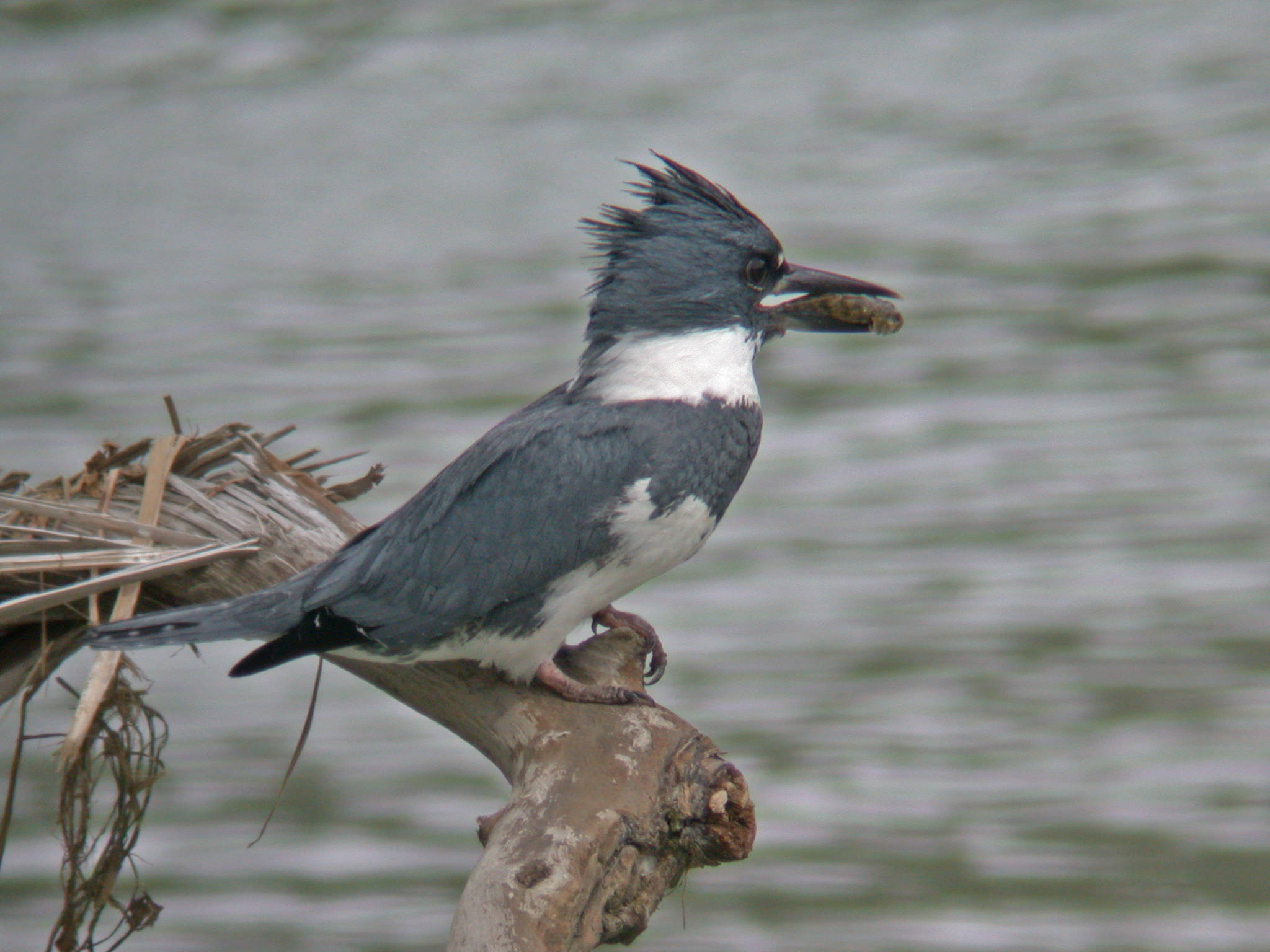
Then, if they spot a fish below, they dive in, plunging underwater and emerging with a flurry of water drops and, often, a fish. They also fly along steep shores and rivers, looking for good hunting prospects, sometimes diving during a flight. Most dives are not very deep, perhaps a foot or less. They have good binocular vision in water and can probably see colors. As many birds reportedly do, they have two foveas in the retina of the eye—two areas of special visual acuity. When they dive, the asymmetrical lens shifts its position a bit, to bring the image from the main fovea (used for vision in air) to the secondary fovea. This allows them to focus in water, where the light rays are bent at a different angle than in air. They can also judge depth accurately. Most fish captured are less than about six inches long; the kingfisher often beats its wriggling prey on a branch or a rock, in order to subdue it, then swallows it headfirst. Although fish are a mainstay, they may also eat crustaceans, insects, amphibians, and in some regions, also small mammals and reptiles.
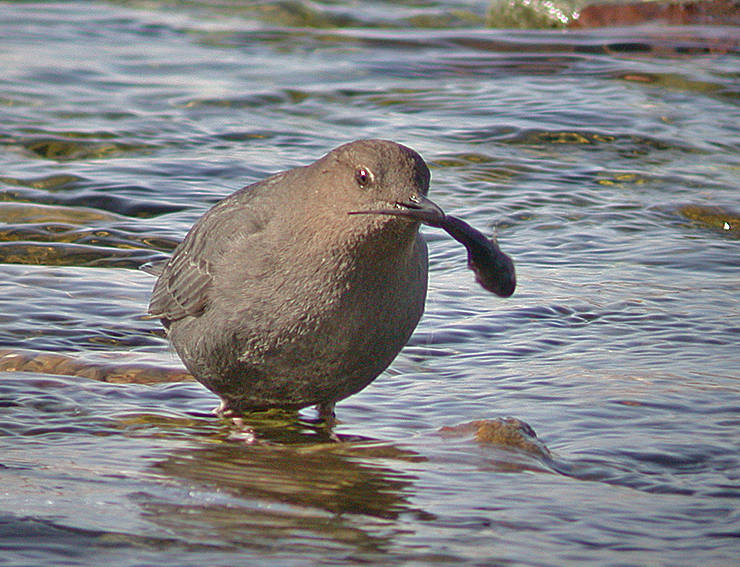
American dippers hunt primarily in clear, freshwater streams, prospecting in the riffles and pools for prey. In winter along the seacoast, however, they also forage in estuaries and along some marine shores. They sometimes sit-and-wait on a rock or icy ledge for prey to move by, but they are also pursuit-predators, chasing a moving prey underwater. In addition, they ‘snorkel’—swimming on the surface with the face in the water as they search. They often capture small fish (usually less than four or five inches long), including sticklebacks, sculpins, starry flounder, and juvenile salmon; large specimens are thrashed on rocks or sticks to inactivate them before swallowing them headfirst. However, invertebrates are usually a more common prey. Stray salmon eggs in season are a special treat.
Although their prey and foraging habits may overlap a bit, the nesting habits of these birds are wildly different. The herons build rough stick nests in trees, usually tall trees but occasionally scruffy little pines; in some areas they are often colonial. Their main nest predators are eagles and ravens; wind storms may occasionally destroy a nest. Our kingfishers dig tunnels in firm
mud banks along a stream, with a nest chamber at the end of the tunnel. Not many predators can get at these nests, but there is a sometimes serious risk of flooding; bank erosion along the Mendenhall River has wiped out several tunnels (mostly during the off-season, fortunately). Dippers commonly nest on cliffs next to a clear stream, building a ball of moss with a chamber inside; but they’ve been known to nest under bridges or even in stream-side buildings. The cliff nests are seldom accessible to predators, but mink, weasels, or perhaps ravens may sometimes raid a nest.
Note: although many birds are reported to have two foveas in their eyes, I have found no specific information about this for herons or dippers.
• Mary F. Willson is a retired professor of ecology.“On The Trails” is a weekly column that appears in the Juneau Empire every Wednesday.
