
Alaska lawmakers are nearing a deal to cut the state subsidy of the oil and gas industry, the first significant step to resolve a multibillion-dollar budget deficit.
They’ll have to act quickly: Saturday is the last day of the Legislature’s second special session this year, and most lawmakers aren’t expected in the Capitol before Wednesday.
“Bills are being drafted and that sort of thing,” said Rep. Andy Josephson, D-Anchorage and a lawmaker on the committee addressing the subsidy.
Earlier this year, the House and Senate passed different versions of House Bill 111, a measure that reforms the state subsidy of oil and gas drilling. The state of Alaska currently offers cash credits to companies that lose money on the North Slope. Those companies are typically those that have been drilling but haven’t yet begun producing oil or gas. With the state facing a multibillion-dollar annual deficit, lawmakers agree that the system is no longer affordable.
The difficult question: What replaces it?
The House and Senate couldn’t agree during the 30th Legislature’s regular session, and they couldn’t agree during the first special session.
Now, the issue stands alone on the agenda at the end of the second special session.
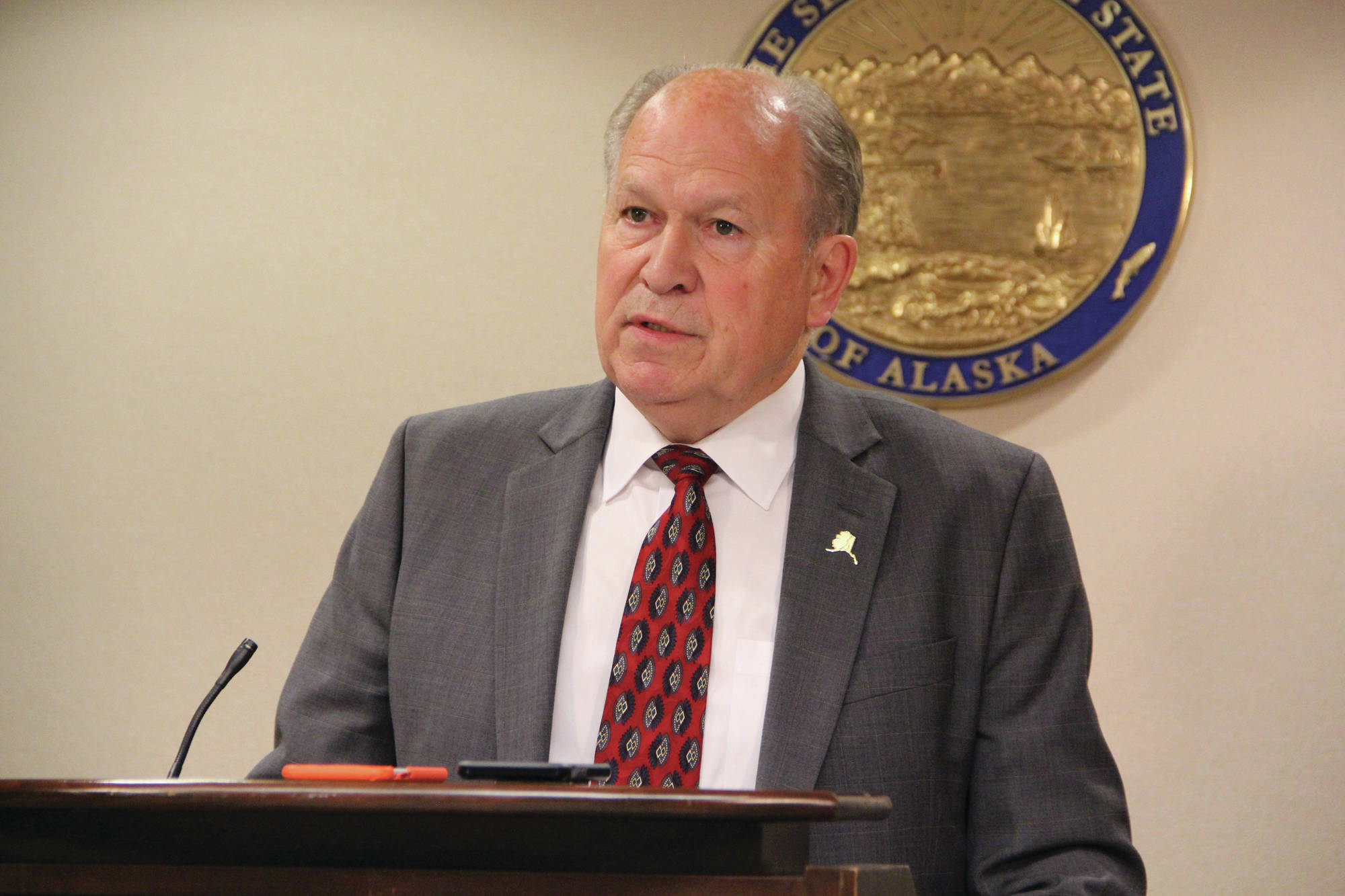
In a press conference Monday, Gov. Bill Walker (who set the special session agenda) said, “Once again, my message is let’s finish the job, and let’s do it this year.”
Walker was referring to a comprehensive strategy to fix the deficit, and members of the coalition House Majority have said that HB 111 is a key part of that strategy.
By phone on Monday, Sen. Cathy Giessel, R-Anchorage and the chief Senate negotiator on HB 111, said the Senate presented a three-point compromise proposal to the House majority on Thursday afternoon.
Rep. Geran Tarr, D-Anchorage and the House’s chief negotiator, said the House agreed to the Senate offer but had one additional request.
“In a game of tennis, they’ve hit the ball to us, and we’ve hit the ball to them,” Josephson said.
Giessel said Monday that House lawmakers are still writing a work draft of their proposal, and senators don’t know what the additional point will be.
“It kind of depends on the details of this last thing that they’re offering is,” Giessel said.
In the Legislature this year, the 22-member coalition House Majority and 13-member Senate Majority hold most of the cards. Each group, working together, has enough votes to perform business without the support of minority Democratic senators or minority Republican representatives.
If the final point is a dealbreaker, the Senate Majority could make a counter-offer, or it could end negotiations until a future legislative session. The House Majority could also withdraw its final point.
The stakes are big. Despite the decline in oil prices, Alaska’s state government is expected to earn $1.7 billion from oil and gas this fiscal year, and the oil and gas industry is expected to pay 11 percent of the state’s wages, according to figures from the Alaska Department of Labor.
In Monday’s interview, Giessel pointed to a recent Department of Labor study that showed Alaska’s gross domestic product had declined for a full year, largely because of the suffering oil and gas industry.
“This is huge,” Giessel said. “This is what the Senate stays awake thinking about at night; at least I do. Whatever we do, we don’t want to jeopardize our competitiveness on the world market.”
The Senate has scheduled a floor session for 8:30 a.m. Wednesday. Senate President Pete Kelly, R-Fairbanks, said Monday that the session will be used for a procedural vote necessary before any deal on HB 111.
Kelly said if the House and Senate reach agreement quickly, a final vote could happen as early as Thursday, but when asked what he thinks will happen, he said, “I couldn’t predict what the schedule’s going to be.”
In depth
The state subsidizes oil and gas drilling through a system of tax credits. If a company loses money on the North Slope (which typically happens while the company is drilling but before it has begun production), the state will pay credits worth 35 percent of the company’s losses.
For the past several years, according to the Alaska Department of Revenue, oil companies have applied for more credits than the state earns in production taxes because oil prices — and tax rates, which scale with the price of oil — are so low. (The state also collects other taxes and royalties from oil and gas production.) For the next 10 years, the department is estimating an average of $150 million in claims per year.
These credits do not expire; they roll over to the next year if unspent. If a company doesn’t have any oil production, it can sell its credits to a company that does, or it can sell those credits back to the state for cash.
Both House and Senate versions of House Bill 111 eliminate the cash credit system. As a replacement, they also agree that companies should instead be able to deduct some of their losses from future taxes directly.
The IRS allows a similar approach at the federal level.
The House and Senate disagree on the amount of that deduction, and they disagree on whether the state’s oil tax system should also change at the same time.
The Senate would allow companies to write off 35 percent of their losses; the House would allow a 25 percent write-off. The House also proposes a 10 percent penalty: A claimed loss would lose 10 percent of its value each year. That would prevent companies from holding on to their write-offs for a long period of time.
There are other differences as well, but those two differences account for much of the gap between the two plans. According to figures from the Department of Revenue, the House’s plan would save $800 million more than the Senate’s between 2017 and 2027. The Senate’s plan would cost about $10 million less than the existing approach.
Gov. Bill Walker has offered a compromise third option, but neither the House nor Senate have voiced any public support for the idea.
The Senate Majority remains concerned about harm to the oil industry, which (according to the Alaska Department of Labor) employs about 11,000 people. That’s far below the fishing industry, but what oil industry jobs lack in numbers, they make up in earning power. Oil and gas jobs pay 11 percent of the state’s wages.
Furthermore, oil is expected to earn the state of Alaska $1.7 billion in the current fiscal year, despite low prices.
The House Majority, meanwhile, says it is concerned about the health of the oil and gas industry, but not at the expense of other sectors of the state economy. It views the elimination of the state’s annual deficit as a top priority, even if it means higher taxes.
It points to the fact that Alaska’s oil revenue has dropped from $11.3 billion (in 2008) to less than 20 percent of that figure.
Members of the House Majority say the uncertainty created by the deficit deters economic investment because Alaskans (and Outside investors) don’t know whether they might be the ones taxed (or forced to shoulder the burden of infrastructure cuts) to solve the deficit.
• Contact reporter James Brooks at james.k.brooks@juneauempire.com or call 523-2258.
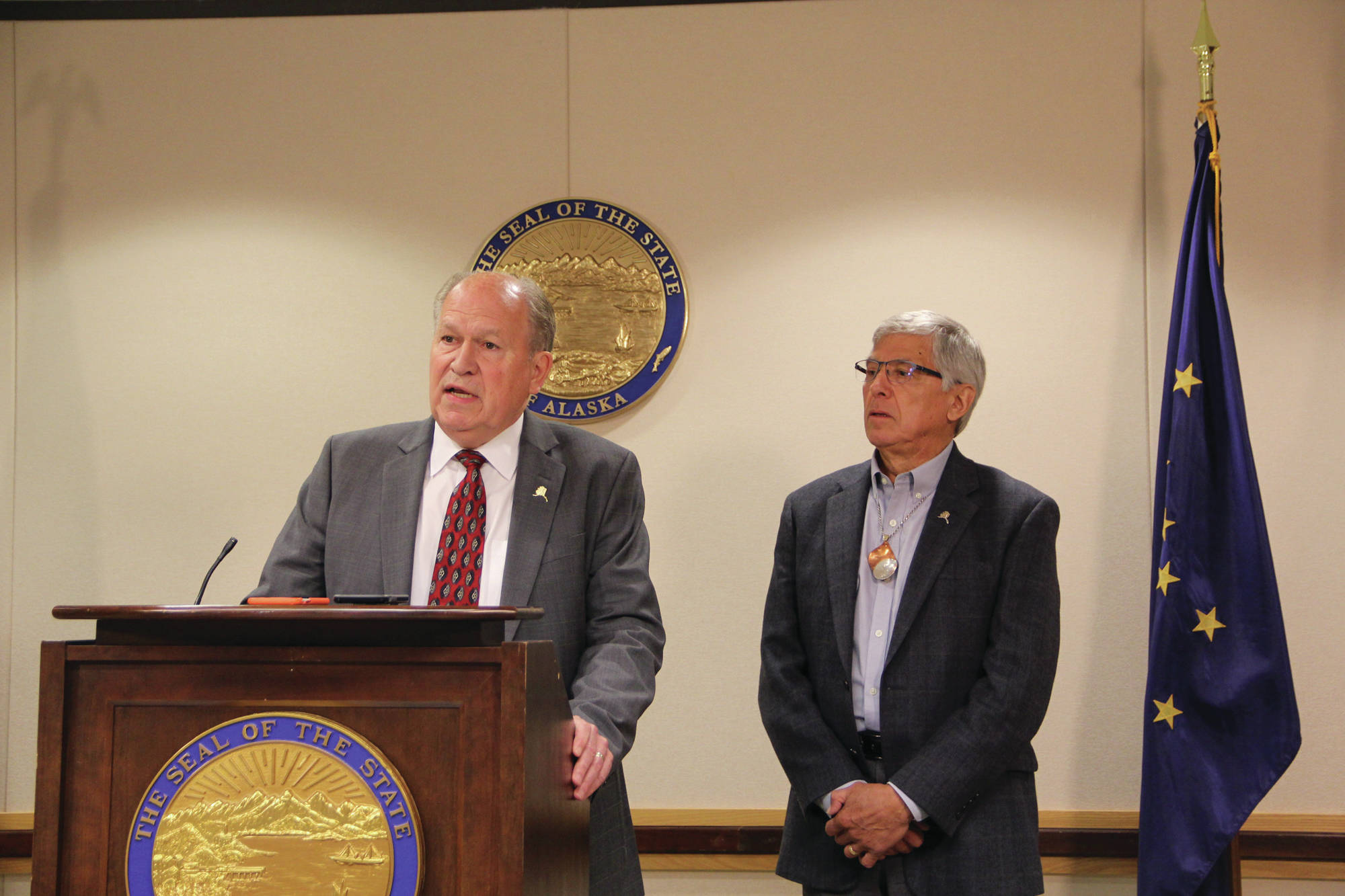
Alaska Gov. Bill Walker speaks during a news conference July 10, 2017, in Anchorage alongside Lt. Gov. Byron Mallott.(Elwood Brehmer | Alaska Journal of Commerce)
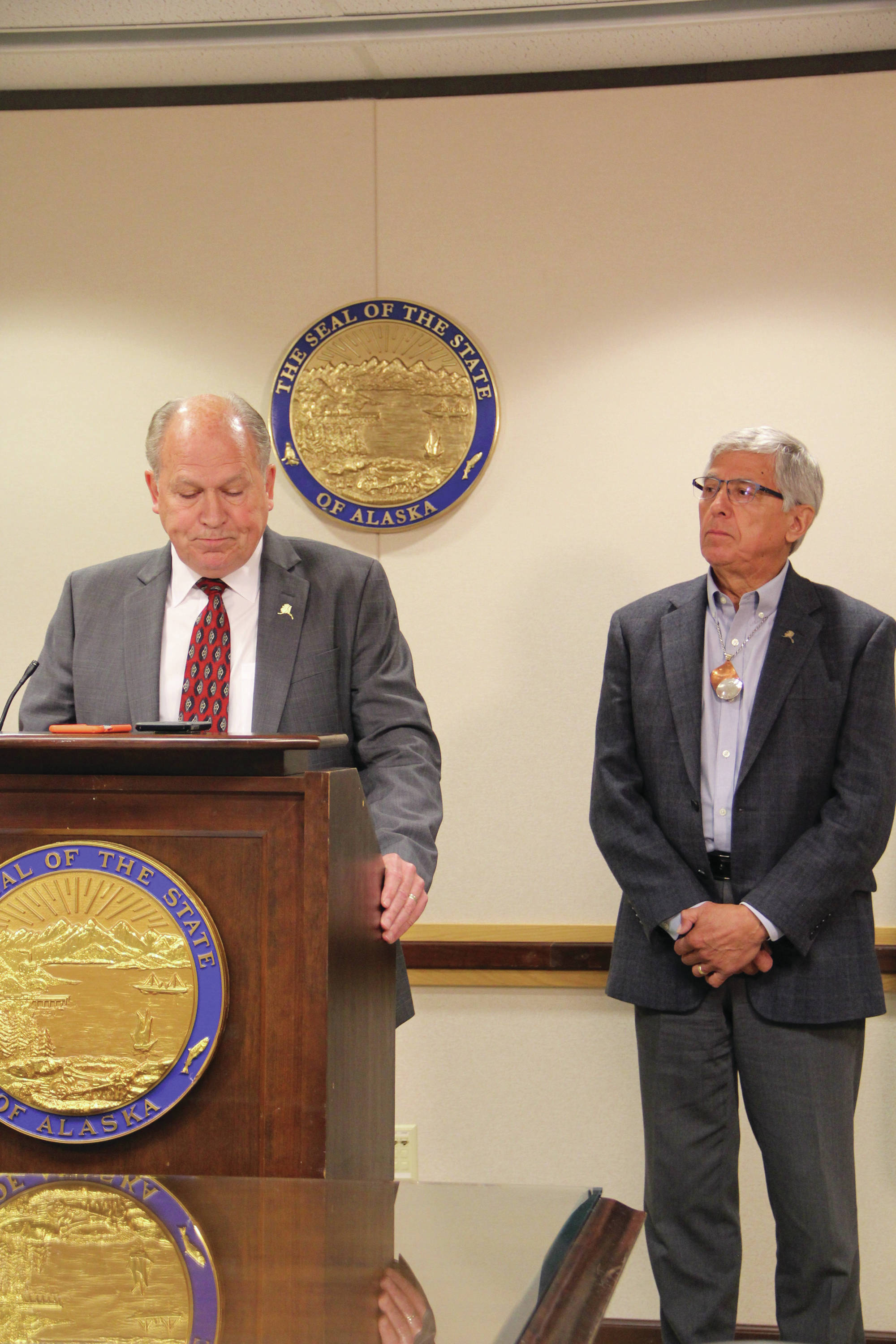
Alaska Gov. Bill Walker speaks during a news conference July 10, 2017, in Anchorage alongside Lt. Gov. Byron Mallott. (Elwood Brehmer | Alaska Journal of Commerce)
