
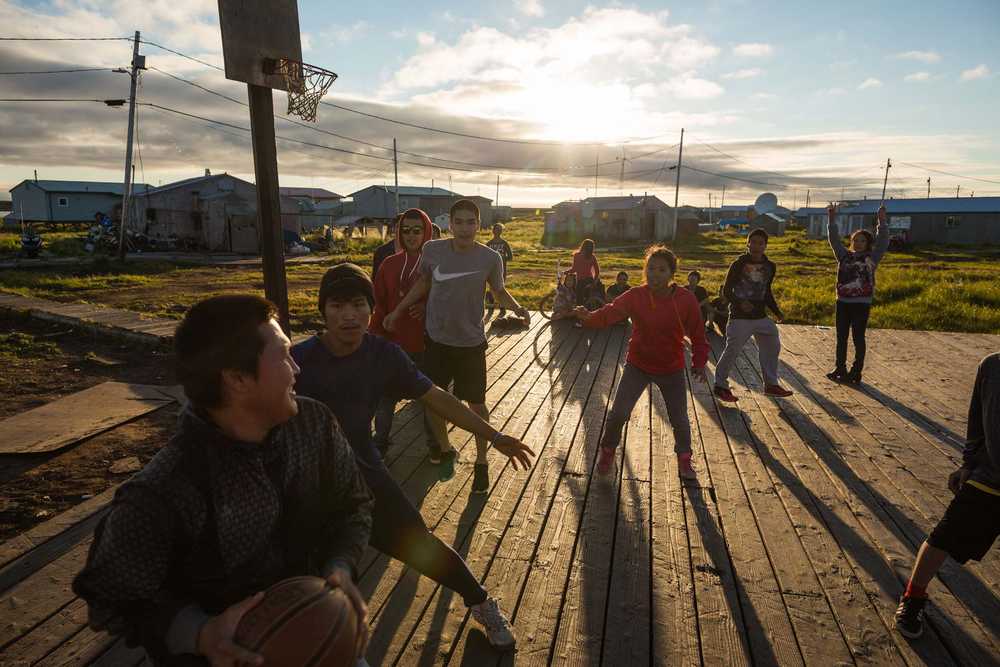
Youths play basketball at the community court in the village of Newtok on Aug. 4. The state is hoping to kick-start a mass exodus from the tiny village through a national competition for states and local governments vying for a slice of nearly $1 billion in grants to be awarded by the U.S. Department of Housing and Urban Development.

Youths play basketball at the community court in the village of Newtok on Aug. 4. The state is hoping to kick-start a mass exodus from the tiny village through a national competition for states and local governments vying for a slice of nearly $1 billion in grants to be awarded by the U.S. Department of Housing and Urban Development.

Officials eye eroding village as relocation model

ANCHORAGE — One of Alaska’s most eroded coastal Native villages is being eyed as a possible national model for relocating whole communities whose futures are threatened by natural disasters escalated by climate change.

The state is hoping to kick-start a mass exodus from the tiny village of Newtok through a national competition for states and local governments vying for a slice of nearly $1 billion in grants to be awarded by the U.S. Department of Housing and Urban Development. HUD’s National Disaster Resilience Competition is billed as an effort addressing climate change and extreme weather.

If successful, Alaska officials are proposing that $62.6 million of the funds be used for relocation costs, including money for infrastructure and money to allow 62 families from Newtok to establish new homes at the chosen relocation site on higher ground 9 miles away. In the draft proposal publicly released Friday, state officials also are seeking a total of $162.4 million for three other vulnerable villages — Emmonak, Galena and Teller — with extensive storm damage in recent years.

But officials acknowledge that competing for the funding unused by Hurricane Sandy victims won’t be easy. Alaska is among 40 finalists for the funds, including Hurricane Katrina-ravaged New Orleans. Still, Alaska officials are hoping their proposal catches the eye of federal officials.

“We think we have a very compelling story to tell,” said Sally Russell Cox, a state planner who worked on the competition entry.

The release of Alaska’s proposal opens a 15-day public comment period before the final contest submission is due to HUD Oct. 27.

President Barack Obama, in his recent three-day visit to the state, focused almost entirely on climate change and how temperatures are rising faster in Alaska than anywhere else, already threatening entire communities.

Newtok is the only one of Alaska’s multiple imperiled communities that has begun a physical move. The Yup’ik Eskimo community of about 380 shepherded various multiagency projects including construction of several homes and the beginning of an evacuation community center, which would be completed with nearly $5.5 million sought through the HUD competition. A tribal power dispute, however, stalled relocation efforts for about two years until a federal appeals panel sided with the new village leaders last month.

Oblivious to village politics, the raging Ninglick River is steadily inching toward homes, gobbling up as much as 75 feet of riverbank a year. Melting permafrost is sinking and knocking homes and village boardwalks out of alignment. Officials estimate Newtok, nearly 500 miles west of Anchorage, has until 2017 until erosion is expected to reach the school.

Villagers believe they’re living on borrowed time, and they are actively lobbying for funding wherever they can find it. Village relocation coordinator Romy Cadiente is in Washington, D.C., this week to gather support by meeting with officials, including Alaska’s congressional delegation or their representatives. The village is also trying to obtain funding for some homes for the new site through the U.S. Federal Emergency Management Agency, or FEMA, and is working with the Cold Climate Housing Research Center in Fairbanks on plans to build a high-efficiency home at the current site as a demonstration model.

“We’re trying to really focus on how to get this village out of there,” Cadiente said in a phone interview Wednesday. “That shore is not going to grow back.”
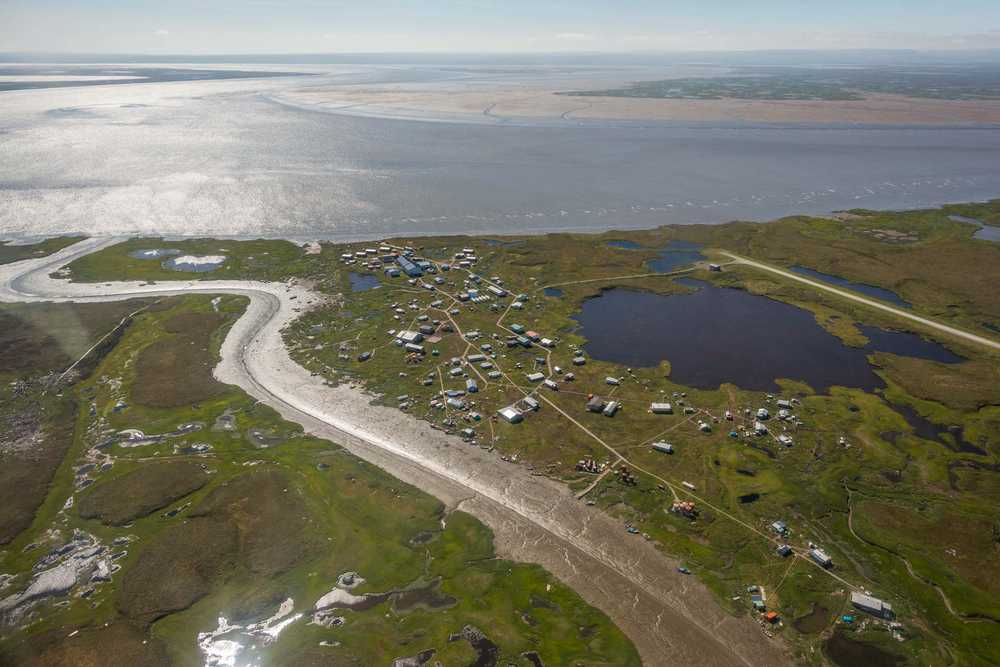
The village of Newtok in western Alaska is viewed on Aug. 4. The state is hoping to kick-start a mass exodus from the tiny village through a national competition for states and local governments vying for a slice of nearly $1 billion in grants to be awarded by the U.S. Department of Housing and Urban Development.

The village of Newtok in western Alaska is viewed on Aug. 4. The state is hoping to kick-start a mass exodus from the tiny village through a national competition for states and local governments vying for a slice of nearly $1 billion in grants to be awarded by the U.S. Department of Housing and Urban Development.

More in News

A house on Telephone Hill stands on Dec. 22, 2025. (Mari Kanagy / Juneau Empire)
Court sets eviction date for Telephone Hill residents as demolition plans move forward

A lawsuit against the city seeks to reverse evictions and halt demolition is still pending.

Juneauites warm their hands and toast marshmallows around the fire at the “Light the Night" event on winter solstice, on Dec. 21, 2025. (Mari Kanagy / Juneau Empire)
A mile of lights marked Juneau’s darkest day

Two ski teams hosted a luminous winter solstice celebration at Mendenhall Loop.

A Capital City Fire/Rescue truck drives in the Mendenhall Valley in 2023. (Clarise Larson / Juneau Empire file photo)
Juneau man found dead following residential fire

The cause of the fire is still under investigation.

CBJ sign reads “Woodstove burn ban in effect.” (City and Borough of Juneau photo)
Update: CBJ cancels air quality emergency in Mendenhall Valley Sunday morning

The poor air quality was caused by an air inversion, trapping pollutants at lower elevations.

A dusting of snow covers the Ptarmigan chairlift at Eaglecrest Ski Area in December 2024. (Eaglecrest Ski Area photo)
Update: Waterline break forces closure at Eaglecrest Friday, Saturday

The break is the latest hurdle in a challenging opening for Juneau’s city-run ski area this season.

Patrick Sullivan stands by an acid seep on July 15,2023. Sullivan is part of a team of scientists who tested water quality in Kobuk Valley National Park’s Salmon River and its tributaries, where permafrost thaw has caused acid rock drainage. The process is releasing metals that have turned the waters a rusty color. A chapter in the 2025 Arctic Report Card described “rusting rivers” phenomenon. (Photo by Roman Dial/Alaska Pacific University)
Ecosystem shifts, glacial flooding and ‘rusting rivers’ among Alaska impacts in Arctic report

NOAA’s 2025 report comes despite Trump administration cuts to climate science research and projects

The U.S. Capitol in Washington, D.C., on Oct. 1, 2025. (Photo by Jennifer Shutt/States Newsroom)
Moderate US House Republicans join Dems to force vote on extension of health care subsidies

WASHINGTON — Republican leaders in the U.S. House will face a floor… Continue reading

The National Weather Service Juneau issues a high wind warning forDowntown Juneau, Southern Douglas Island and Thane due to increased confidence for Taku Winds this afternoon. (National Weather Service screenshot)
Taku winds and dangerous chills forecast for Juneau

Gusts up to 60 mph and wind chills near minus 15 expected through the weekend.

Chloe Anderson for the Juneau Empire
Fallen trees are pictured by the Mendenhall river on Aug. 15, 2025. Water levels rose by a record-breaking 16.65 feet on the morning of Aug. 13 during a glacial outburst flood.
Lake tap chosen as long-term fix for glacial outburst floods

The U.S. Army Corps of Engineers and Juneau leaders agreed on the plan.

Most Read