
By Yereth Rosen
Alaska Beacon
To Bill Ritter, who served for four years as the Democratic governor of Colorado, the only way to get meaningful action to curb climate change and achieve a transition to renewable energy is to bridge divides across political parties and diverse communities.
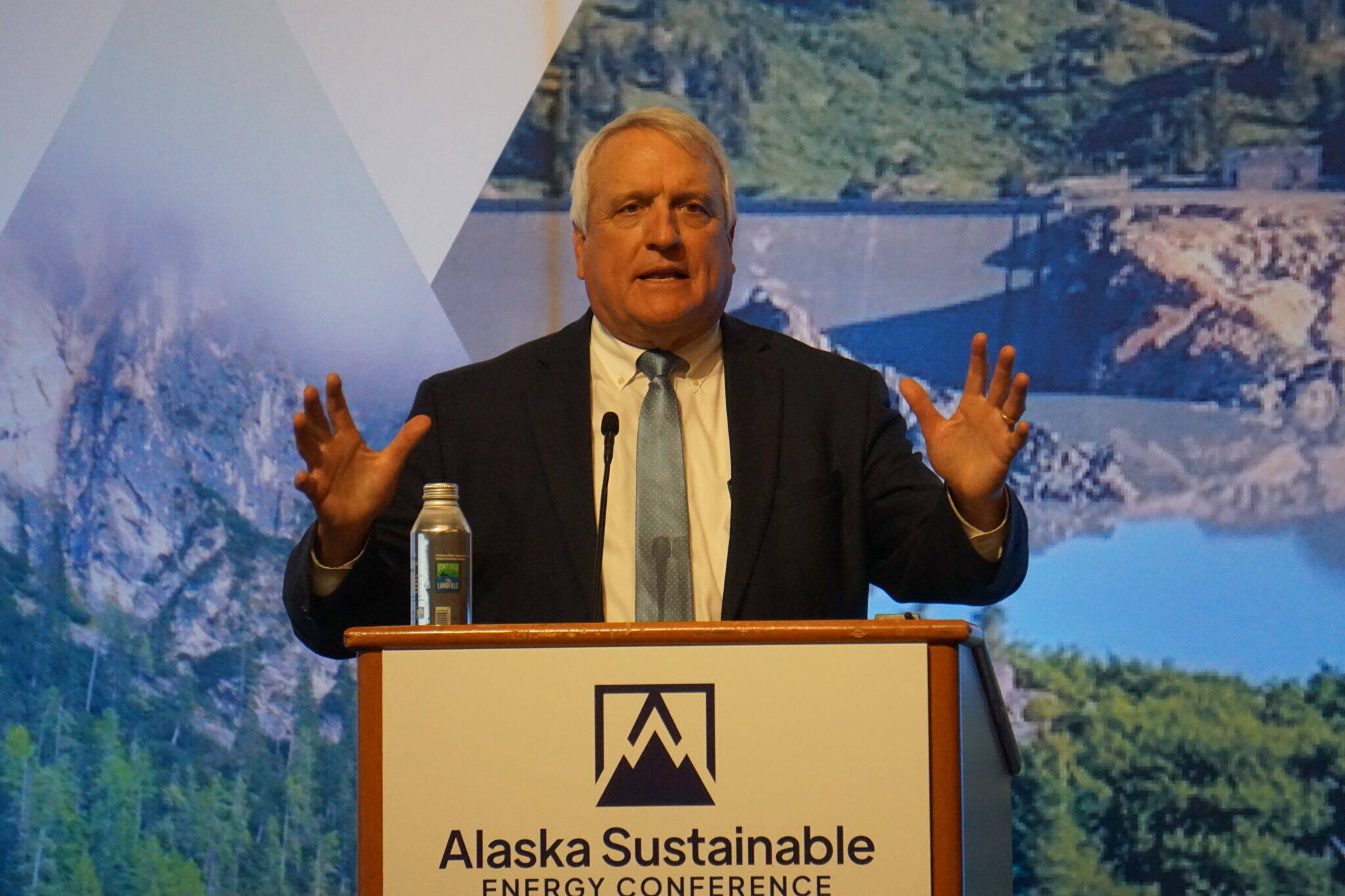
At the Alaska Sustainable Energy Conference, convened by Republican Gov. Mike Dunleavy, Ritter described the mission of the Center for the New Energy Economy that he founded at Colorado State University: building consensus among wide-ranging communities for the transition to a renewable energy future.
“I really believe that we should do this in a bipartisan way. I really believe that partisanship or political divides around managing our energy policy was such an awful thing to have happened to the United States,” Ritter said in his opening address at the three-day conference.
“If we don’t think of this in a bipartisan way, if we think of how do we talk to other sides of the aisle about that, we’re not going to get there,” he added.
Not everyone promoted bipartisanship
Some conference participants did not heed that message.
Rick Perry, in a recorded address, blasted President Biden and his administration for inflation, for “an energy crisis of epic proportions” and for the delay of a massive North Slope natural gas pipeline project that has been proposed since the 1970s – when it was approved by President Carter – but never built because of economics that have so far proven to be prohibitive.
He also took swipes at environmentalists. “What we need is to stop kowtowing the ESG-only crowd and the well-funded environmental lobby who are driving some in Washington to make policy choices that are harming families around this country,” he said, referring to the acronym for environmental, social and governance factors affecting investment decisions. And he predicted that “November will be a month of reckoning,” with angry voters providing a backlash.
Former Secretary of State Mike Pompeo, who spoke to the audience by teleconference, criticized climate “alarmists” and, more subtly, the Intergovernmental Panel on Climate Change, which said in its most recent report that there must be rapid, deep and immediate cuts to carbon emissions to avoid extreme danger. “Sign me up as someone who is not an alarmist but who is rational,” Pompeo said.
Alaska Sen. Dan Sullivan, who addressed the conference by video, was another Republican who criticized Biden. “It is frustrating working with this administration right now because from Day One, they have been focused on limiting the production of American energy, especially in our state,” he said.
States working on solutions
Ritter, after hearing the comments from Perry and Pompeo, said they have a different “framework” than he does.
“I think people who sometimes spend a lot of time at the federal level, like both the secretaries have, focus a bit on Washington, D.C., politics,” he said in a brief interview. “My own thing about solving this is, get away from Washington, D.C., and you really have a variety of states around the country that are finding solutions that are across party lines.”
Ritter expressed sympathy for the Biden administration, which has the challenge of balancing the need for climate action and environmental protection with the need for energy supplies in difficult geopolitical conditions.
“They’re very big on trying to solve for climate. But they also have to solve for reliability of energy systems in the European Union because of the Russian invasion,” Ritter said. “Those kind of tensions, it’s actually part of what leadership is about. It’s not about pointing fingers, it’s not about saying it’s their fault, not ours. It’s really about trying to take the tensions that exist inside of these big questions and resolve those in favor of doing both things.”
Opposition to natural gas
Outside of any partisan divides, some Alaska environmentalists took issue with what they said was an improper promotion of natural gas – itself a fossil fuel – as a bridge to a renewable future.
“There’s no role for natural gas in that transition. It’s a false solution,” said Matthew Jackson of the Southeast Alaska Conservation Council, one of the attendees – and one of the people who staged a quiet protest outside the Dena’ina Center on Tuesday, the conference’s opening day.
Overall, Jackson said, the conference provided a lot of useful and important information, but he was uncomfortable with many speakers’ embrace of natural gas. “They’re coming here, trying to sell us something instead of listening to local communities about what we need,” he said.
Pushback against natural gas as a climate-change solution goes beyond Alaska. In response to a European Union proposal to cast natural gas as “green,” along with nuclear energy, activists in Europe have launched a campaign called “Stop Fake Green.”
The debate about the role of natural gas played out on the speakers’ podium at the Anchorage conference as well.
Gas proponents advocate role
Ray Leonard, a senior adviser with Texas-based Linden Energy who gave a grim overview of climate change trends, promoted major natural gas development in Alaska as a way to get much of the world to switch from coal to natural gas.
The long-languishing plan for shipping stranded North Slope natural gas by pipeline “has always been a good project, but now is even more needed,” Leonard said. The alternative plan to commercialize North Slope natural gas, as proposed by a new company Qilak LNG, is another good strategy, he said. “If you can do it from Yamal in northern Siberia, you can certainly do it in Alaska,” he said.
Other speakers touted natural gas as feedstock for a switch to hydrogen energy, possibly through ammonia, a process being studied by others.
The Alaska Gasline Development Corp., the state entity promoting the latest proposal for a North Slope natural gas pipeline project, is incorporating that concept into its plan, said Brad Chastain, the organization’s project manager. National gas shipped by pipeline from the North Slope to Caook Inlet, as AGDC’s plan envisions, could be processed on the Kenai Peninsula, with carbon dioxide injected into the ground to be sequestered and other elements processed as hydrogen-bonding ammonia, he said.
Others see no long-term role for natural gas
But one keynote speaker, Silicon Valley entrepreneur, investor and author Tony Seba, characterized natural gas’ role in the energy transition as “none.”
“We have a big natural gas infrastructure now, and that’s going to live over the next five, seven, 10 years,” Seba said in response to a question during his presentation Thursday. By the 2030s and 2040s, natural gas will have only limited use, for fertilizers and some specialized industries, he said.
“Solar, wind and batteries are already cheaper than natural gas. Solar, plus four hours of storage, is already cheaper than the operating costs of a natural gas power plant. In the U.S. no one is building new natural gas power plants because just the operating costs are higher than solar and so on,” he said
“Yes, there is a market over the next 10 years, but I would not look beyond that. It’s not a role in the transformation per se. It’s a role in the existing system, which is going to go away,” he said.
Yereth Rosen came to Alaska in 1987 to work for the Anchorage Times. She has been reporting on Alaska news ever since, covering stories ranging from oil spills to sled-dog races. This article originally appeared online at alaskabeacon.com. Alaska Beacon, an affiliate of States Newsroom, is an independent, nonpartisan news organization focused on connecting Alaskans to their state government.
