
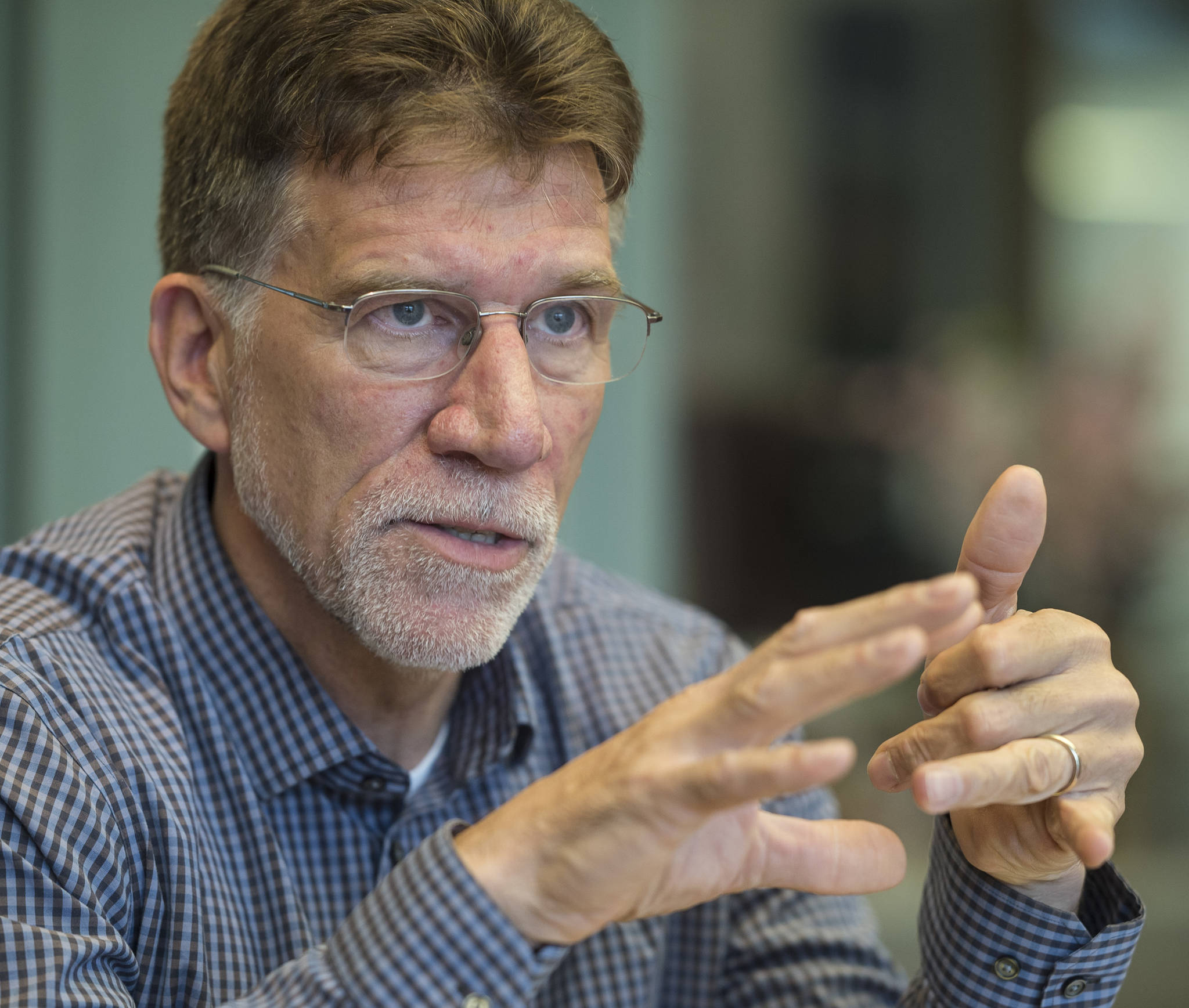
The University of Alaska Southeast starts classes on Aug. 27, and this will be the first year of a new Alaska College of Education.
For Steve Atwater, dean of the new college, the job isn’t like a pilot preparing for takeoff. It’s more like a pilot boarding a plane that’s already flying.
“Your airplane doesn’t stop flying and so we have to keep rolling out what we’re doing,” he said during a Friday interview with the Empire.
Summer might be the offseason for most students, but when you’re teaching teachers, you have to get to them during their “offseason.” During the school year, they’re too busy teaching to take classes of their own. That makes a busy summer for Atwater, who started in mid-July and is continuing programs even as he prepares an expanded teacher-training effort by the University of Alaska.
The college includes 15 faculty and staff at the Auke Lake campus, plus other faculty in Anchorage and Fairbanks.
Atwater, who moved from the University of Alaska Fairbanks to accept his new position, said Alaskans shouldn’t expect immediate changes in the way the university handles teacher education.
“There won’t be any immediate sense of change. You can’t shift gears as quickly as people think might happen,” he said.
When those gears do shift, University of Alaska President Jim Johnsen is hoping the changes will be big.
To understand the importance of the college, Johnsen (who was with Atwater on Friday) referred to a chart he showed to legislators. That chart indicated a direct correlation between a state’s average income and the proportion of the state’s population with a secondary degree.
Alaska was one of the few exceptions to that trend, but as the state’s mineral wealth is exhausted, Johnsen expects the state to fall in line. Where it stands in that line will depend on its education system, he argues.
“Unless we really increase educational attainment in the state, we’re not going to have a competitive economy,” he said Friday. “A critical part of the strategy is preparing our own teachers.”
Right now, school districts across the state hire between 700 and 800 teachers per year, according to figures provided by Johnsen and Atwater. That figure is high because many new teachers don’t last more than a year, particularly in rural Alaska.
That has huge implications. A 2017 study by the Institute for Social and Economic Research at the University of Alaska found teacher turnover costs districts $20 million per year on top of the effects it has on education. Students with new teachers typically have lower test scores.
“The good news is that University of Alaska-prepared teachers remain in the system,” Atwater said. “A teacher from Ohio comes up for a couple years — typically they don’t last.”
Right now, the University of Alaska trains fewer than 35 percent of the new-hired teachers in the state. Johnsen said his ultimate goal is to boost that to 90 percent or more.
Doing that requires increasing supply and lowering demand. If the new College of Education can train more teachers within Alaska, those teachers will remain on the job and reduce the need for replacements, what Atwater refers to as “crossing the lines.”
“We’re actually going to need, I think, around 500 (teachers) or so (per year),” he said.
The new college is a step toward that goal, and it’s one the university believes is important enough to spend money on. While the university’s budget has declined drastically in the past four years, the Alaska Legislature provided additional money this year, reversing the downward trend.
Some of that new money is going toward the college. The City and Borough of Juneau is also pitching in, having pledged $1 million in a successful effort to lure the institution from Fairbanks.
Above all else, Johnsen said the college is an important way to consider the future. Oil is becoming a less important part of Alaska’s economy, but no one knows what will replace it.
“Who knows what it’s going to be, but it’s not going to be anything without really smart people,” he said. “There’s no more important piece of this puzzle than teachers.”
• Contact reporter James Brooks at jbrooks@juneauempire.com or 523-2258.
