
Northern Southeast Regional Aquaculture Association has a few things on tap for 2018.
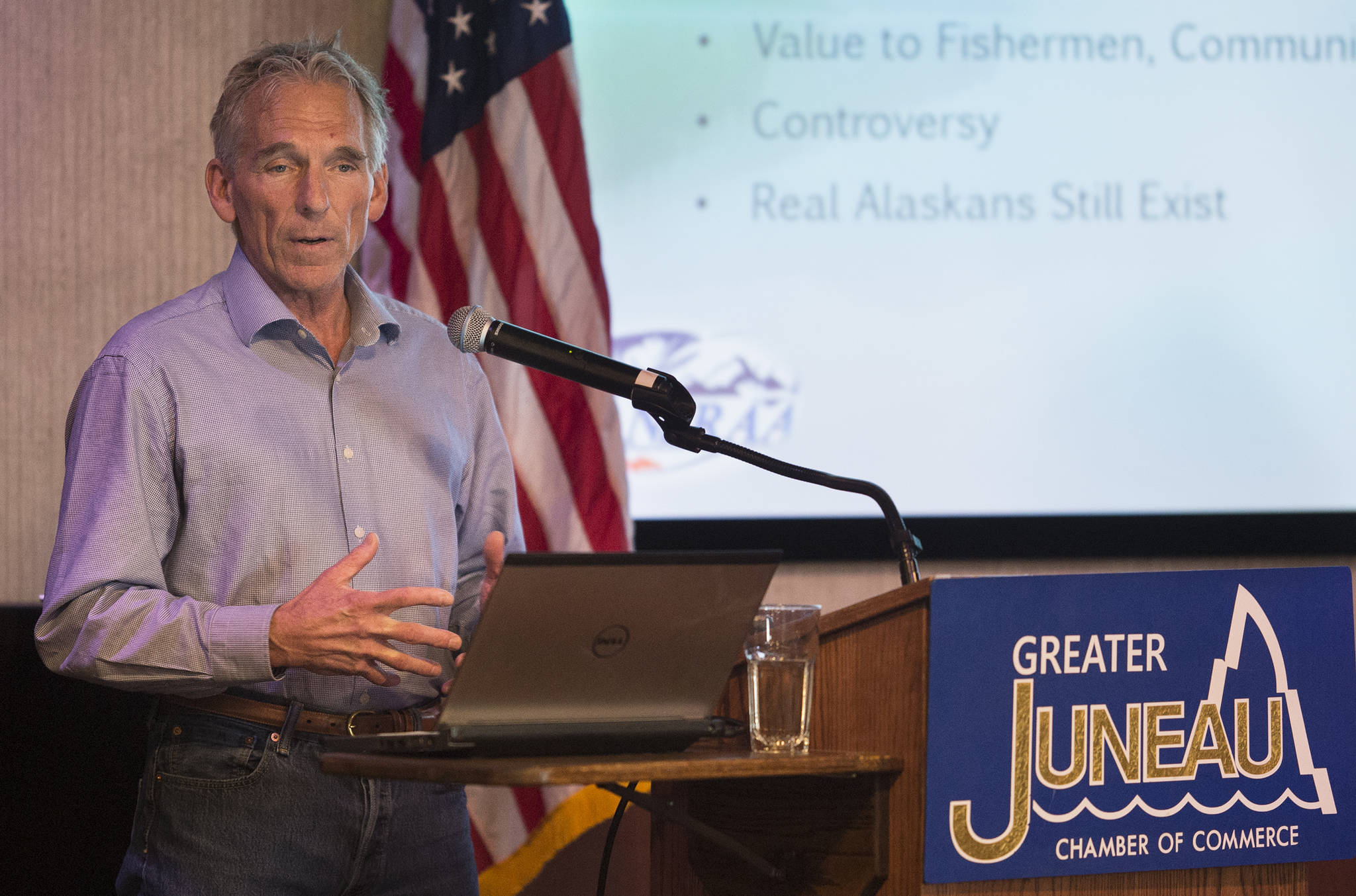
The private nonprofit, which operates hatcheries from Petersburg to Haines, is reopening a hatchery near Kake and working on science which could help them understand how to more efficiently raise Chinook, NSRAA General Manager Steve Reifenstuhl said at Thursday Chamber of Commerce Luncheon at the Hangar on the Wharf Ballroom.
The Gunnuk Creek Hatchery near Kake closed in the summer of 2014 after accruing $22 million in debt to the State of Alaska. It then fell into state hands, and NSRAA bought the hatchery through a bidding process last year.
Reifenstuhl said NSRAA plans to have salmon eggs at the hatchery by October, stocking it with supply from nearby Hidden Falls Hatchery on Baranof Island.
NSRAA will outfit the newly-refurbished hatchery with more efficient water-using technology, Reifenstuhl said. Instead of letting water flow through the hatchery system, like they do at most hatcheries, Gunnuk Creek will filter in water a little bit at a time. The new setup is a creature of necessity: the Gunnuk Creek site doesn’t have the volume of water to operate as a “single pass” hatchery like Macauley Salmon Hatchery in Juneau.
“Most hatcheries are pass through, so the water is captured, runs through a pipeline, comes into the hatchery with enough head that it drives it through the incubators. But it’s single pass,” Reifenstuhl explained. “We just don’t have enough water to do that” at Gunnuk Creek.
Hatcheries aren’t without controversy, Reifenstuhl said. Fish raised in hatcheries can stray from their habitat, ending up in other streams and crossbreeding with wild salmon. Reifenstuhl said NSRAA and its partners are about halfway through a research initiative aimed at answering how much hatchery salmon are creating a deleterious effect through crossbreeding.
It’s a $20-million effort begun seven years ago. Researchers backed by Alaska’s seven regional aquaculture boards and a group of fish processors have charted DNA from successive life cycles of pink and chum salmon in Alaska. Both those species make up the bulk of hatchery production in the state.
If hatchery salmon are breeding with wild salmon, researchers will be able to tell to what extent they’re affecting the gene pool. The studies require researchers study least two successive generations of salmon, so it’s still five years from wrapping up studies on both species. But Reifenstuhl did say he hopes to have results for the pink salmon portion of the study back by the end of 2019.
One audience member on Thursday asked if NSRAA has plans to help boost Southeast’s struggling Chinook stocks. Reifenstuhl said Chinook are finicky and time-consuming to rear in a hatchery. NSRAA is already rearing as many Chinook as they can, he said.
But they are looking to study two small populations of salmon which could help them more efficiently rear Chinook. It could lead to future Chinook hatchery production six times faster than current production models.
Reifenstuhl explained that most Chinook spend their year or so in brackish water, bulking up before venturing into the ocean. But two known Chinook stocks called “zero check” fish don’t do this. A proportion of Chinook on the Unuk River, near Ketchikan, and Situk River, near Yakutat, are zero check. Those fish go straight to the ocean, where they stay before several years before returning.
Zero check Chinook are about one-sixth the size of regular Chinook when they initially enter the marine environment, Reifenstuhl said, but survive to spawn anyway. Reifenstuhl said NSRAA is currently trying to understand more about what makes zero-check Chinook tick: what kind of environment do they like and what sets them apart from other Chinook.
Hypothetically, he said, rearing only zero-check Chinook might allow NSRAA to produce six Chinook cycles a summer instead of just one. Chinook weigh about 20-25 grams at release, he said, while zero-check Chinook are only about four grams.
“If they’re only four grams at release, instead of a million, we can do six million,” Reifenstuhl said.
