
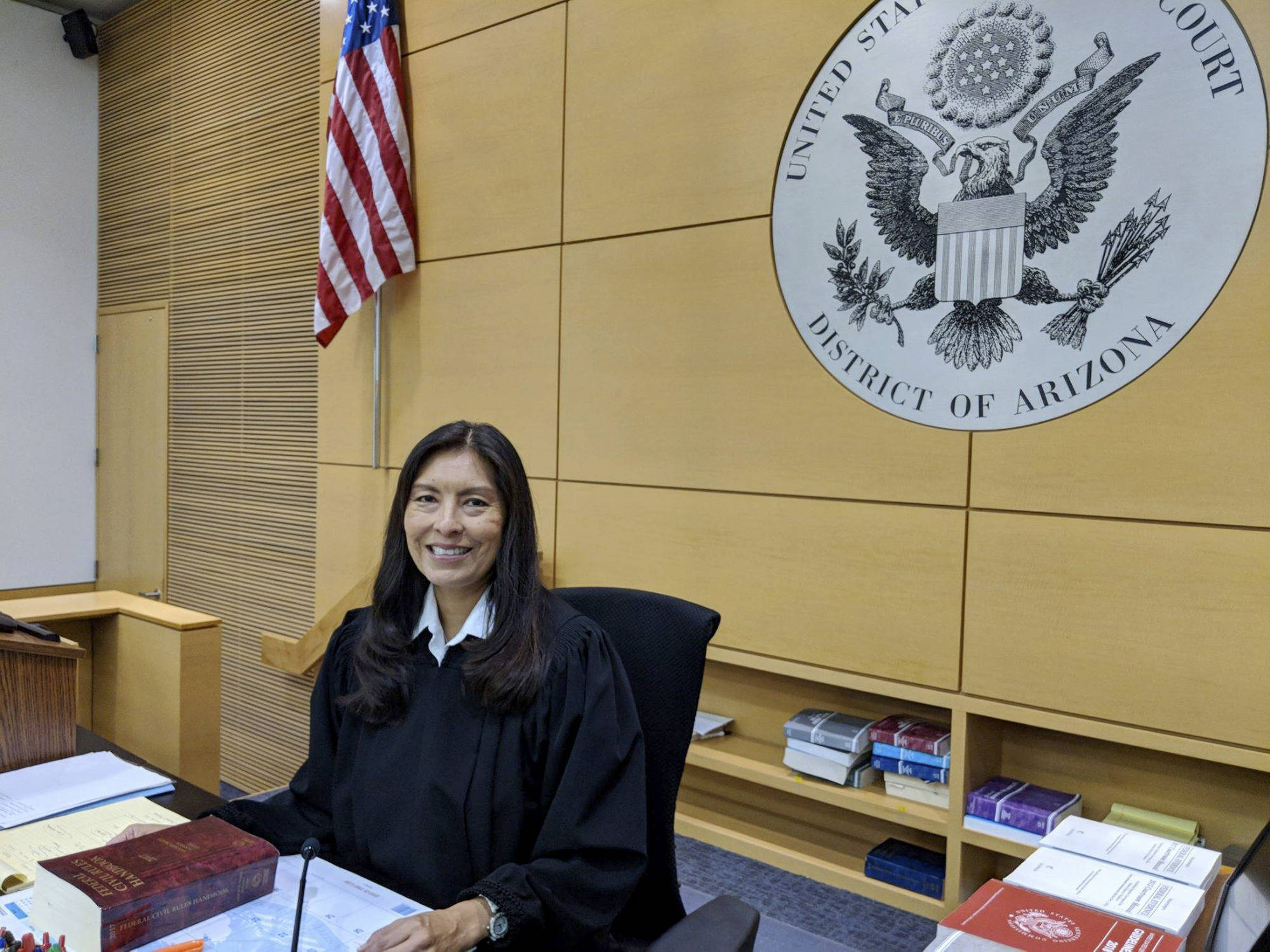
There are 870 federal judges in the United States. Two are Native American: one in Arizona, and one in the Eastern District Court of Oklahoma. No American Indians or Alaska Natives serve on any of the nation’s federal appeals courts. Or the U.S. Supreme Court.
That works out to 0.229%, or less than one-quarter of 1%.
But even that number requires an asterisk because one of the judges is Frank H. Seay, Cherokee, who took senior status in 2003 and has been inactive for many years, Indian Country Today reported.
A recent review by the Center for American Progress, a liberal policy group, found a lack of female judges, judges of color and judges self-identifying as LGBTQ throughout America’s “Article III” courts, which include its top court, nearly 100 federal courts and more than a dozen federal appeals courts.
That’s unfortunate because “judges from different backgrounds and with different life experiences bring their unique and invaluable perspectives to bear on the cases that come before them,” the center said. “For litigants, diversity on the federal bench offers real, substantive benefits, including fairer judicial decisions.”
“I don’t focus on it,” said Judge Diane Humetewa, Hopi, with the U.S. District Court of Arizona. “I focus primarily on the job I’m here to do. But at the same time, studies like the one that came out remind me of how there is a lack of diversity.”
When she was nominated by President Barack Obama in 2013, then later confirmed unanimously by the Senate, she was shocked to learn the historical significance as she would be the first Native American woman to ever serve as a federal judge. All article III judges are nominated by the president and confirmed by the Senate.
“Being female and Native American, people aren’t used to seeing us as lawyers, at least when I was practicing back in the ’90s,” she said.
Humetewa said Native American judges are particularly needed in states with large Native populations.
“It gives the community the perception that people that they see on the district court reflect their community and some familiarity with the environment,” she said.
And during her time as a prosecutor for Arizona’s U.S. attorney’s office, she discovered how she was different from her peers.
“I noticed none of the other prosecutors used to visit tribal lands,” she said. “My belief was you can’t do your job appropriately if you don’t go to the area where the event happened and not meet with the people.”
Before she worked as a prosecutor at the U.S. attorney’s office in Arizona, she was a victims advocate there. Her peers noticed her ability to establish a rapport and communicate well with Native crime victims, so they urged her to apply to law school.
“I have that level of familiarity that other people have to learn about,” Humetewa said.
She said despite the low numbers of American Indian judges, the data is improving considering the 2010 U.S. Census found American Indians make up only 1.7% of the national population. Native American youths in many places also are just beginning to attend college, while other demographics have generations of family members who are lawyers, she said.
“It’s going to take an amount of time,” she said. “I think it’s a natural progression of what we’re seeing.”
Humetewa also said her journey to the U.S. district court wasn’t a sudden occurrence.
“A lot of people overlook the fact that I’ve been a lawyer before I got the nomination. I was practicing law for 20 years,” she said.
She recommends that Native Americans who want to be part of the judicial system gain experience with federal cases and court practices.
“In my view, Native people who are interested in these kinds of positions eventually have to have in-depth experience in practicing federal courts (and) at least some familiarity in state positions to the extent of state judgeships,” she said.
She mentions that the selecting of federal judges is political, too.
“Sadly if you don’t have the right political affiliations, that is going to be a detriment to any Native American person if they are of the wrong political stripe,” she said.
John Echohawk, executive director of the nonprofit Native American Rights Fund, which provides legal assistance to Indian tribes, organizations and individuals, agrees that the political scene is one obstacle Native Americans face in joining the judiciary field.
“We just need to keep recruiting and keep educating young law students coming up about the need, and hope for the best. Everyone is working on it,” he said.
One initiative the Native American Rights Fund is part of is the Federal Judicial Selection Project, developed by tribal leaders in 2001. It was created to educate the federal judiciary about tribal laws and vice versa.
“These programs are ongoing and hopefully will produce some results,” Echohawk said.
According to the Federal Judicial Center, only three Native Americans have been federal judges in history. Michael Burrage, Choctaw, was confirmed in 1994 and served on the bench in Oklahoma until 2001, when he returned to private practice.
Echohawk noted Native Americans in law are increasing, but gradually.
“From the time I was in law school, 50 years ago, we had 25 Native American attorneys who were able to be identified nationally, now we have over 2,500 Native American lawyers,” he said.
The Center for American Progress found that as of late 2019, people of color made up 20% of sitting judges and 27% of active judges in the nation’s federal courts. Of those, African Americans made up 10% of sitting judges and 13% of active judges, Hispanics 7% and 9%, and Asian Americans 2.5% and 4%.
“Active judges of color comprise at least half of the bench on only 13 district courts — 14%. Just one district court — the District Court of Puerto Rico — entirely comprises judges of color.”
Women made up 27% of sitting judges and about 33% of active judges.
At the appellate court level, although people of color comprise roughly 40% of the U.S. general population, they made up just 17% of sitting circuit court judges and 23% of active judges.
“There is not a single circuit court where judges of color comprise more than 36% of the bench, and the 7th Circuit has no judges of color at all,” the report said.
• This is an Indian Country Today report bt Kalle Benallie shared by the Associated Press.
