
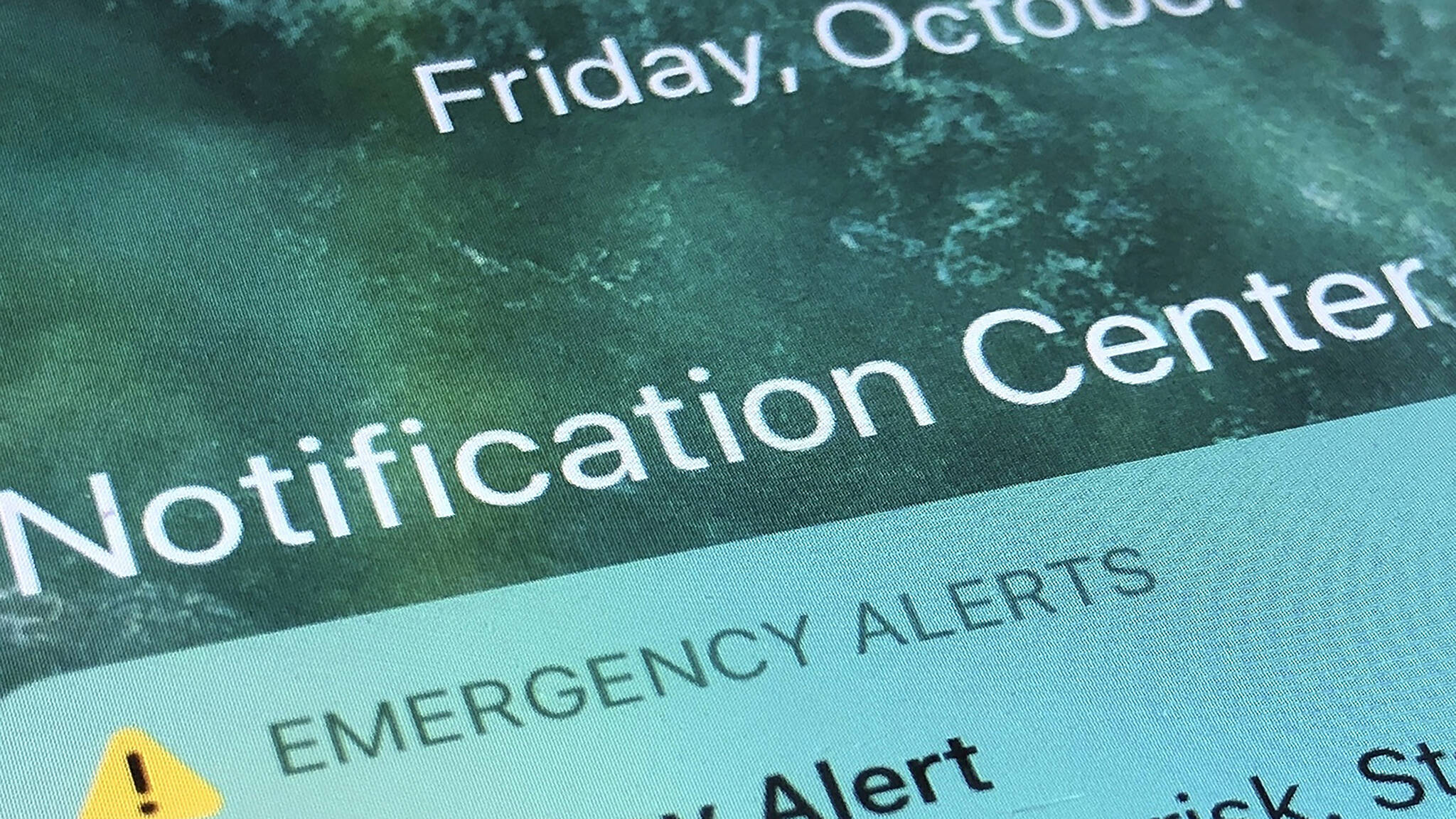
An emergency alert is displayed on a cellphone, Oct. 30, 2020, in Rio Rancho, N.M. (AP Photo/Susan Montoya Bryan, File)

An emergency alert is displayed on a cellphone, Oct. 30, 2020, in Rio Rancho, N.M. (AP Photo/Susan Montoya Bryan, File)

Nationwide emergency alert test to hit cellphones and TVs starting at 10:20 a.m. Wednesday

People scheduled to get an alert during a 30-minute window.

  • By Rebecaa Santana Associated Press
  • Wednesday, October 4, 2023 8:39am
  • News

“THIS IS A TEST”: If you have a cellphone or are watching television Wednesday, that message will flash across your screen as the federal government tests its emergency alert system used to tell people about emergencies.

The Integrated Public Alert and Warning System sends out messages via the Emergency Alert System and Wireless Emergency Alerts.

The Emergency Alert System is a national public warning system that’s designed to allow the president to speak to the American people within 10 minutes during a national emergency via specific outlets such as radio and television. And Wireless Emergency Alerts are short messages — 360 characters or less — that go to mobile phones to alert their owner to important information.

While these types of alerts are frequently used in targeted areas to alert people in the area to thing like tornadoes, Wednesday’s test is being done across the country.

The test is slated to start at 10:20 p.m. Alaska Time on Wednesday. Wireless phone customers in the United States whose phones are on will get a message saying: “THIS IS A TEST of the National Wireless Emergency Alert System. No action is needed.” The incoming message will also make a noise and the phone should vibrate.

Customers whose phones are set to the Spanish language will get the message in Spanish.

The test will be conducted over a 30-minute window started at 10:20 p.m., although mobile phone owners would only get the message once. If their phones are turned off at 10:20 p.m. and then turned on in the next 30 minutes, they’ll get the message when they turn their phones back on. If they turn their phones on after the 30 minutes have expired they will not get the message.

People watching broadcast or cable television or listening to the radio will hear and see a message lasting one minute that says: “This is a nationwide test of the Emergency Alert System, issued by the Federal Emergency Management Agency, covering the United States from 14:20 to 14:50 hours ET. This is only a test. No action is required by the public.”

Federal law requires the systems be tested at least once every three years. The last nationwide test was Aug. 11, 2021.

The test has spurred falsehoods on social media that it’s part of a plot to send a signal to cellphones nationwide in order to activate nanoparticles such as graphene oxide that have been introduced into people’s bodies. Experts and FEMA officials have dismissed those claims but some social media say they’ll shut off their cellphones Wednesday.

More in News

The northern lights are seen from the North Douglas launch ramp late Monday, Jan. 19. A magnetic storm caused unusually bright northern lights Monday evening and into Tuesday morning. (Chloe Anderson/Juneau Empire)
Rare geomagnetic storm causes powerful aurora display in Juneau

The northern lights were on full display Monday evening.

teaser
Juneau activists ask Murkowski to take action against ICE

A small group of protesters attended a rally and discussion on Wednesday.

Cars pass down Egan Drive near the Fred Meyer intersection Thursday morning. (Clarise Larson / Juneau Empire file photo)
Safety changes planned for Fred Meyer intersection

DOTPF meeting set for Feb. 18 changes to Egan Drive and Yandukin intersection.

Herbert River and Herbert Glacier are pictured on Nov. 16, 2025. (Mari Kanagy / Juneau Empire)
Forest Service drops Herbert Glacier cabin plans, proposes trail reroute and scenic overlook instead

The Tongass National Forest has proposed shelving long-discussed plans to build a… Continue reading

A tsunami is not expected after a 4.4-magnitude earthquake northwest of Anchorage Wednesday, Feb. 4, 2026. (U.S. Geological Survey)
No tsunami expected after 4.4-magnitude earthquake in Alaska

U.S. Geological Survey says 179 people reported feeling the earthquake.

ORCA Adaptive Snowsports Program staff member Izzy Barnwell shows a man how to use the bi-ski. (SAIL courtesy photo)
Adaptive snow sports demo slides to Eaglecrest

Southeast Alaska Independent Living will be hosting Learn to Adapt Day on Feb. 21.

Cars drive aboard the Alaska Marine Highway System ferry Hubbard on June 25, 2023, in Haines. (Photo by James Brooks)
Alaska’s ferry system could run out of funding this summer due to ‘federal chaos problem’

A shift in state funding could help, but a big gap likely remains unless a key federal grant is issued.

Photo by James Brooks/Alaska Beacon
U.S. Sen. Dan Sullivan stands with acting Coast Guard Commandant Adm. Kevin Lunday during the after the commissioning ceremony for the Coast Guard icebreaker Storis on Sunday, Aug. 10, 2025, in Juneau, Alaska.
Coast Guard’s new Juneau base may not be complete until 2029, commandant says

Top Coast Guard officer says he is considering whether to base four new icebreakers in Alaska.

Students from the Tlingit Culture Language and Literacy program at Harborview Elementary School dance in front of elders during a program meeting in 2023. (Clarise Larson / Juneau Empire file photo)
Sealaska adds more free Tlingit language courses

The new course is one of many Tlingit language courses offered for free throughout the community.

Most Read