
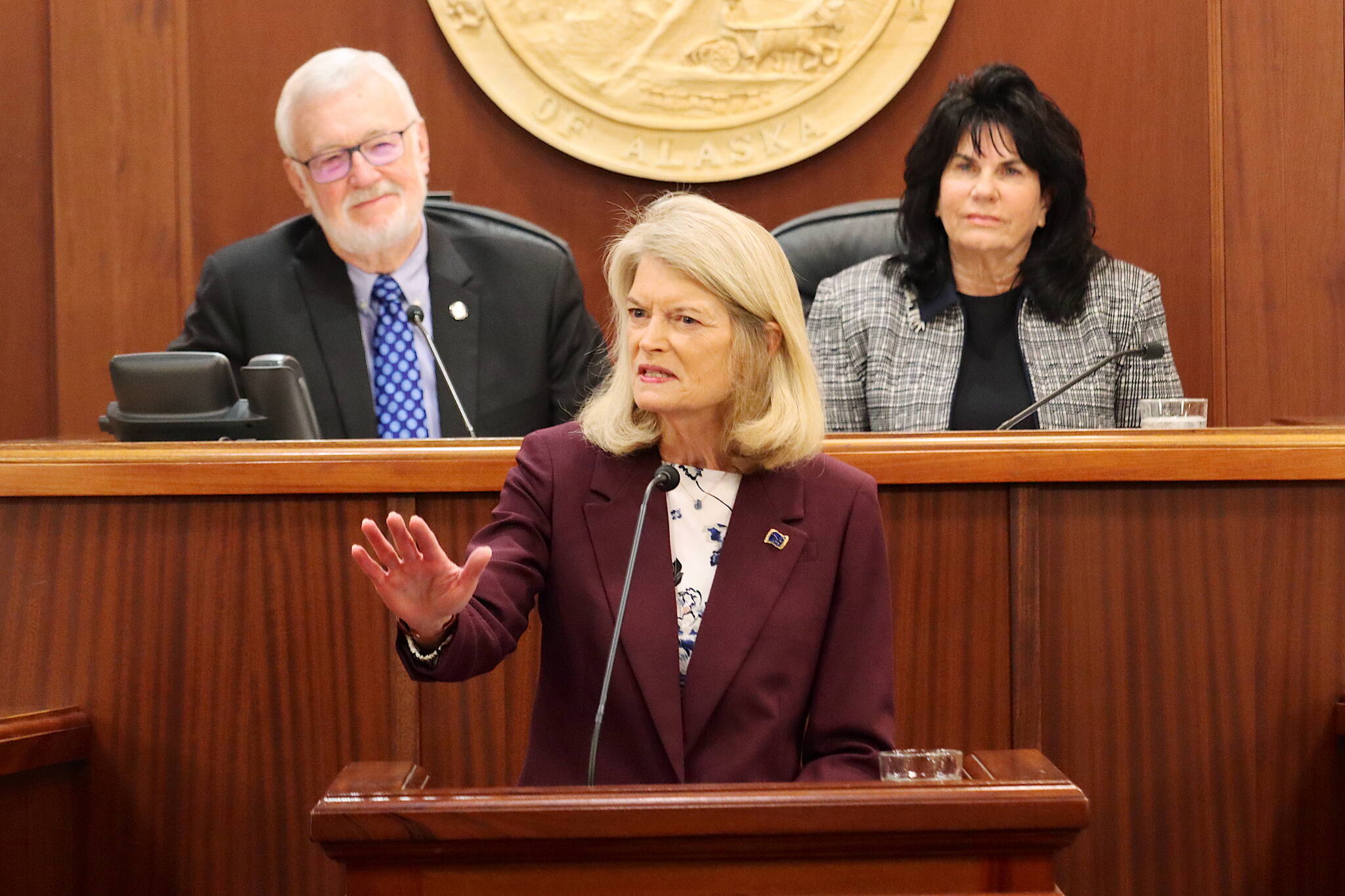
Denouncing both presumptive U.S. presidential candidates as well as actions by Congress during an election year, U.S. Sen. Lisa Murkowski delivered an annual address to the Alaska Legislature she acknowledged was “a downer in some places.”
But while she also noted Alaska is behind the rest of the country on issues such as housing, child care and education, she devoted much of her speech to ways the state is dealing with adversity and taking promising steps toward the future.
“When you step back and look at things there’s a lot going well in our state right now,” she said during the speech and subsequent question-and-answer period with state lawmakers that lasted more than an hour.
However, “all of this comes at the front end of a divisive presidential election year, with two deeply flawed candidates set to lead their party tickets at a time when Congress is more inclined to kick the can than solve our nation’s problems,” she said.
Later, toward the end of her speech, she added “as the elections approach there’s going to be pressure to show whether you’re with the Republicans or the Democrats, with little in-between. So let’s show the country that sure, we have our differences, but we can figure out ways to work through them by working together and putting Alaska ahead of all else.”
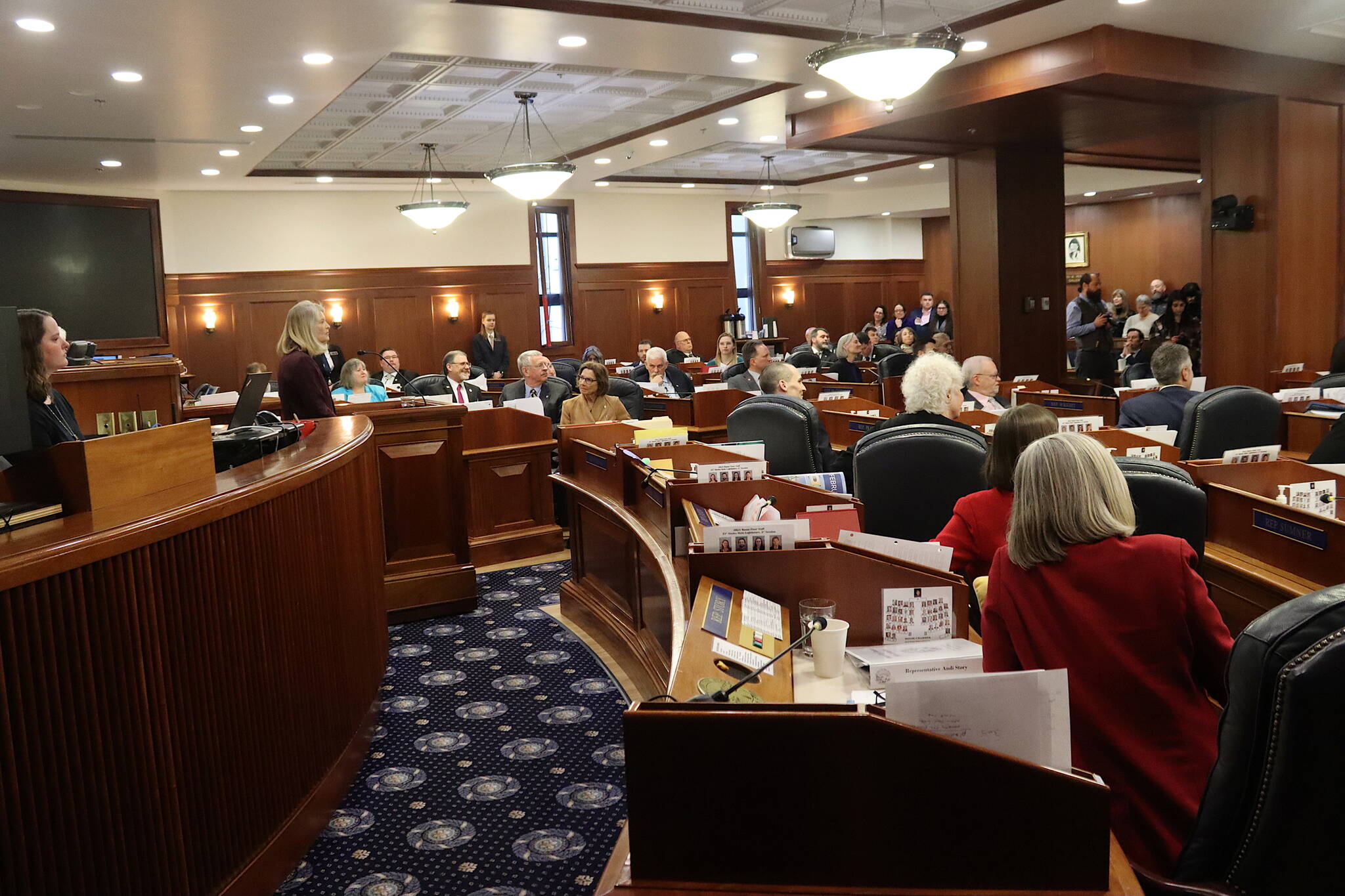
U.S. Sen. Lisa Murkowski introduces members of her staff in the audience gallery during her annual speech to the Alaska Legislature on Thursday. (Mark Sabbatini / Juneau Empire)
Tourism is at pre-pandemic levels, the $7.2 billion for Alaska so far under the bipartisan infrastructure law is the most per-capita of any state, and work that started during the past year on the Willow and Pikka oil fields on the North Slope are prime examples, Murkowski said.
“ConocoPhillips is hiring 1,800 people this winter for its construction activities at Willow,” she said. “Santos is hiring more than 2,400 on the North Slope this season. That’s over 4,000 in total that we’re talking about here. When was the last time we could point to numbers like that for anything in our state?”
Furthermore, “forecasts show we are on track to add thousands more jobs, mostly from major projects, in the next few years,” Murkowski said.
But as with many subjects she discussed, there were negative as well as positive words about the workforce situation.
“Everything I’ve mentioned requires workers, and we’re at 11 straight years and counting with a net loss of working-age Alaskans,” Murkowski said. “Quality of life is everything, but inflation has made everything cost more (and) high interest rates add insult to injury. We’re behind on housing, we’re behind on childcare, we’re behind on education.”
Similarly, she said some positive actions have occurred with fisheries during the past year, such as the U.S. closing loopholes in sanctions “that allow Russia to dump its overharvested seafood into our markets” — an action all three members of Alaska’s congressional delegation lobbied heavily for. On the other hand, there is great concern about “the unequivocally bad state of so many of our fisheries.”
“The ‘absence of abundance’ is threatening subsistence, commercial and recreational fishing alike,” she said. “Fish racks hang empty on the Yukon and Kuskokwim. The processing industry is undergoing a wave of consolidation. Outside groups are attempting to shut down entire fisheries and attempting to list the king salmon as endangered.”
Murkowski, as she has often the past couple of years, emphasized the need for state lawmakers to make the most of federal funding by providing state matching funds or taking other necessary steps. But this year the Alaska Marine Highway System — which last year she said was in a “death spiral” — went largely unmentioned in her speech other than calling it “revitalized” thanks to $416 million in federal funds for vessel and infrastructure upgrades.
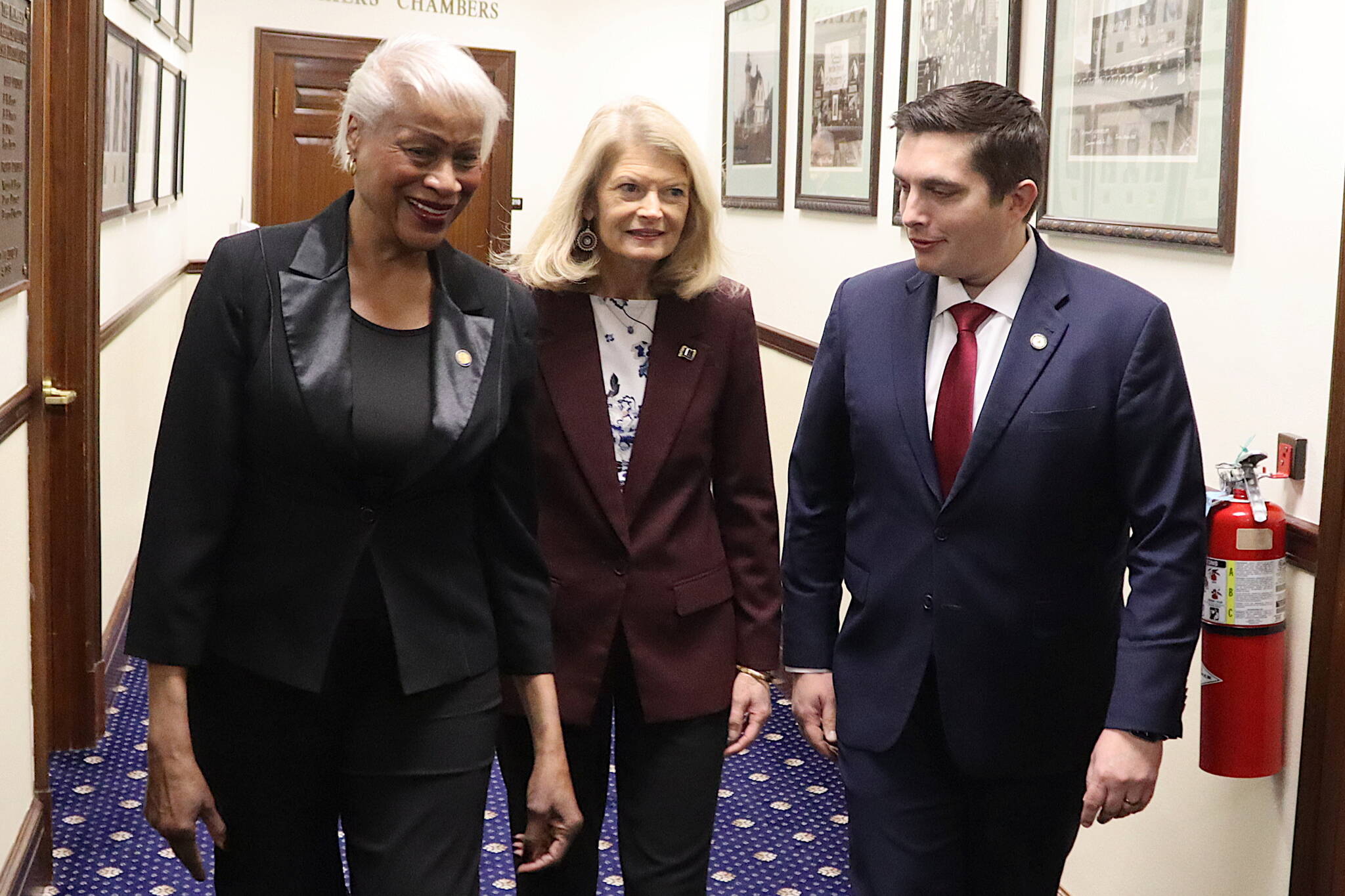
State Sen. Elvi Gray-Jackson (left) and Rep. Justin Ruffridge escort U.S. Sen. Lisa Murkowski to the House Chambers for her annual speech to the Alaska Legislature on Thursday. (Mark Sabbatini / Juneau Empire)
In an interview after her speech, Murkowski said it appears the state is meeting the match requirements she sought for ferries. That includes Gov. Mike Dunleavy’s first-ever use of “toll credits” — essentially passenger fees — which she called “creative” and said at present aren’t raising any red flags with federal transportation officials she has talked to.
The legality of using ferry revenues for such purposes has previously been questioned by some officials, and state Department of Transportation and Public Facilities Commissioner Ryan Anderson said Thursday that federal approval of such use is still pending.
However, Murkowski did single out other programs she cited as crucial where the state is failing to take full advantage of available funds.
“We’re not taking good enough care of those struggling with hunger, mental health, or homelessness, either — roughly 40% percent of the funds I secured for Alaska to help homeless kids in school, through the American Rescue Plan, have not yet been spent,” she said.
Hot-button national issues such as the recent debate on border security legislation that failed were also cited by Murkowski in her speech.
“The bill was not perfect,” she said. “That’s what the process is for. It allows us to bring bills to the floor, and debate it and amend it. We could have improved our failing border policies, but instead we locked them in for the rest of the year and potentially well beyond.”
Similarly, she touted the Senate’s passage of a bill on Tuesday providing security assistance for Ukraine, Israel and Taiwan.
“It helps our allies and it sends a strong message to our enemies, and it’s also crucial to reinforce our domestic defense base,” she said. “But it’s also months late and faces resistance in the House of Representatives.”
Murkowski said “during what has been a pretty unproductive Congress so far, I’m focusing on legislative solutions for Alaska — and looking for every window of opportunity I can find.” Among a number of specific issues such as food security programs and overcoming the housing shortage in remote communities, she mentioned the landslide in Wrangell last Nov 20 that killed six people and cut off many residents from road access to town.
“As the people in Haines and Sitka can attest, these 100-year events are seemingly now happening every few years and taking the lives of Alaskans,” she said. “Our communities need to be protected and anxious residents need reassurance. It’s going to take time to build out data and forecasting, but we’re underway. I’ve reintroduced my earthquake preparedness bill, another to reauthorize landslide monitoring and will continue to secure federal funds to directly meet these needs.”
During a press conference after her speech, Murkowski cited a number of specific problems she has with both Joe Biden and Donald Trump as the presumptive presidential nominees, and is holding out hope “a stunning come-from-behind” effort is possible by Republican challenger Nikki Haley.
“She is a strong figure who has proven herself and her abilities, and could lead this country well,” the senator said.
Murkowski was also asked about the federal government’s rejection of the State Transportation Improvement Program (STIP) for 2024-27 due to a lengthy list of compliance and other faults, putting billions of dollars of projects at risk beginning next month. Alaska is the only state facing such a dilemma.
Murkowski said she was meeting with Dunleavy on Thursday afternoon and, among other topics, she planned to emphasize the need to focus on resolving the deficiencies cited by the federal government by a March 1 deadline so the STIP can be reconsidered, rather than seeking to assign blame.
“I’m going to urge him this is not a time to say ‘It’s the Biden administration and they’re just out to get us,” she said. “There’s too much on the line right now. These federal dollars are hugely significant.”
• Contact Mark Sabbatini at mark.sabbatini@juneauempire.com or (907) 957-2306.
