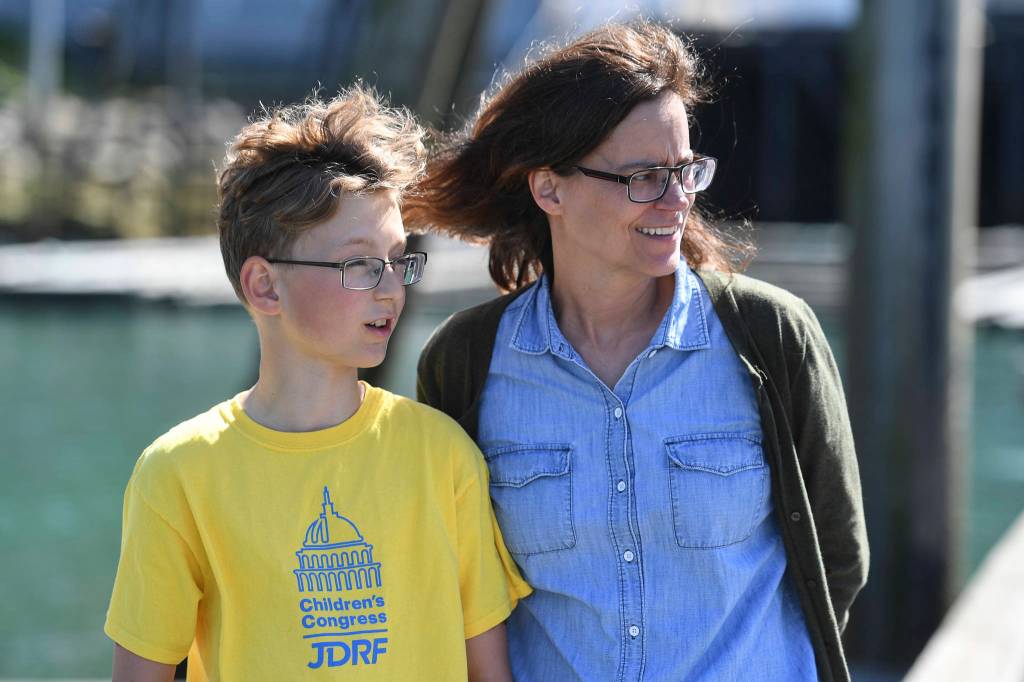
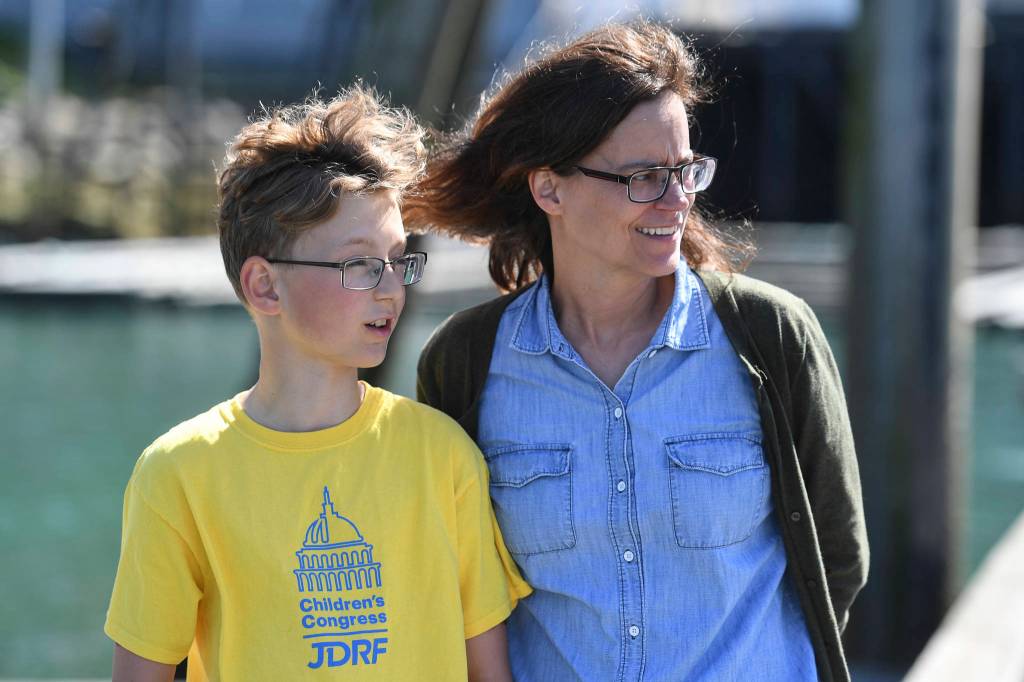
<strong>Photos by Michael Penn</strong> | Juneau Empire                                Bruno Malecha and his mother, Jen, watch people fish at the Wayside Park on Channel Drive on Tuesday. Bruno, who has Type 1 diabetes, will be traveling to Washington, D.C., this summer to lobby members of Congress to support diabetes research.

Photos by Michael Penn | Juneau Empire Bruno Malecha and his mother, Jen, watch people fish at the Wayside Park on Channel Drive on Tuesday. Bruno, who has Type 1 diabetes, will be traveling to Washington, D.C., this summer to lobby members of Congress to support diabetes research.

Mr. Malecha goes to Washington: Local with Type 1 diabetes advocates for research funding

He wants everyone to have what he has

Bruno Malecha is going to Washington, D.C. because he wants other youths with Type 1 diabetes to live the same way he does.

Malecha, 12, was diagnosed with Type 1 diabetes — a disease that means the body does not produce insulin — when he was 1 year old. While diabetes means Malecha needs to be aware of what he eats and his activity level, he told the Empire he is fortunate to be covered by health insurance and have access to medical equipment that allow the Scout to do things like go on overnight camping trips or join his mother, Jen, on lengthy hikes.

“I’m pretty lucky with my diabetes,” Malecha said. “I’ve got good management.”

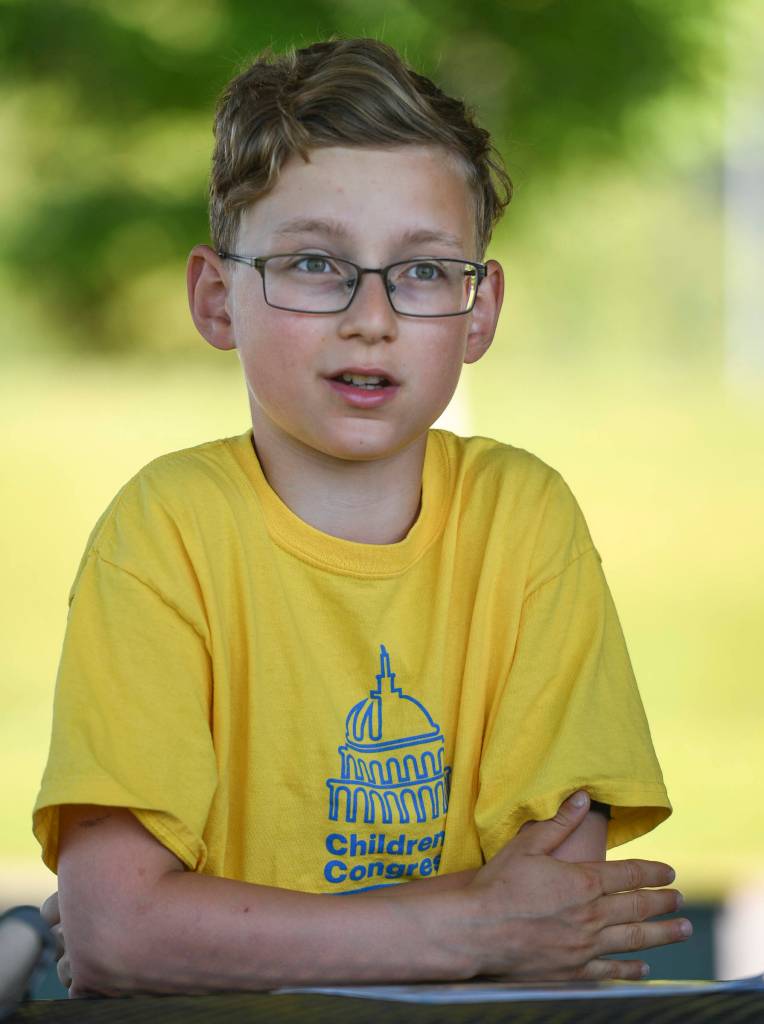
Bruno Malecha, 12, speaks about living with Type 1 diabetes on Tuesday, June 25, 2019. Bruno will be traveling to Washington, D.C., this summer to lobby members of Congress to support diabetes research. (Michael Penn | Juneau Empire)

Bruno Malecha, 12, speaks about living with Type 1 diabetes on Tuesday, June 25, 2019. Bruno will be traveling to Washington, D.C., this summer to lobby members of Congress to support diabetes research. (Michael Penn | Juneau Empire)

But he knows not everyone has access to the care and equipment he does, so he applied to be part of the JDRF 2019 Children’s Congress. Every two years about 160 children with Type 1 diabetes lobby the adult Congress to renew the Special Diabetes Program.

[Robbery suspect kicks cane away from teen, steals purse]

“They give money to companies to develop existing technologies and create new ones,” Malecha said.

The Special Diabetes program was created 1997, according to the organization formerly known as Juvenile Diabetes Research Foundation and now simply known by its initials. The program typically receives bipartisan support. It was last renewed for two years in 2018 at $150 million per year.

The Children’s Congress allows youths with Type 1 Diabetes to tell lawmakers about how the autoimmune disease affects their lives.

Jen Malecha, who is also an impassioned advocate for diabetes research, said technological advancement spurred by the program is part of the reason her son can live and enjoy the life he has.

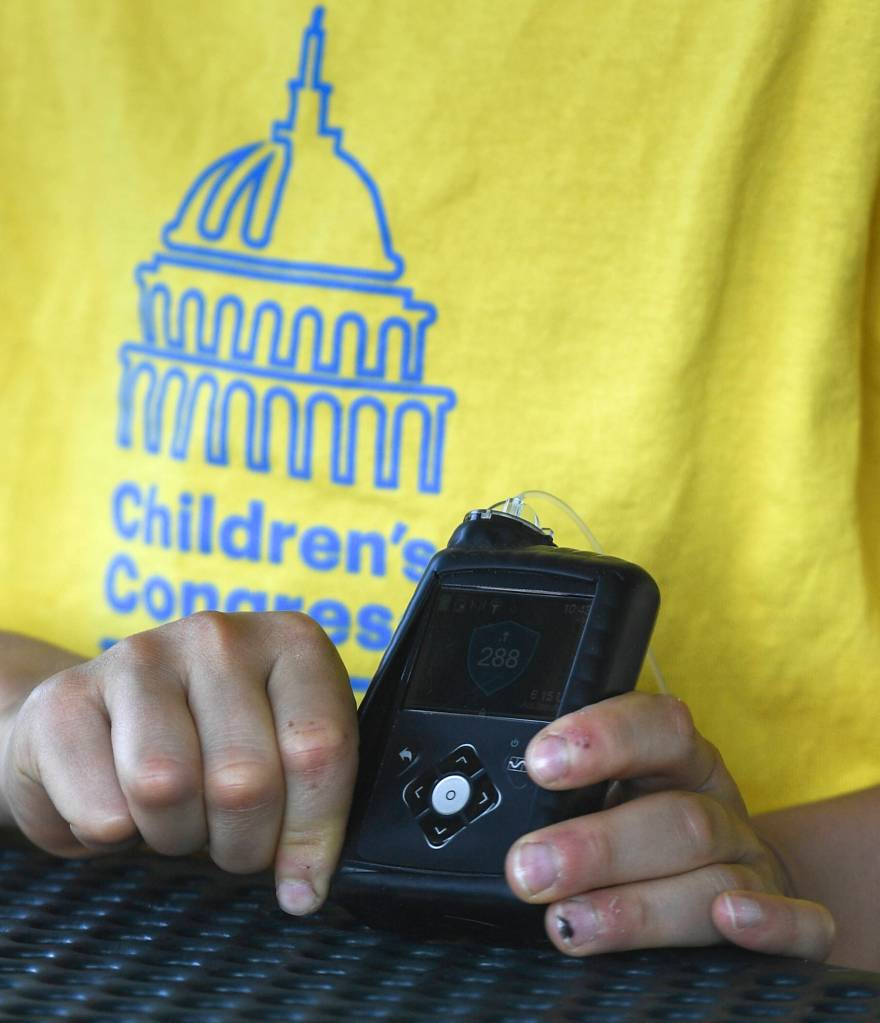
For the past year, Bruno Malecha has used a continuous glucose monitoring system that works with an insulin pump, and the relatively new device has increased the quality of life for everyone in the Malecha family.

“It adjusts Bruno’s insulin based on his real-time glucose numbers instead of us constantly checking his blood sugar and deciding if we should give him more insulin,” Jen Malecha said.

Bruno Malecha uses a continuous glucose monitoring system that works with an insulin pump to use real-time data to decide when to administer glucose and the size of the dose. “It adjusts Bruno’s insulin based on his real-time glucose numbers instead of us constantly checking his blood sugar and deciding if we should give him more insulin,” said his mom, Jen Malecha. (Michael Penn | Juneau Empire)

Bruno Malecha uses a continuous glucose monitoring system that works with an insulin pump to use real-time data to decide when to administer glucose and the size of the dose. “It adjusts Bruno’s insulin based on his real-time glucose numbers instead of us constantly checking his blood sugar and deciding if we should give him more insulin,” said his mom, Jen Malecha. (Michael Penn | Juneau Empire)

She said it’s the closest thing to an artificial pancreas that is available to people with diabetes.

“It’s a huge step, and it’s made a huge difference in his life,” Jen Malecha said. “All three of us sleep so much better at night. We used to check him several times throughout the night and now we rarely have to check him at night.”

Bruno said he appreciates having a device that eases the burden of having to make hundreds of daily decisions about what he eats or does.

[Something déjà vu, there’s a lot new at Rendevous]

The Malechas feel strongly that similar peace of mind, or at least life-saving medicine, should be available to everyone with diabetes.

Jen Malecha said she has been advocating for the Special Diabetes Program since shortly after her son’s diagnosis, but this is the first time Bruno will be part of the JDRF Children’s Congress.

Bruno Malecha said knowing that people have died because they were rationing their insulin because of its cost was a main motivating factor in his decision to participate in the Children’s Congress.

“We just feel like insulin should not be that expensive,” Jen Malecha said. “It’s a really, really old drug. People are dying and suffering because of it.”


• Contact reporter Ben Hohenstatt at (907)523-2243 or bhohenstatt@juneauempire.com. Follow him on Twitter at @BenHohenstatt.


More in News

The northern lights are seen from the North Douglas launch ramp late Monday, Jan. 19. A magnetic storm caused unusually bright northern lights Monday evening and into Tuesday morning. (Chloe Anderson/Juneau Empire)
Rare geomagnetic storm causes powerful aurora display in Juneau

The northern lights were on full display Monday evening.

A tsunami is not expected after a 4.4-magnitude earthquake northwest of Anchorage Wednesday, Feb. 4, 2026. (U.S. Geological Survey)
No tsunami expected after 4.4-magnitude earthquake in Alaska

U.S. Geological Survey says 179 people reported feeling the earthquake.

ORCA Adaptive Snowsports Program staff member Izzy Barnwell shows a man how to use the bi-ski. (SAIL courtesy photo)
Adaptive snow sports demo slides to Eaglecrest

Southeast Alaska Independent Living will be hosting Learn to Adapt Day on Feb. 21.

Cars drive aboard the Alaska Marine Highway System ferry Hubbard on June 25, 2023, in Haines. (Photo by James Brooks)
Alaska’s ferry system could run out of funding this summer due to ‘federal chaos problem’

A shift in state funding could help, but a big gap likely remains unless a key federal grant is issued.

Photo by James Brooks/Alaska Beacon
U.S. Sen. Dan Sullivan stands with acting Coast Guard Commandant Adm. Kevin Lunday during the after the commissioning ceremony for the Coast Guard icebreaker Storis on Sunday, Aug. 10, 2025, in Juneau, Alaska.
Coast Guard’s new Juneau base may not be complete until 2029, commandant says

Top Coast Guard officer says he is considering whether to base four new icebreakers in Alaska.

Students from the Tlingit Culture Language and Literacy program at Harborview Elementary School dance in front of elders during a program meeting in 2023. (Clarise Larson / Juneau Empire file photo)
Sealaska adds more free Tlingit language courses

The new course is one of many Tlingit language courses offered for free throughout the community.

teaser
New Juneau exhibition explores art as a function of cultural continuity

“Gestures of Our Rebel Bodies” will remain on display at Aan Hít through May.

teaser
Juneau protestors urge lawmakers to defund Homeland Security after Minneapolis killings

Hundreds gathered hours before congressional delegation voted on whether to extend ICE funding.

Kyle Khaayák'w Worl competes in the two-foot high kick at the 2020 Traditional Games. (Courtesy Photo / Sealaska Heritage Institute)
Registration opens for 2026 Traditional Games in Juneau

The ninth annual event will feature a college and career fair and international guest athletes.

Most Read