
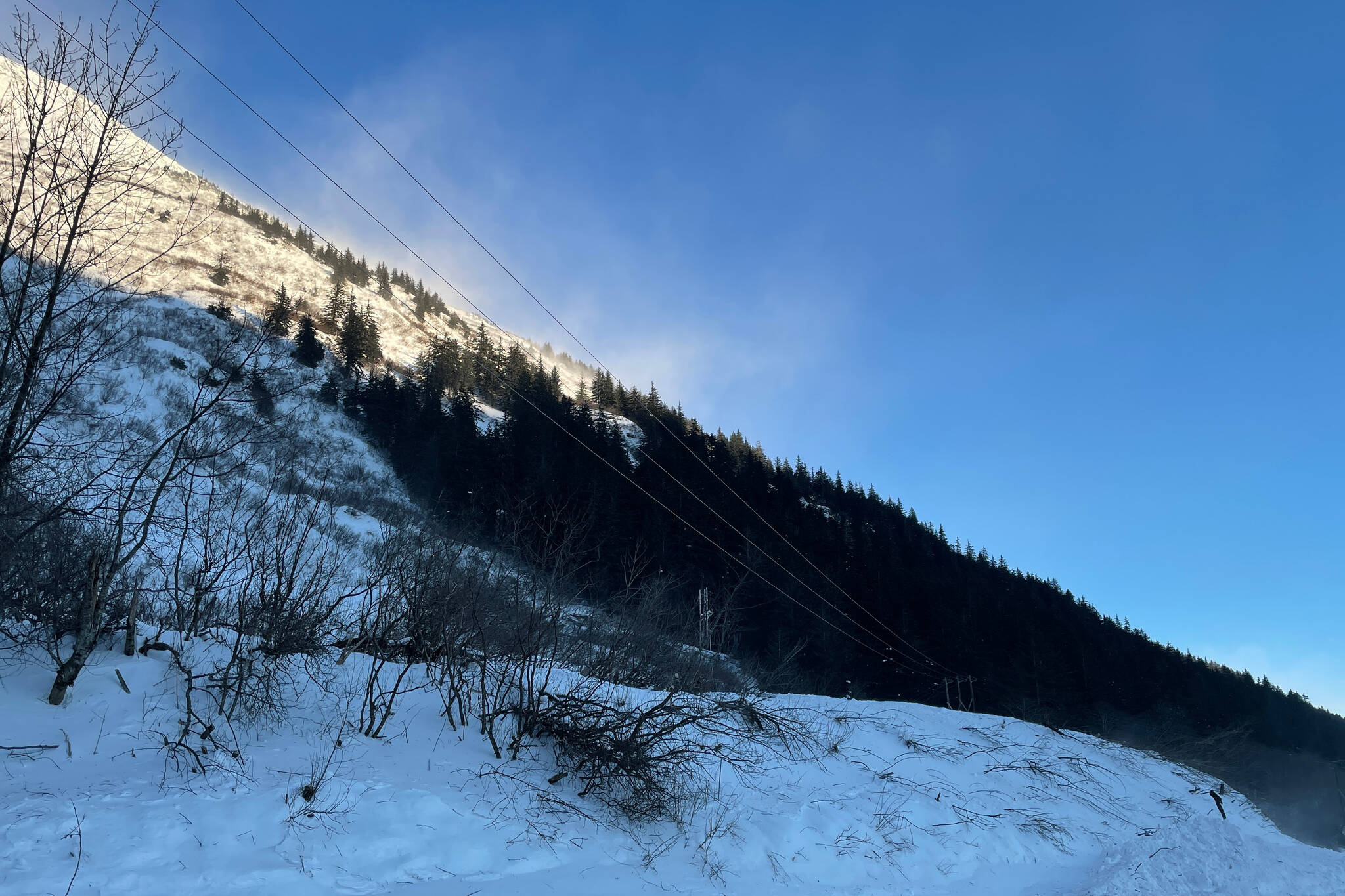
As the bitter boreal cold slightly abates early next week, Juneau residents may be able to look forward to some of the snow adorning the city melting off.
That might come as a relief to some of Juneau’s residents less enamored of the winter wonderland. For the snowpacks crowning the mountains ringing Juneau, it’s a bit more complicated, said the city emergency program manager Tom Mattice.
“Warming through storm cycles is never good. When you transition from below freezing to above freezing during a storm, that’s not good,” Mattice said in a phone interview. “We will probably see avalanches. A lot of that depends on how high the rain line goes.”
[Don’t get tagged: It’s time to register your dog]
However, in the longer term, many other signs are positive, said Mike Janes, avalanche forecaster for Alaska Electric Light and Power.
“We’re in better shape in a lot of ways because it’s been staying cold, and we haven’t had a lot of thaws coming in to create a bunch of layers,” Janes said in a phone interview. “In general we don’t have a lot of long-lived weak layers like we did last year.”
Steady snow without long periods of clear, cold weather has kept the pack fairly structurally sound throughout without the critically weak layers that might otherwise form, Mattice said.
“When you have a consistent snowpack that keeps snowing and snowing and snowing you get a fairly strong snowpack,” Mattice said. “We have a fairly homogeneous snowpack.”
There’s also considerably less snow at higher altitude than there was last year during the period of greatest concern about the possibility of an urban avalanche, Mattice said, when the snowpack was about 11 feet deep. While Juneau residents at sea level might be soldiering through a winter of high snow and cold temperatures, a lot of the precipitation that falls on sea-level Juneau as rain and higher elevations as rain didn’t happen this year.
“We’re at about 170 cm (approximately 5 1/2 feet) if you average Eaglecrest and Mount Roberts,” Mattice said. “The full season snowpack is not nearly where we were last year.”
A number of areas, including Thane, Behrends Avenue, Thunder Mountain, Douglas and other chutes in the greater Juneau area saw avalanches in the last week or so, Mattice said, many propelled by high winds.
“It takes more than 3 feet of snow, closer to 4 feet of snow, to come down and hit houses,” Mattice said. “The other day, Thane had an avalanche that hit the road, crossed the road. Even in one single storm event combined with wind loading, you can get enough snow to hit houses.”
However, those small avalanches may prepare the slopes for larger avalanche events in the future, Mattice said, as they grease the way, covering rugged terrain whose abrasiveness kills off a lot of momentum from the avalanche.
“We have a lot of snow at lower levels. A lot of years, that terrain below 800 feet acts as a cheese grater, eating a lot of snow,” Mattice said. “When you have a lot of snow at sea level you have the ability to create longer, faster avalanches.”
While AEL&P and the Alaska Department of Transportation and Public Facilities both have the capability to go out and disrupt the snowpack, creating smaller avalanches to mitigate risk, the timing isn’t always right, Janes said. The risk of an avalanche from a storm like the New Year’s Eve storm isn’t something that could be bled out before the storm hit, Janes said — going out and using the Daisybell or throwing explosives on the snowpack would have been ineffective.
“You have to time your mitigation for the right time and sometimes there’s not an opportunity till after the storm,” Janes said.
Small avalanches around town have eased pressure in some places, but not others, Mattice said.
“Just because you took away some danger in some areas doesn’t mean it’s not lingering,” Mattice said.
• Contact reporter Michael S. Lockett at (757) 621-1197 or mlockett@juneauempire.com.
