
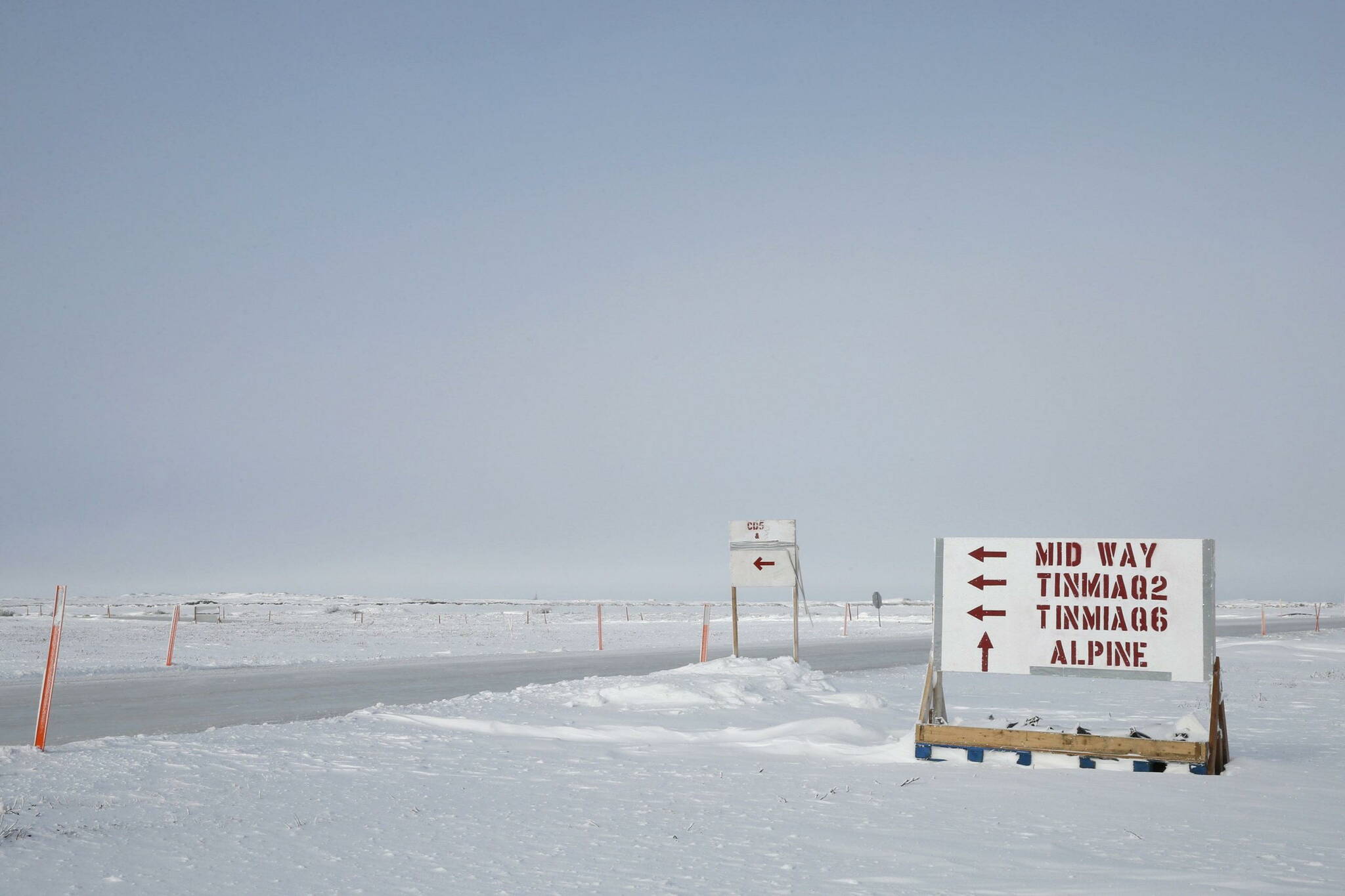
Contrary to what headlines and tweets might imply, the Willow oil field hasn’t overcome all of its obstacles yet and the North Slope isn’t completely closed off to further oil drilling as a result of two landmark decisions announced Monday by President Joe Biden.
Also, despite the promise of future riches Alaska is likely to see a net loss of revenue during the first several years of the Willow project due to the state’s oil tax laws, according to analysts and officials.
All that said, the Willow approval was heralded as a huge win and restrictions on future Arctic oil activity amid a huge loss for drilling advocates (and vice-versa for opponents worried about climate impacts). But there are a lot of “what’s next” questions.
The next questions for Willow — the largest new project in two decades — are how quickly already-promised lawsuits to stop the project are filed, how long resolving them takes and if ConocoPhillips as the developer prevails when the first oil from the planned 30-year project is extracted.
“So much of it depends on how long this is going to drag through the courts,” U.S. Sen. Lisa Murkowski, a Republican, said in an interview Monday.
But given what she sees as a solid application by ConocoPhillips and its response to issues previously raised in court “I think we’re going to be in a position where we’re going to see Conoco bringing up first oil in a just matter of a few years.”
“They’ve got an aggressive schedule and they’ve been teeing this up for five years, so it’s not like they’ve got to start thinking about how they’re going to access this,” she said.
As for the new restrictions banning Arctic oil drilling offshore and in several parts of the National Petroleum Reserve-Alaska, the questions are if any projects under current consideration will be affected and if unannounced future projects truly will be off-limits — especially since the ban could be overturned by another administration as has happened in past years.
Murkowski acknowledged the last Arctic offshore activity in Alaska was by Shell PLC in 2007 and “it’s not as if companies are lining up to be prospective up there.” But while Willow is being allowed to proceed since ConocoPhillips already holds the leases to the sites, and other projects that have initiated the permitting process may continue as well, the senator said
“There’s always something lost when you have the federal government taking off the table the opportunity in the future to advance any kind of exploration or production activities,” she said. Beyond that “what I am concerned about is there are valid existing leases that are in the NPR-A that have been bought up over the years. Will this special protection, these proposed rules impact any of them? We don’t know that and that’s why we’ve got to look critically at what this proposed rule is all about.”
Gov. Mike Dunleavy, who has filed multiple lawsuits against the federal government and is seeking millions of dollars more for future “statehood defense” purposes in next year’s state budget, said during a media call Monday he will discuss the possibility of a legal challenge to the ban this week with members of his administration.
“Right now we’re studying exactly what is proposed to take place, what is predicted to take place in the future and to see if we’re going to have whatever plan of action, if any, we’re going to undertake,” he said.
Responding to a follow-up question, Dunleavy said part of the issue is “where does the authority lie for this, or are we at a point in country’s situation where a president can just declare something off the table.”
Major changes and reversals in drilling policy have occurred during previous presidential administrations, such as Barack Obama authorizing fossil fuel extraction in up to 52% of the NPR-A, Donald Trump increasing that to 82% and Biden last year reverting to the level set by Obama. Similarly, efforts to approve drilling in the Arctic National Wildlife Refuge that began in the 1970s were finally successful under Trump in 2017, but halted by Biden on his first day in office in 2021.
Supporters of the $8 billion Willow project claim it will generate up to 2,500 construction jobs, about 300 permanent jobs during its 30-year lifespan, and billions of dollars in royalty payments and tax revenue to governments. But analysts assert — and officials acknowledge — the state government will actually lose money during the first several years of production because the project is on federal land and the state therefore gets no production royalties.
Instead those royalties are split between the federal government and the North Slope Borough, which is projected to receive about $1.2 billion in addition to property taxes from the development — although those funds for the region are also are likely many years away.
“I realize some of the ramifications may be way into the future before we actually realize a positive cash flow on it, but I think it’s the right thing to go ahead and do it,” state Sen. Donny Olson, a Golovin Democrat who represents the region, told the Alaska Beacon.
The state is expected to eventually collect several billion dollars in production taxes during the life of the project. A 2019 estimate by the state Department of Natural Resources of $5 billion to $9 billion is based on oil prices of $60 a barrel, although the Beacon reported a new estimated is being drafted.
Dunleavy said production from Willow will extend the life of the Alaska Pipeline and ensure production levels remain sustainable as existing fields continue to go through a long-term slow decline.
“It’s a risky and chaotic future that I think most of us are staring at as a result of some of the decisions made on the national level, but nevertheless we believe there is a benefit to the state of Alaska with Willow,” he said.
It’s important to “think about the other impacts that the state will see,” including the construction and operating jobs, Murkowski said.
“Those are the direct jobs,” she said. “We’re not even talking about the indirect jobs and opportunities that will come.”
Revenue from Willow will also provide funding for critical needs in North Slope Borough communities, as well as the eventual wider impacts statewide, Murkowski said.
“It’s a little bit less to the state, but it’s still extraordinary benefits overall,” she said.
• Contact reporter Mark Sabbatini at mark.sabbatini@juneauempire.com
