
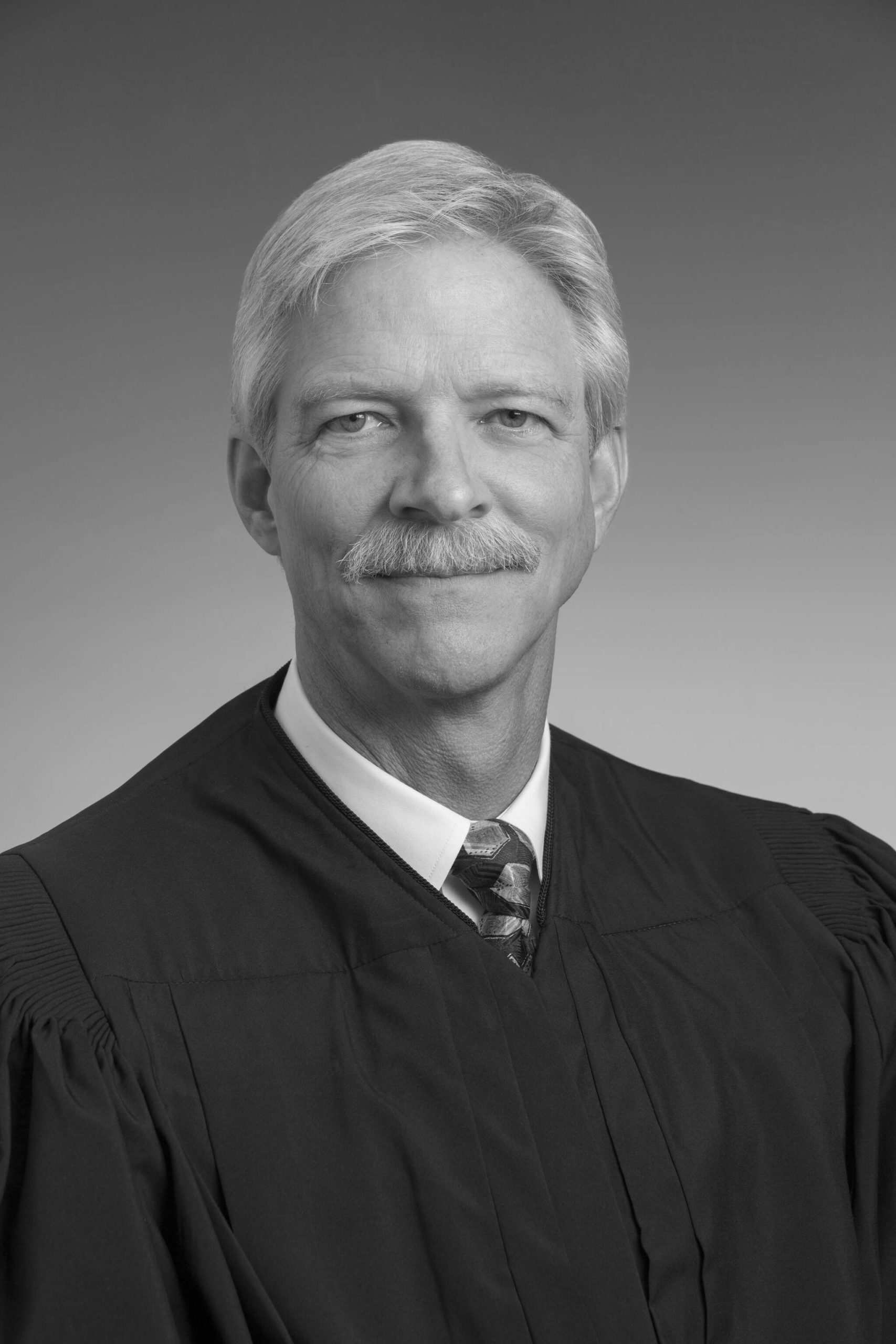
Peter Maassen has been selected as the next chief justice of the Alaska Supreme Court by his fellow justices, putting a magistrate who’s spent most of his 40-year legal career in private practice at the pinnacle of the state’s judicial branch after a decade on the bench.
The appointment announced by the Alaska Court System on Tuesday is scheduled to take effect Feb. 7, 2023, the day after current Chief Justice Daniel E. Winfree’s planned retirement at the end his three-year term as chief and 15 years on the Supreme Court. Maassen was appointed to the court in 2012 by Republican Gov. Sean Parnell, but the justice’s record – including being part of a ruling invalidating a law requiring doctors to notify parents of minor children seeking abortions – has at times irked conservatives.
Maassen, in an interview Tuesday, said his immediate reaction after being selected was a mix of gratefulness and anticipation.
“I guess gratitude for the confidence of my colleagues and feeling a huge responsibility, and I hope I’m up to it,” he said.
The state Supreme Court has taken on some high-profile and controversial cases related to matters such as elections and the COVID-19 pandemic during Winfree’s tenure as chief justice, but Maassen said he doesn’t expect he will preside over a court that differs much in its approach and docket.
“I would say every election season sees a few high-profile cases,” said Maassen, whose tenure will span any lingering issues from the just-completed ranked choice election to beyond the 2024 election. But overall “most of the cases we have don’t have nearly the run of the mill (in controversies) as those in the U.S. Supreme Court.”
Maassen said the biggest difference between himself and Winfree is probably their upbringings.
“I think the unique thing about Justice Winfree is he’s a homegrown Alaskan,” Maassen said. “Definitely a Fairbanks boy, born and raised. I don’t have those roots.”
But Maassen and Winfree are similar in their judicial careers, having worked long in private practice before being appointed to the court, and Maassen said he believes his approach will be similar.
Maassen, who grew up and graduated from law school in Michigan before moving to Alaska in 1981, spent all but two years in private practice in Anchorage before his appointment to the state Supreme Court. In his retention election in 2016, he wrote about experiencing a steep learning curve because “I was immediately immersed in substantive areas of the law in which I had little experience: particularly criminal, domestic relations, and child-in-need-of-aid cases.”
In his interview Tuesday, the new chief justice said “I don’t think the learning curve is going to be as steep going from justice to chief justice and that’s because we have a great (courts) administration.”
The justice got high scores in the Alaska Judicial Council’s 2016 retention survey, getting an average rating of 4.6 out of five from attorneys and 4.8 from court employees, roughly equal to scores for the court’s other justices. Attorneys rated him highest for integrity (4.8), and lowest for legal ability and diligence (4.6). On scores by case types his lowest rating from attorneys was for criminal matters (between 4.2 and 4.4) and highest for “other” (not civil and/or criminal, with scores between 4.8 and 5).
Maassen stated “I greatly enjoy the writing process” in his retention evaluation, but “only wish it went more quickly.”
“I try to write opinions that are readable and clear, and I think I’m succeeding for the most part,” he wrote. “Essentially, I hope to maintain throughout my career the court’s existing high standards of fairness, personal integrity, and the clarity of judicial reasoning.”
His retention was opposed in 2016 by Alaska Family Action due to his part in a ruling invalidating a law requiring doctors to notify parents of minor children seeking abortions, which the judicial council and other legal entities expressed concern about due to the potential to politicize future rulings by judges. He was retained with 57.47% of the vote.
Maassen was also part of a 3-2 majority in a notable Alaska Native child support case in early 2016, upholding a Superior Court ruling that a woman who moved to a rural Alaska village to pursue a subsistence lifestyle must continue to pay child support at the same rate as when she was employed by a pipeline company in Anchorage.
A study analyzing judicial partisanship published by Ballotpedia in 2020 gave Maassen an “indeterminate” rating, noting his appointment by a Republican governor via the state’s hybrid judicial nominating commission, and his contributing a total of $1,050 to Democratic candidates and organizations.
In addition to his time in private practice, Maassen spent two years working for the General Counsel’s Office of the U.S. Department of Commerce and for a law firm with a federal administrative practice in Washington, D.C. He also served as editor-in-chief of the Alaska Bar Rag (the official publication of the Alaska Bar Association) from 1994-2000, was a member of the Board of Governors from 2009-2012, and served for 10 years on the board of the Anchorage Youth Court.
Alaska’s judicial selection process is designed to be less partisan than national and many other states by requiring the governor to select a judge from a list approved by the seven-member judicial council, which includes three members of the Alaska Bar Association, three public members appointed by the governor and the chief justice. Gov. Mike Dunleavy refused to follow the process to fill vacancy on Palmer Superior Court bench in 2019, saying the list sent to him was inadequate, which became part of an unsuccessful recall effort.
Supreme Court justices serve 10-year renewable terms, although their first retention election must occur during the regularly scheduled statewide election following their first three years in office. The current Supreme Court consists of four justices appointed by Republican governors (two by Dunleavy) and one by independent former Gov. Bill Walker.
• Contact Mark Sabbatini at mark.sabbatini@juneauempire.com
