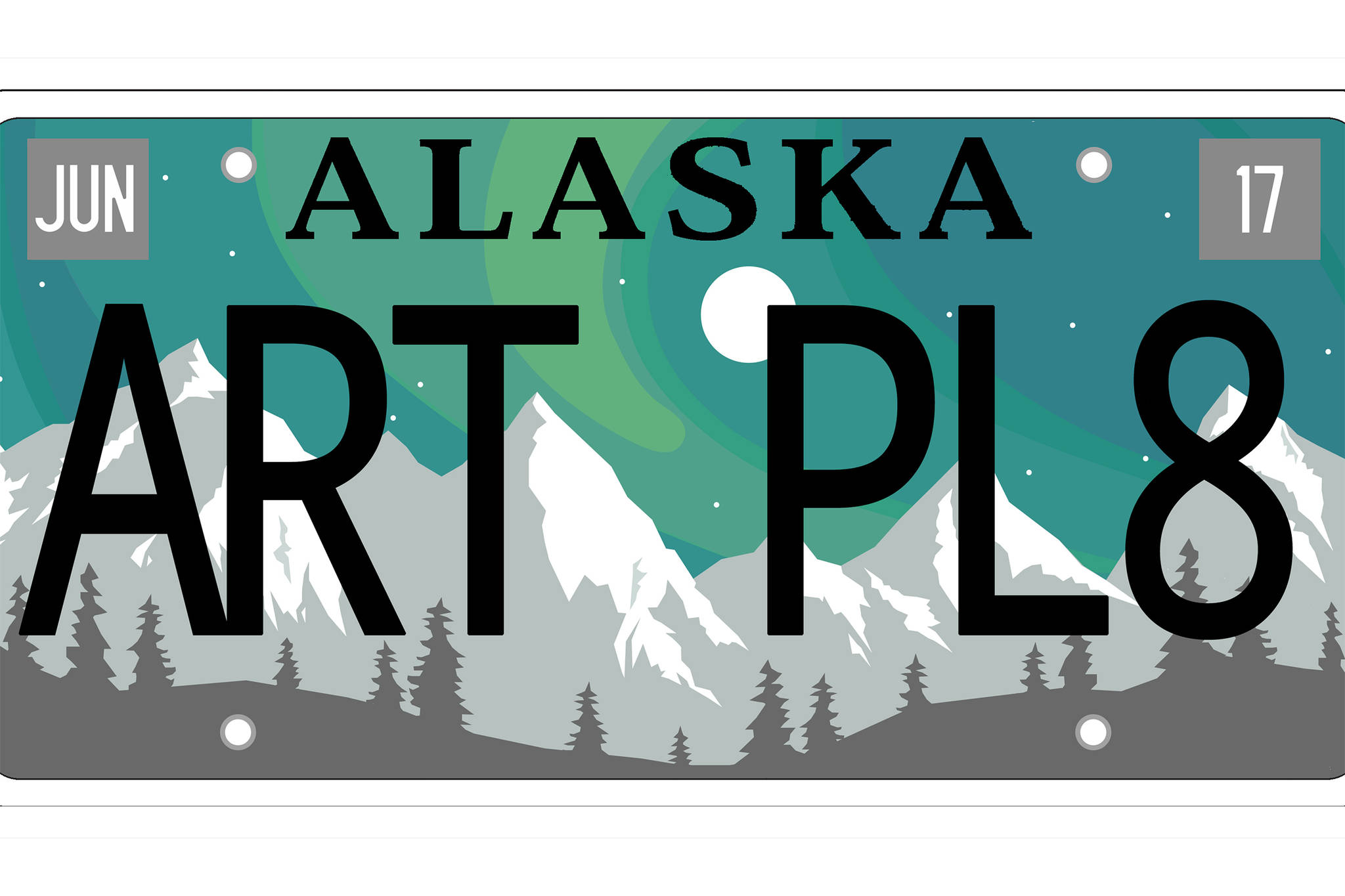
This license plate designed by Anita Laulainen was the winning design in the 2017 Alaska Artistic License competition. A surcharge could be attached to plates like this one if a bill heard by the Senate Education Committee Thursday becomes law. The additional charge could be used to provide funding for the Alaska State Council on the Arts. (Courtesy Photo | Alaska State Council on the Arts)

This license plate designed by Anita Laulainen was the winning design in the 2017 Alaska Artistic License competition. A surcharge could be attached to plates like this one if a bill heard by the Senate Education Committee Thursday becomes law. The additional charge could be used to provide funding for the Alaska State Council on the Arts. (Courtesy Photo | Alaska State Council on the Arts)

License plates could be a roadway to revenue

Alaska State Council on the Arts would set the surcharge.

License plates could be a big part of the continued existence of Alaska’s state arts agency.

A bill heard in the Senate’s Education Committee Thursday would allow a charge of up to $50 be attached to specially designed arts-supporting license plates that could create revenue for the Alaska State Council on the Arts. There’s already an existing Alaska Artistic License program, but there is currently no extra charge for the plates produced by the program’s 2017 contest.

The exact cost of the surcharge would be set by the state council, per the bill, and ASCA chair Ben Brown said it’s unlikely to be the allowable limit of $50.

“The goal is to find that sweet spot where we have as many artistic license plates as cars on the roads, but we’re generating a meaningful amount of income and earned revenue for the State Council on the Arts,” Brown said.

Based on the popularity of the existing artistic plates, it may not take a steep surcharge to generate an impactful sum.

From March 2018 when the plates began to be issued to August 2019, more than 30,000 of the arts plates were issued, according to data from the Division of Motor Vehicles shared during the committee meeting.

“For a period last year, that was more than either the bear over the counter or the yellow standard,” Brown said.

If a $5 surcharge did not dissuade drivers from ordering the plates, that would equate to over $150,000 for ASCA. That’s over 21% of the about $700,000 in general fund money included in Gov. Mike Dunleavy’s June 2019 veto of $2.8 million in funding for the state council.

That full vetoed amount also included federal funding and funding from private foundations. The license plate bill would also exclude private nonprofit money raised by ASCA from being subjected to vetoes.

That loss in funding threatened the existence of the state council, which shut down amid financial uncertainty for about two months last summer.

Federal funding for state arts agencies is dependent on matching funds from the state, so the vetoes also meant ASCA lost its federal support. With no federal or state funds coming through, Brown said private donors were uninterested in picking up the entirety of the slack.

Funding was restored in July and signed into law in August, and ASCA reopened.

[NEA chair says loss of arts would hurt the economy]

“The Rasmuson Foundation and Margaret A. Cargill Philanthropies are not interested in paying for an education program and all the staff costs of administrating it,” Brown said.

After the committee meeting, Brown said in an interview that while the Alaska State Poetry Out Loud poem recitation contest is progressing as usual with a final competition scheduled for March 12 in the capital city, ASCA as a whole is still getting back up to speed.

“Being shut down for two months does a lot more damage to your operations than you might guess,” Brown said.

• Contact reporter Ben Hohenstatt at (907)523-2243 or bhohenstatt@juneauempire.com. Follow him on Twitter at @BenHohenstatt.

More in News

The trans-Alaska pipeline, seen on Oct. 8, 2008, threads over snow-covered terrain in the Brook Range foothills. A gryfalcon is perched on one of the pipeline’s thermosphyons in the lower center of the photo. (Photo by Craig McCaa/U.S. Bureau of Land Management)
Alaska revenue forecast predicts more oil, but its importance to the state budget is declining

The Permanent Fund, not oil, is Alaska’s No. 1 source of general-purpose money and has been for years

A mound of a snow obscures a “student drop off” sign near Sít’ Eetí Shaanàx-Glacier Valley School. (Ben Hohenstatt / Juneau Empire file photo)
Juneau schools closed, city facilities delayed Monday due to weather

NWS released a weather warning in effect through the evening.

The emergency cold-weather warming shelter is seen in Thane on Thursday, April 10, 2025. (Jasz Garrett / Juneau Empire file photo)
Man charged for alleged rape at warming shelter

Staff have increased the frequency of safety rounds, and are discussing potential policy changes.

Photo by James Brooks/Alaska Beacon 
Alaska Gov. Mike Dunleavy speaks during a news conference in Juneau on Thursday, April 27, 2023. To his side is a screen displaying significant budget deficits and exhausted savings accounts if oil prices perform as expected.
Disasters, dividends and deficit: Alaska governor unveils first-draft state budget

In his final year, Gov. Dunleavy again proposes to spend from savings in order to pay a larger Permanent Fund dividend

Eaglecrest Ski Area photo 
Eaglecrest Ski Area as seen in a photo posted to the hill’s Facebook page on Tuesday, Dec. 11, 2025.
Eaglecrest boots up for a limited opening this weekend

15 degree highs usher in the hill’s 50th season.

Sen. Jesse Bjorkman, R-Nikiski, speaks Wednesday, April 23, 2025, on the floor of the Alaska Senate. (Photo by James Brooks/Alaska Beacon)
State senators express skepticism about proposed Juneau ferry terminal backed by Dunleavy

In a Friday hearing, members of the Alaska Senate spoke critically about… Continue reading

SouthEast Alaska Regional Health Consortium is one of the primary health care providers in Juneau, accepting most major public and private insurance plans. (Mari Kanagy / Juneau Empire)
Marketplace health premiums set to rise in 2026

Here’s what you need to know about how coverage is changing, and for whom.

Capital City Fire/Rescue completes last season’s ice break rescue training at the float pond near Juneau International Airport. (photo courtesy of Capital City Fire/Rescue)
On thin ice: Fire department responds to season’s first rescue at Mendenhall Lake

This week’s single digit temperatures have prompted dangerous ice ventures.

Most Read