
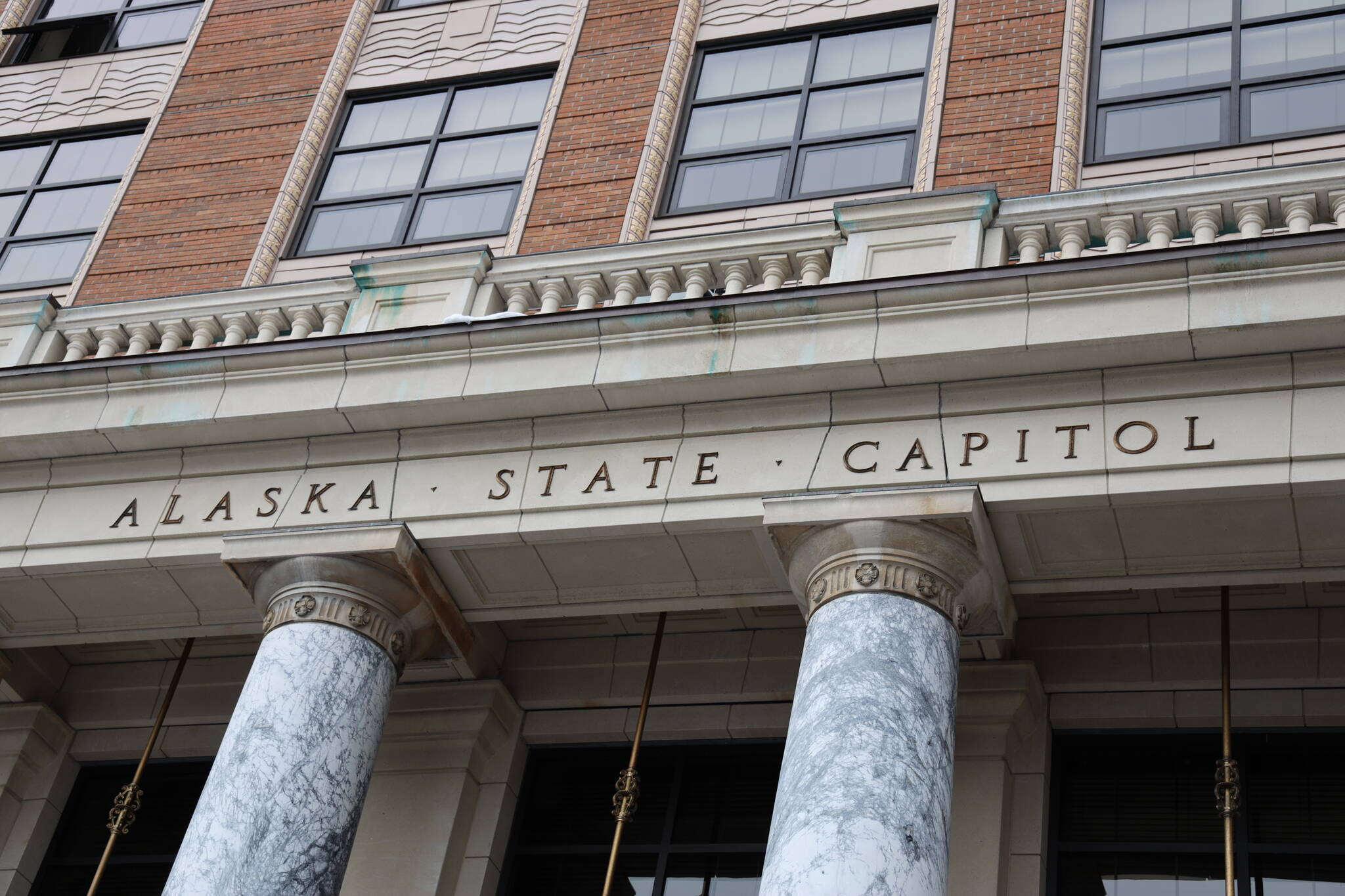
Legislators are about 50 days through the statutory 90-day limit for the session at the Alaska State Capitol, although in reality they are expected to meet for at least the 121 days allowed in Alaska’s Constitution. (Clarise Larson / Juneau Empire File)

Legislators are about 50 days through the statutory 90-day limit for the session at the Alaska State Capitol, although in reality they are expected to meet for at least the 121 days allowed in Alaska’s Constitution. (Clarise Larson / Juneau Empire File)

Legislature rejects raises for executive branch officials

House joins senate in unanimously rejecting increases.

A pay raise for Alaska’s executive branch leaders was unanimously rejected by the legislative branch, with some lawmakers saying paychecks for both branches should be considered if more money is at stake.

Raising the governor’s salary from the current $145,000 per year to $176,000 was recommended by the State Officers Compensation Commission, based on a 2% annual increase since the last raise in 2011. Similar increases would raise the lieutenant governor’s salary to about $140,000 and department commissioners — whose last increase was in 2015 — to $168,000.

The commission recommended no changes to legislative pay, which has remained the same since 2010.

Gov. Mike Dunleavy’s salary ranked 28th among governors in the U.S. in 2021, while the increased amount would have ranked 10th. In Alaska, his pay ranked 862nd among public sector employees in fiscal 2022 — behind the manager at Bethel’s airport.

The state’s top 10 earners included three investors from the Alaska Permanent Fund Corp., an investor for the Teachers Retirement System, three state troopers, a corrections officer in Bethel and the chief psychiatrist of the Alaska Psychiatric Institute, according to the Alaska Beacon.

The House rejected the increases by a 40-0 vote on Monday evening, following the Senate’s unanimous rejection last week. There was little discussion of the merits (or lack thereof) of pay raises for either the executive or legislative branches, merely an explanation that the raises would occur automatically unless the Legislature rejected them by March 25, which in reality meant lawmakers needed to pass a bill by Thursday due to the 15-day period the governor has to sign, veto or allow the bill to become law without his signature.

The governor’s office has not yet stated if he will sign the bill.

Some legislators, including Senate President Gary Stevens, a Kodiak Republican, are questioning the role of the commission — whose five members are appointed by the governor — due to their inaction on legislative salaries. He said this week legislation is likely to be introduced to adjust legislative and executive branch salaries separately from the commission process.

House Majority Leader Dan Saddler, an Eagle River Republican, said after Monday’s floor vote he doesn’t yet have a sense of whether his coalition would support changes the commission process.

Last year, the Legislature rejected a commission recommendation to increase legislative salaries to $64,000 a year instead of the current $50,400, but reducing per diem expenses to $100 a day instead of the current $307 per day to $100 per day, which would have resulted in an average of about $11,000 less in compensation.

• Contact reporter Mark Sabbatini at mark.sabbatini@juneauempire.com

More in News

Brenda Schwartz-Yeager gestures to her artwork on display at Annie Kaill’s Gallery Gifts and Framing during the 2025 Gallery Walk on Friday, Dec. 5. (Mari Kanagy / Juneau Empire)
Alaska artist splashes nautical charts with sea life

Gallery Walk draws crowds to downtown studios and shops.

A totem pole, one of 13 on downtown’s Totem Pole Trail in Juneau, Alaska, Nov. 27, 2024. (Christopher S. Miller/The New York Times)
Downtown Juneau experiences its first significant city-level snow fall of the season as pictured on Saturday, Dec. 6, 2025. (Mari Kanagy / Juneau Empire)
Sub-zero temperatures to follow record snowfall in Juneau

The National Weather Service warns of dangerous wind chills as low as -15 degrees early this week.

A truck rumbles down a road at the Greens Creek mine. The mining industry offers some of Juneau’s highest paying jobs, according to Juneau Economic Development’s 2025 Economic Indicator’s Report. (Hecla Greens Creek Mine photo)
Juneau’s economic picture: Strong industries, shrinking population

JEDC’s 2025 Economic Indicators Report is out.

Map showing approximate location of a 7.0-magnitude earthquake on Saturday, Dec. 6, 2025. (Courtesy/Earthquakes Canada)
7.0-magnitude earthquake hits Yukon/Alaska border

Earthquake occurred about 55 miles from Yakutat

A commercial bowpicker is seen headed out of the Cordova harbor for a salmon fishing opener in June 2024 (Photo by Corinne Smith)
Planned fiber-optic cable will add backup for Alaska’s phone and high-speed internet network

The project is expected to bring more reliable connection to some isolated coastal communities.

Gustavus author Kim Heacox talked about the role of storytelling in communicating climate change to a group of about 100 people at <strong>Ḵ</strong>unéix<strong>̱</strong> Hídi Northern Light United Church on Wednesday, Dec. 3, 2025. (Mari Kanagy / Juneau Empire)
Author calls for climate storytelling in Juneau talk

Kim Heacox reflects on what we’ve long known and how we speak of it.

The Juneau road system ends at Cascade Point in Berners Bay, as shown in a May 2006 photo. (Michael Penn / Juneau Empire file)
State starts engineering for power at proposed Cascade Point ferry terminal

DOT says the contract for electrical planning is not a commitment to construct the terminal.

Most Read