
Juneau was lucky.
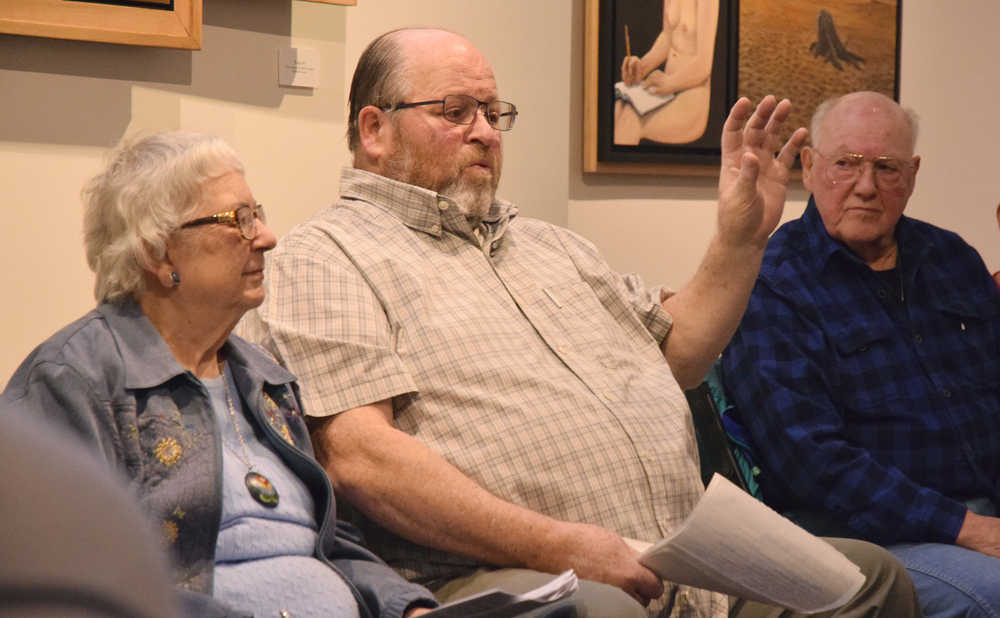
That appeared to be the conclusion Saturday as an expert panel discussed the capital city’s history of disasters in the 20th century. The panel discussion, held at the Juneau-Douglas City Museum, featured former firefighters and historians who revealed how the capital city escaped the fate that befell most of Alaska’s gold-rush era towns and cities.
“We were very lucky to just burn down single buildings or two buildings at a time instead of the whole downtown,” said Merrill Sanford, a former Juneau Mayor and longtime capital city firefighter.
Across Alaska, between 1880 and 1920, various gold rushes brought thousands of people to isolated portions of the territory. The rushing hordes threw up poorly constructed wood-frame buildings, and government services — where available at all — rarely met demand. The result, almost inevitably, was fire. Fairbanks, Nome, Circle, Eagle, Petersburg and Douglas — which has been swept by fire several times — all suffered from enormous blazes that wiped out much of their downtowns.
Wind, combined with wooden construction, created deadly danger.
“That is what, as Douglas has found out,” Darlin said, “is a large part of any fire: how the wind is blowing.”
Juneau’s significant fires — in 1911, 1939, 1946, 1956, and 1963 — all coincided with windy conditions, but the wind died down before the flames reached high.
In 1972, when the Juneau-Douglas Community College (housed in the old elementary school, built in 1917) caught fire, a Taku wind was blowing. Fortunately, Juneau by then had a modern fire department.
Sanford and fellow former firefighter Doug Boddy remembered how that blaze took place in bitterly cold February conditions. More than 2 million gallons of water was poured onto the fire, and the resulting spray froze on the firefighters, who wore inches of ice. Sanford recalled how the weight of the ice would pull down his head as it clung to his beard. An assistant fire chief would go from man to man, rapping them on the helmet to knock off the accumulated spray.
Luck might be one reason Juneau dodged a significant fire in its early years, but Boddy suggests there was a more practical reason as well. For much of Juneau’s history, it had two water systems: a freshwater system for drinking and a saltwater system that fed the Alaska-Juneau gold mine.
“That was one of the saving graces. Back in those days that we had two water systems,” he said. “I think that’s one of the biggest factors why we didn’t burn down the whole downtown.”
With the mine’s pumps able to to pour 150 pounds of water pressure from the head of a nozzle, there was rarely a shortage of water or pressure to fight a fire.
Saturday’s lecture also discussed Juneau’s weather-caused disaster history, the avalanches and landslides that struck the city in the first half of the 20th century. A 1936 landlide on Gastineau Avenue and South Franklin Street killed 15 (or 16, sources vary) people in the city’s deadliest single disaster.
Floods of Gold Creek between 1918 and 1952 carried away homes and encouraged the city to channel the creek into a concrete viaduct that still stands.
Through all the disasters, Darlin said, the underlying message was that when bad things happened, Juneau residents tended to pull together. When big fires ignited, everyone pitched in, fighting the flames or housing the newly homeless.
“When you have a disaster, everything comes together,” she said.
