
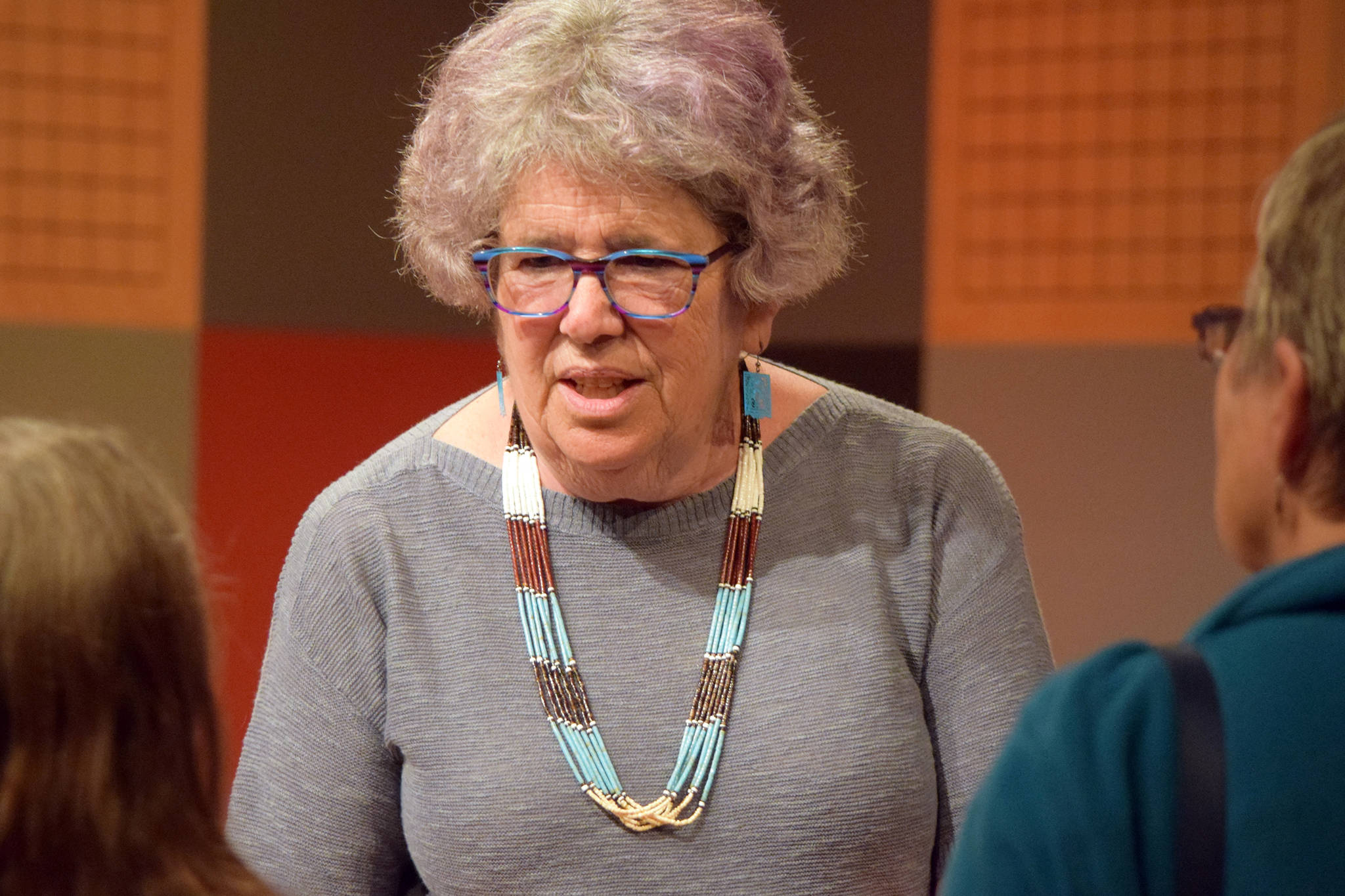
Living at the United States’ southwest border is a lot different than reading about it, said Susan Fitzgerald.
That’s why the longtime Juneau resident and current volunteer at the El Calvario Refugee Shelter in Las Cruces, New Mexico gave a short presentation Friday evening about the things and people she sees every day.
“People who come to the border and experience it first-hand have a different sense of it than people who have not experienced it,” Fitzgerald told the Empire. “I hope to bring a bit of that experience. It’s pretty hard to get to the border from here. El Paso’s not a hot spot for vacation.”
She said words are often more impactful when coming from someone they know, and Fitzgerald estimated she knew at least half of the people in attendance. Based on the cluster of folks who stopped to talk to her afterward, that seemed to be a safe estimate.
During her presentation and a question-and-answer session that followed, Fitzgerald confirmed some widely circulated information about undocumented immigrants and asylum-seekers and repudiated other points.
“The border is safe,” she said. “El Paso is one of the safest cities in the country. It’s welcome, people are great. It’s diverse.”
[Governor prepares for Mat-Su special session]
However, she said reports of family separations and mistreatment of immigrants by United States Border Patrol or while being kept in detention centers are accurate.
“People come in, and they’ve been physically abused,” Fitzgerald said in response to a question from the audience.
During her presentation, she described what people are fed while in a detention center.
“When they’re in a detention center, they mostly get fed ramen and frozen bean burritos,” Fitzgerald said. “Their welcome to this country is most unkind.”
She said the country of origin for most refugees in the shelter is not Mexico, but instead typically one of three countries —Guatemala, El Salvador and Honduras — that form the Northern Triangle of Central America.
The reason people from those countries may seek a better life in the U.S. boils down to economic opportunity. Fitzgerald said someone can justify securing a coyote — someone who aids undocumented immigrants in crossing the border or borders —when they may be able to put food on the table three times each day instead of three times each week.
She mentioned a handful of factors that led to the prevalence of poverty in Central America, including free trade agreements that have “devastated local agriculture” as well has a history of U.S. meddling with foreign governments.
Examples of the latter include the U.S. backing the Sandanistas in Nicaragua in the late ’70s and early ’80s and the actions of the United Fruit Company while setting up a commercial empire in Guatemala and other nations. Both led to political instability.
Additionally, Fitzgerald said climate change is making it more difficult for farming to be a viable way of life in Central America.
“These are the first climate refugees,” Fitzgerald said.
[Number of homeless people in Juneau slightly decreases]
When refugees come to shelters like the one Fitzgerald volunteers at multiple times per week, they have already declared they are seeking asylum, passed through detention and have the name and address of a sponsor as well as court date.
“We take their papers and we go through them and make sure they are as accurate as they can possibly be,” Fitzgerald said.
Refugees are then welcomed by a pastor, a kitchen provides freshly cooked food and people are given a chance to wash up. The American Civil Liberties Union teaches the immigrants some basic English and their rights, and volunteers including Fitzgerald help to arrange travel for the refugees.
Fitzgerald said she is motivated to volunteer by her Jewish faith and because she is only one or two generations removed from immigrants.
While she said volunteers do preserve their personal time, it is difficult to shut off her phone or miss a day of helping, especially in light of living in relative comfort.
“My privilege is right there in front of me all day every day,” Fitzgerald said.
Fitzgerald said if people hearing about the work being done and the people being helped feel moved to action, making a monetary donation is preferred to a spontaneous trip to New Mexico.
“Money is the best thing,” Fitzgerald said. “Somebody who comes for three days and wants to volunteer takes more of my time.”
• Contact arts and culture reporter Ben Hohenstatt at (907)523-2243 or bhohenstatt@juneauempire.com. Follow him on Twitter at @BenHohenstatt.
