
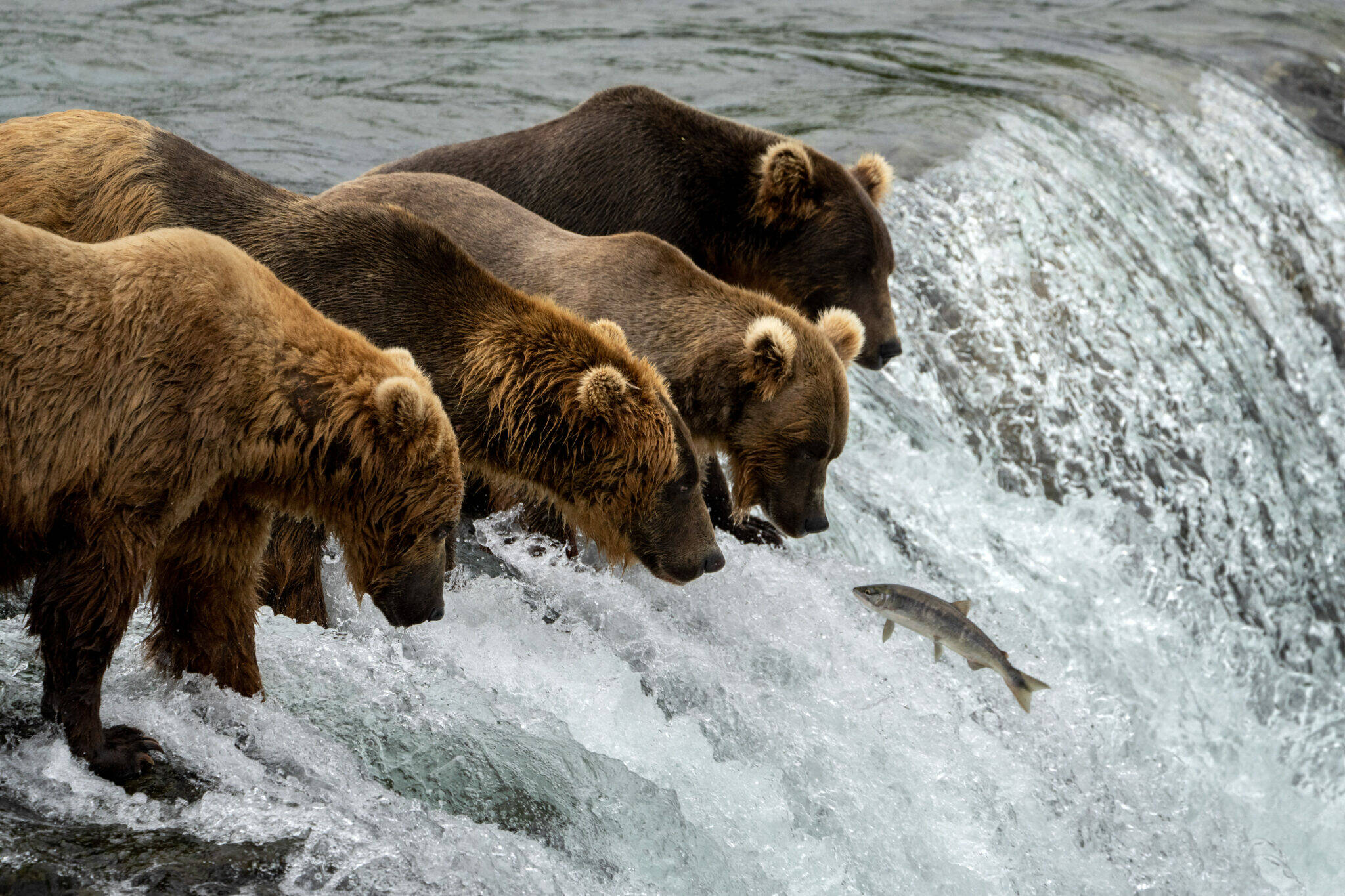
Two new lawsuits are challenging a program used to kill bears and wolves in southwestern Alaska in a state-conducted campaign to control predators to increase caribou numbers in the region.
The lawsuits, filed in state Superior Court in Anchorage last Thursday and on Monday, are focused on a predator control program conducted earlier this year that was aimed at boosting the flagging Mulchatna caribou herd.
That campaign, authorized by the Alaska Board of Game in January 2022, killed 94 brown bears, five black bears and five wolves when it was carried out earlier this year. The animals were shot by Alaska Department of Fish and Game personnel this spring in an “intensive management” plan intended to run through 2028.
Those killings sparked the legal complaints, the plaintiffs said.
“The main impetus was what we call the ‘Mulchatna Massacre,’” said Anchorage attorney Michelle Bittner, the plaintiff in the lawsuit filed Monday.
“This program should alarm any Alaskan interested in our state’s wildlife management,” Nicole Schmitt, executive director of the Alaska Wildlife Alliance, the plaintiff in the other lawsuit, said in a news release issued Tuesday.
The lawsuits name the state, the Alaska Board of Game and Doug Vincent-Lang, the commissioner of the Alaska Department of Fish and Game, as defendants. The lawsuits seek to have courts invalidate the Board of Game authorization for the Mulchatna program and to compel more changes to limit predator control.
Ryan Scott, acting director of wildlife conservation for the Department of Fish and Game, declined to comment specifically on the lawsuits. But the department has asserted over the past several months that predation is one of the problems facing the Mulchatna herd, which declined from a peak of about 200,000 animals in the 990s to 12,850 in 2021. The Department of Fish and Game’s goal for the Mulchatna caribou herd is 30,000 to 80,000 animals.
The herd’s range includes the Togiak National Wildlife Refuge and several Bristol Bay-area villages. Hunting has was closed in 2021 and 2022, and recent scientific research has pointed to climate-related habitat changes that have made the region better for moose and worse for caribou.
While factors like habitat changes and the spread of the infectious disease brucellosis are issues for the herd, “predator control is an immediate tool the department can use to attempt to reverse the herds’ decline,” the Department of Fish and Game said in a statement released after this year’s campaign was completed. Residents of 48 communities in that region of Western Alaska depend on the Mulchatna herd for food, the June 6 statement said. “The control program was undertaken in an effort to provide a secure food resource for Alaskans,” it said.
The two lawsuits made counter arguments, saying the killing of bears and wolves does nothing to help the caribou herd because the herd’s problems are from factors other than predation. The lawsuits point to biologists’ information, which had been submitted to the Board of Game, about habitat changes and overgrazing that reduced food availability, very high rates of brucellosis in the population and illegal hunting by people.
Though the Board of Game says it uses science-based management, “there is no credible scientific basis for the massive reduction of the bear population that supports the contention that the killing of bears will significantly increase the caribou population,” and therefore the board’s actions violated a clause of the Alaska Constitution, the Alaska Wildlife Alliance lawsuit said. That clause says the state’s replenishable resources, like wildlife, “shall be utilized, developed, maintained on the sustained yield principle, subject to preferences among beneficial uses.”
Bittner’s lawsuit makes similar claims, though it also focuses on arguments that the Board of Game is depriving Alaska’s nonhunters of their rights.
“Many Alaskans, and perhaps a majority, do not hunt but rather want to be able to view wildlife in Alaska and to live in a place where the wildlife is flourishing… . Many Alaskans are devastated when the State of Alaska kills bears and wolves, or allows bears and wolves to be killed by private citizens so that there will be more caribou and moose for hunters to hunt, particularly when the science does not support a belief that four-legged predators are responsible for the decline of these species,” the lawsuit said.
Though it will not help the caribou, the state’s Mulchatna campaign may have already had negative effects on the bear population in that region of the state, Bittner said. There are indications of those problems at Brooks Camp, she said, referring to the world-famous bear-viewing site in Katmai National Park and Preserve where individual bears have been identified and are known to return year after year to feast on salmon.
“Some of those bears have not returned,” Bittner said.
Without commenting directly on the lawsuits, Scott defended the Mulchatna predator control program.
The department acknowledges that factors other than predation have contributed to the herd’s decline, Scott said. But the herd should have started to recover from those problems by now, he said.
Instead, the herd is showing good signs of reproduction but poor “recruitment,” meaning calves adding to the population, indicates that predation is part of the problem, he said.
• Yereth Rosen came to Alaska in 1987 to work for the Anchorage Times. She has reported for Reuters, for the Alaska Dispatch News, for Arctic Today and for other organizations. She covers environmental issues, energy, climate change, natural resources, economic and business news, health, science and Arctic concerns. This story originally appeared at alaskabeacon.com. Alaska Beacon, an affiliate of States Newsroom, is an independent, nonpartisan news organization focused on connecting Alaskans to their state government.
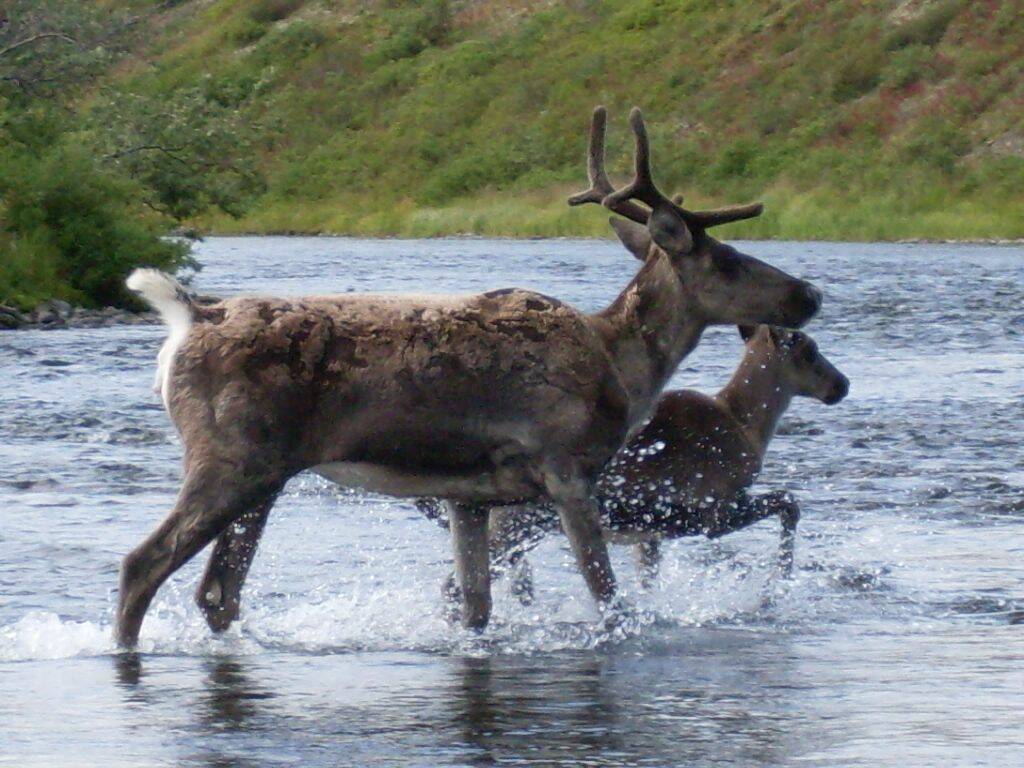
Caribou cross the Kanektok River in the Togiak National Wildlife Refuge on Aug. 25, 2009. The Mulchatna caribou herd, which ranges in the refuge, has declined sharply since the 1990s, and scientists cite numerous factors. The controversial Mulchatna predator-control campaign was conducted this spring to help boost the herd’s numbers. (Photo by Allen Miller/U.S. Fish and Wildlife Service)
