
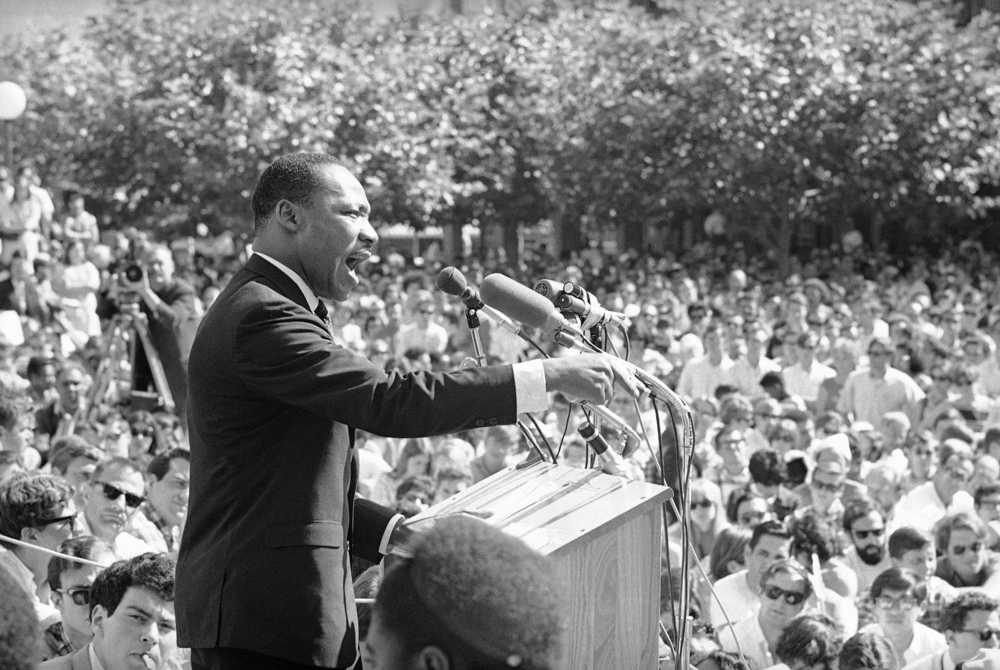
PHILADELPHIA — For Abdul Aliy-Muhammad, the Martin Luther King Jr. he learned about as a child was a man of love, peace and racial harmony, a gifted orator.
It wasn’t until Aliy-Muhammad became an activist that he came to know, and appreciate, the King who decried the Vietnam War as “unjust” and made a firm, insistent case for economic justice for black Americans.
“There is a Martin Luther King that is important to the resistance movement that we don’t hear about,” said the 33-year-old co-founder of the Black and Brown Workers Collective in Philadelphia. “We always hear about love and forgiveness. … There was also a King who was radical.”
Younger black activists say they prefer the pointed, more forceful King to the Nobel Prize-winning pacifist who preached love over hate as he led nonviolent marches across the segregated South. They like the fact that the urgency in King’s demand for equality in the years just before his assassination in 1968 is in keeping with the tenacious nature of today’s Black Lives Matter rallying cry.
“Then as now, it was about promises not translating into substantive transformation,” said Princeton University professor Imani Perry. “The questions young people are asking and the way they’re challenging the status quo are important. If we don’t have that kind of vision, we end the possibility for change before we even have the conversation. In that sense, they really are carrying the torch.”
Fifty years ago this month, King retreated to the Caribbean with his wife, Coretta, and a few friends to write his final book, “Where Do We Go From Here: Chaos or Community?” In the book, published in June 1967, King argued for racial equality for black Americans through the wholesale embrace of social and economic reform.
During the book’s promotional tour, King spoke out against the Vietnam War and criticized U.S. leaders for allowing slum conditions to persist in the cities. “Everyone is worrying about the long hot summer with its threat of riots. We had a long cold winter when little was done about the conditions that create riots,” King said in June 1967.
Today’s young activists say King’s harsher words resonate just as much as his methods of peaceful protest.
“We do King a disservice when we try to tell a flat story of turning the other cheek,” said 31-year-old Charlene Carruthers, national director of the Black Youth Project 100 in Chicago. “It was never simply that.”
As Carruthers sees it, “agitation” was the core of King’s work. “Their agitation shows up differently than how our agitation shows up today. However, I think King’s work and the work we do are part of the larger tradition of black radical resistance.”
In an August 1967 speech to the Southern Christian Leadership Conference, King pointed out disparities in unemployment, housing, education and infant mortality. He called for black Americans — then barely a century out of bondage — to “assert our dignity and worth.”
“The job of arousing manhood within a people that have been taught for so many centuries that they are nobody is not easy,” King told the audience. “Psychological freedom, a firm sense of self-esteem, is the most powerful weapon against the long night of physical slavery.”
King fought to end public segregation and fought for the right to vote. But he also advocated for a living wage and worked to close the employment gap for blacks and spoke out against discrimination in policing — to which rioting was a common response. King reacted to the Feb. 29, 1968, release of the report by the National Advisory Commission on Civil Disorders, also known as the Kerner commission, by noting that the solutions suggested “have been made before almost to the last detail and have been ignored almost to the last detail.”
It is a familiar climate for some working in the Black Lives Matter movement, who see their efforts in cities like Ferguson, Missouri, Chicago, Baltimore and Cleveland on a continuum that reaches back to King.
They identify with the fact that King was only 26 when he was thrust into a leadership role in the 1955 Montgomery Bus Boycott. When he died at 39 in 1968, before he could launch his Poor People’s Campaign, King was still far younger than civil rights establishment figures such as A. Philip Randolph and Adam Clayton Powell.
Remembering King as a community organizer places his movement alongside contemporary activism, said Patrisse Cullors, co-founder of Black Lives Matter.
“He was really focused on poor black people,” Cullors, 33, said. “Let’s remember the King who was invested in changing the country that he loved so much, who called out elected officials who continued to endanger black people.”
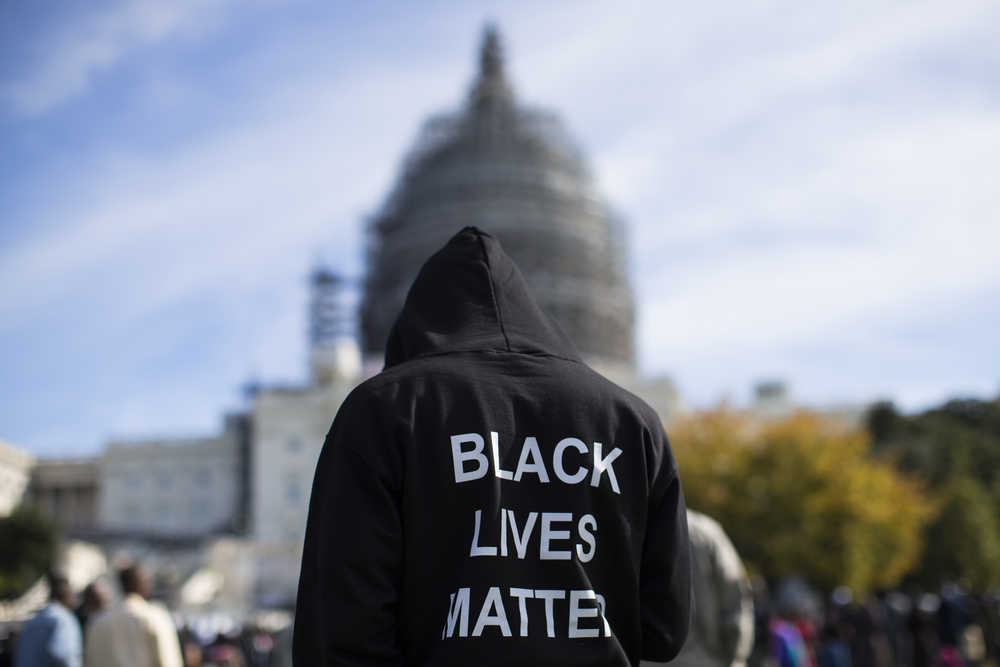
In this Oct. 10, 2015 photo, a man wears a hoodie which reads, “Black Lives Matter” on the lawn of the Capitol building in Washington during a rally to mark the 20th anniversary of the Million Man March.
