
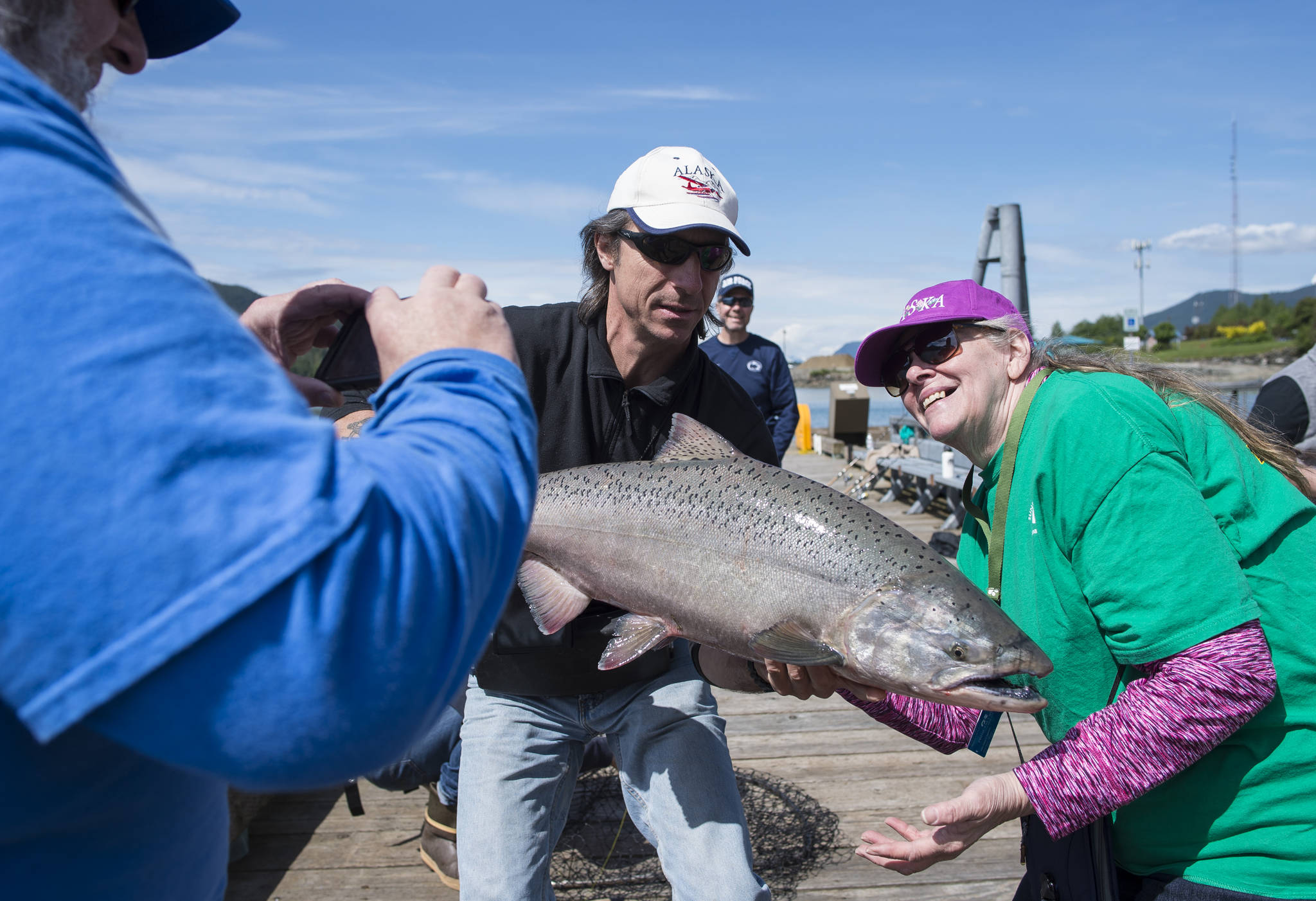
Correction: The annual limit for king salmon applies only to nonresident fishermen, not resident fishermen, as this article previously indicated. This has been updated to reflect the change.
Today marks the earnest start of king salmon fishing. Retention of the sought after species, barred so far this summer fishing season, will now be allowed with certain restrictions.
The Southeast-wide king salmon crisis isn’t over. Fish and Game still expects the Taku River to return a record or near record low of large adult king salmon. Other Southeast king salmon stocks are experiencing similarly dire circumstances.
But by June 1, managers believe about half of local wild kings have made it up river, past fishermen. That number rises to about 80-90 percent by mid-June, Alaska Department of Fish and Game sport fish management biologist Dan Teske. Today, managers believe most of the Chinook in local waters are hatchery origin, so Fish and Game can liberalize regulations without much fear that harvests will do damage to struggling wild stocks.
Two things happened today at 12:01 a.m., said Alaska Department of Fish and Game sport fish management biologist Dan Teske said.
“Number one, the inside closure areas will be lifted that will expire on Friday, so those areas will divert to the regional limits,” Teske said.
That means resident fishermen can keep one king salmon a day 28 inches or over in length, with an annual limit of three fish for nonresidents (starting July 1, the nonresident annual limit drops to one). Those rules apply to nearly all inside waters like southern Lynn Canal, Chatham Strait, Icy Strait and Stephens Passage. (That’s everywhere except for Seymour Canal and Upper Lynn Canal.)
Special harvest areas around hatcheries will also open up to king salmon retention today. These small areas don’t have a 28-inch limit, Teske said, and fishermen are allowed to keep two fish, with two in possession, when fishing in these areas. Fish and Game has opened up special harvest areas in Auke Bay, Fritz Cove and north Gastineau Channel before, but one new special harvest area opens up this year. Hatchery fish have been released at Lena Cove since 2012. The return there is “decent” enough now to allow a harvest, Teske said.
Charter woes
On Thursday at Don D. Statter Memorial Harbor, Juneau charter fisherman Kevin Burchfield and deckhand Matthew Puckett fueled up Burchfield’s 30-foot aluminum charter fishing vessel, “The Wolf Eel.”
Burchfield, the president of the Juneau Charter Boat Operators Association, said business has been about halved this year during the ban on retention. He estimates local charter boat operators have lost about $250,000 in revenue due to king salmon conservation measures. Southeastwide, he estimates a loss in the millions.
“It’s affected us tremendously. We’ve done quite a bit fewer trips because people don’t want to do catch and release necessarily, they want to go and keep them,” he said.
Burchfield said he’s caught and released only one king salmon this year. They caught the fish with a barbless hook and released it while it was still in the water, best practice for making sure a fish survives the catch. Sport and charter fishermen locally have caught and released only about five fish, Burchfield said, this year.
He said he’s gotten a lot of pushback from people concerned that charter fishermen are still taking visitors out during the retention ban. Some people have even met him at the dock to confront him about it.
Their problem, he said, is that some portion of salmon don’t survive being caught and released. But if best practices are followed, salmon gain a good chance of surviving. Burchfield said charter fishermen have every incentive, just like sport fishermen, to make sure fish survive the encounter. He’s switched to barbless hooks this year, for one, a gear switch which minimizes damage to the fish. That’s a voluntary measure, he said, and Fish and Game has worked closely with charter fishermen to educate them on how to properly release fish.
Many of Burchfield’s clients aren’t going trolling anyway. It has been more popular to target rockfish during the retention ban, or simply go whale watching, something many fishing charters do on the side.
Gillnets hemmed
Charter fishermen aren’t the only ones affected by the king salmon retention ban. Gillnet fishermen in Lynn Canal and at the outlet of Taku River will have to abide by regulations limiting their time and fishing area. Commercial trollers, perhaps the most negatively affected user group, suffered stark cut backs as well.
Trollers won’t have their first king salmon opening until July, but gillnet fishermen will start working their nets north and south of Juneau starting Sunday. Fisherman Carl Peterson, owner-operator of the Ashley Marie, prepared to put his net on the boat Thursday at Harris Harbor in downtown Juneau.
Peterson, a 38-year veteran of the gillnet fishery, targets chum salmon like most of the rest of the local fleet. But chum swim in the same waters as king salmon, and Fish and Game has limited gillnetters to two days for the first week to protect them. They’ve also barred gillnetters from fishing from 10 p.m.-4 a.m. in Lynn Canal as more kings are caught in nighttime.
The limits “can’t be good” for business, Peterson said. But he’s learned not to make predictions.
“One thing I learned after 38 years is that whatever you expect, it’s not going to happen,” Peterson said.
The limits will mean more boats working smaller “postage stamp” areas. Peterson said he’d make it work and is expecting things to go back to normal after the second week of fishing, he said.
Some hope
Early indications are that this year’s return on the Taku River might not be as bad as predicted. Fish and Game had projected only 4,700 large adult kings to return on Taku River this year. That would be the worst ever return in ADFG’s 40 years of data.
But early numbers estimated from radio-telemetry studies indicate that 2017 and 2018’s run might be about equal. Last year was the previous record low.
“So far, in that project, the encounter rate has been matching about what we saw last year. Which is on one hand, good, because we were expecting it to be about half as good,” Harris said. “One way to put it is that, instead of being the absolute worst since we’ve monitored it, we’re now tied for the worst.”
• Contact reporter Kevin Gullufsen at 523-2228 and kgullufsen@juneauempire.com. Follow him on Twitter at @KevinGullufsen.
