
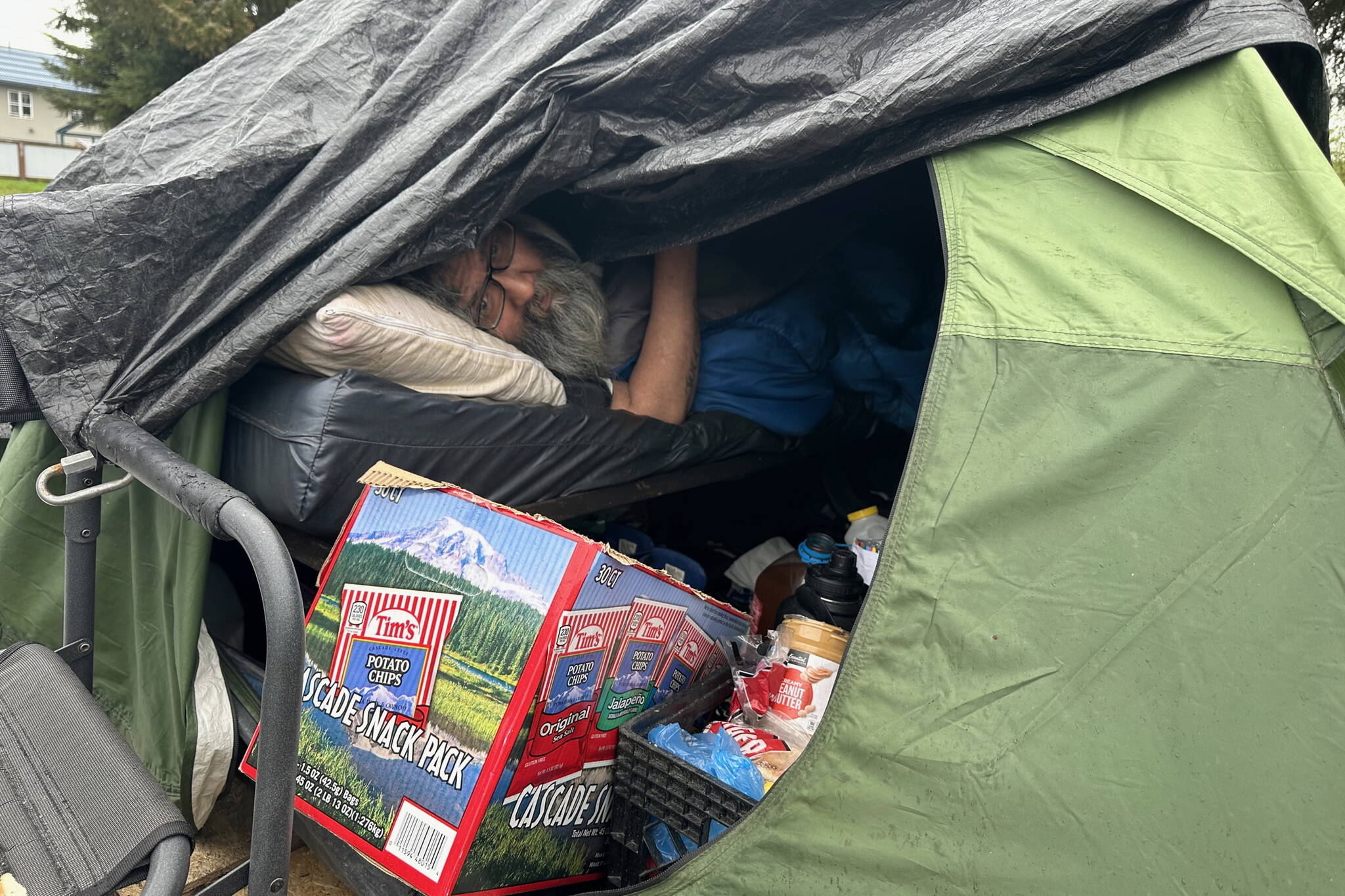
Tiffany Koeneman says people experiencing homelessness shouldn’t be living in squalor near the business where she works. Jason Williams, lying ill in a tent along a nearby street because he’s unable to find housing or medical care, couldn’t agree more.
“I need help and there should be some kind of law against throwing a disabled person out on the streets,” he said.
Koeneman, a manager at Alaska Glacier Seafoods, which has property a couple blocks down the street, said employees living and working there are constantly facing dangerously unhealthy circumstances. She said the property is strewn with contaminants ranging from needles to used tampons, what appear to be drug deals are taking place constantly in plain sight, and employees are being attacked by people carrying knives and other weapons.
“Nobody is safe,” she said during a Juneau Assembly meeting last Monday night where several other people voiced similar complaints.
This is the second year of a “dispersed camping” policy that requires the more than 200 people experiencing homelessness in Juneau to find their own places to sleep, with shelter beds available for only a fraction of them. Assembly members decided a year ago it was less problematic than a designated campground where rampant illegal activity was reported by people at and near the site.
There’s widespread agreement among the housed and unhoused the current policy is also disastrous. But city leaders say their dilemma is there are no ideal solutions within the resources available to them.
Williams was lying on a cot alongside a colostomy bag necessitated by one of his physical ailments that also include diabetes and limited mobility due to an improperly healed leg fracture. He said on Saturday he’s also suffering from post-traumatic stress disorder, sleep apnea and depression.
His tent is pitched on a wood platform that extends over the embankment of a water-filled ditch next to Teal Street that was built by a neighboring resident without housing so he has a legal and secure place to stay. The person who built the platform, Virginia McPhail, said police gave her an official notice Friday to move a tent she shares with another person from the side of an adjacent street by Monday.
“I may have to build another one of those,” she said while explaining how she built the platform, noting she used to work in construction and made it to her second year of engineering school before having to drop out due to being overwhelmed trying to raise three kids at the same time.
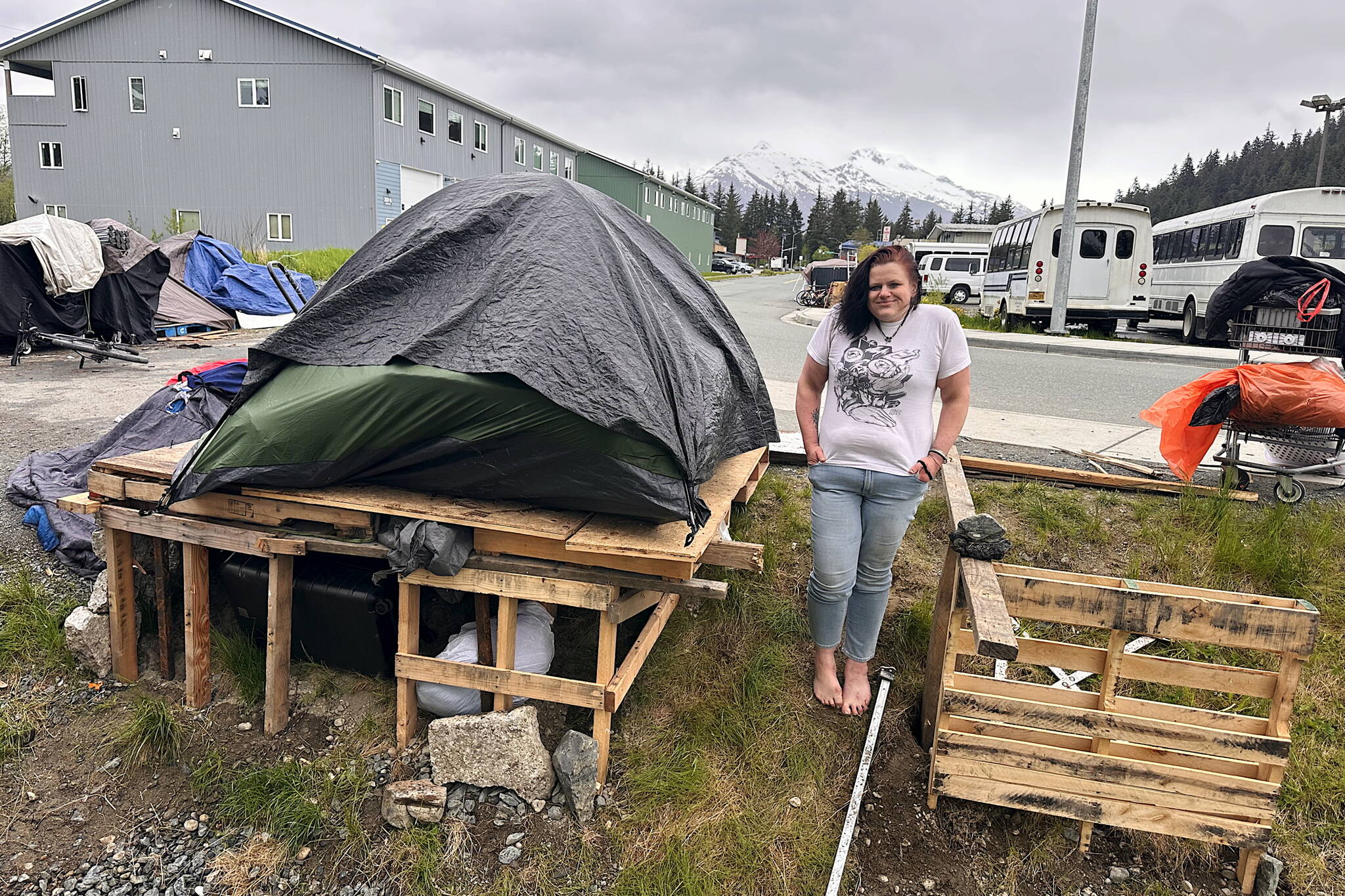
Virginia McPhail, a Juneau resident experiencing homelessness, shows a platform she built on an embankment above a ditch on Teal Street on May 24, 2025. The platform allows another person without housing who is suffering from medical issues to have a tent site that is legal under Juneau’s “dispersed camping” policy. (Mark Sabbatini / Juneau Empire)
As McPhail was speaking, a Juneau Police Department vehicle approached slowly.
“You need to move away from there,” the officer reiterated sternly out his rolled-down window as he slowed to a near-stop momentarily.
“Yeah, we’re packing our things,” she replied. “We’re just talking right now.”
The patrol car continued down the street and around the corner, passing slowly by the tents along the ditch without stopping for similar warnings. The rule — as understood by campers and officials — is people can legally camp on public land in Alaska, but that excludes Juneau’s municipal government property.
Thus the only legal spot at the street corner where Williams and others are camped is the ditch — and a very narrow strip of land along its banks. The platform built by McPhail that extends well past the edge of the bank ensures Williams isn’t living in a risky situation he can’t escape from.
“We actually have a pretty strong community between us homeless people, whereas like there’s so much separation between ‘them’ and us,” she said.
A couple hundred yards away, across the street from the Glory Hall homeless shelter on Teal Street, is a row of eight more tents on a similarly narrow strip of dry land that’s another legally permissible spot. People camping in the tents said their reason for being there is obvious — even if there’s no beds available at the Glory Hall, meals and other services are available there during the day.
That’s problematic for Jim Erickson, whose family owns Alaska Glacier Seafoods, who said troubling encounters with people experiencing homelessness have proliferated since the city’s cold-weather emergency shelter south of downtown closed in mid-April. The shelter is open from mid-October to mid-April and, in response to a question Monday night from an Assembly member, he said that facility offered at least some assistance for his business and employees.
“It certainly seems less noticeable, but you can be on our property any month of the year and still feel in danger,” he said. “We’ve done everything we’re supposed to do. We put signs up all around the perimeter of the property. It’s private property. We own the property. None of that matters. I’ve been challenged by people on our property all the time. Our HR director, our employees, have all been threatened and challenged at various times.”
The warming shelter operated by St. Vincent de Paul Juneau under a contract with the city is closed during the warmer months since there isn’t the funding or staff to keep it open year-round, according to Dave Ringle, executive director of the nonprofit.
While people with businesses and housing in the area say they feel threatened by the homeless, McPhail said the feeling is mutual due to incidents such as cars seemingly trying to hit people camping alongside the street, along with constant harassment and threats from drivers.
“They don’t feel safe around us? We don’t feel safe around them, telling us to go die and (expletive) like that,” she said. “How are we supposed to feel safe? We can’t. We don’t want to have to live like this. But Juneau is severely underfunded in all the wrong areas and overfunded in (expletive) tourism. They don’t want the tourists to see this, but they’re not doing anything to support or resolve this.”
“There’s no long-term care facility for those people they’re afraid of who have actual severe disabilities. And then they’re bitching about the addiction, but they don’t understand that the addiction will resolve itself if you treat the mental health. But nobody here is treating mental health for (expletive) — you get a 72-hour hold and then it’s goodbye.”
Her companion, Berton Tullis, a longtime Juneau resident, showed a disfiguring torso wound that he said resulted from being hit by a truck driving along the street four or five months ago. More common, though, is the constant harassment by people who at times will simply circle the neighborhood blowing car horns, taking photos and yelling threats.
“These people, they are challenging us,” he said. “And it’s like we’re pretty rough-and-tumble people so I don’t know what they really expect out of us.”
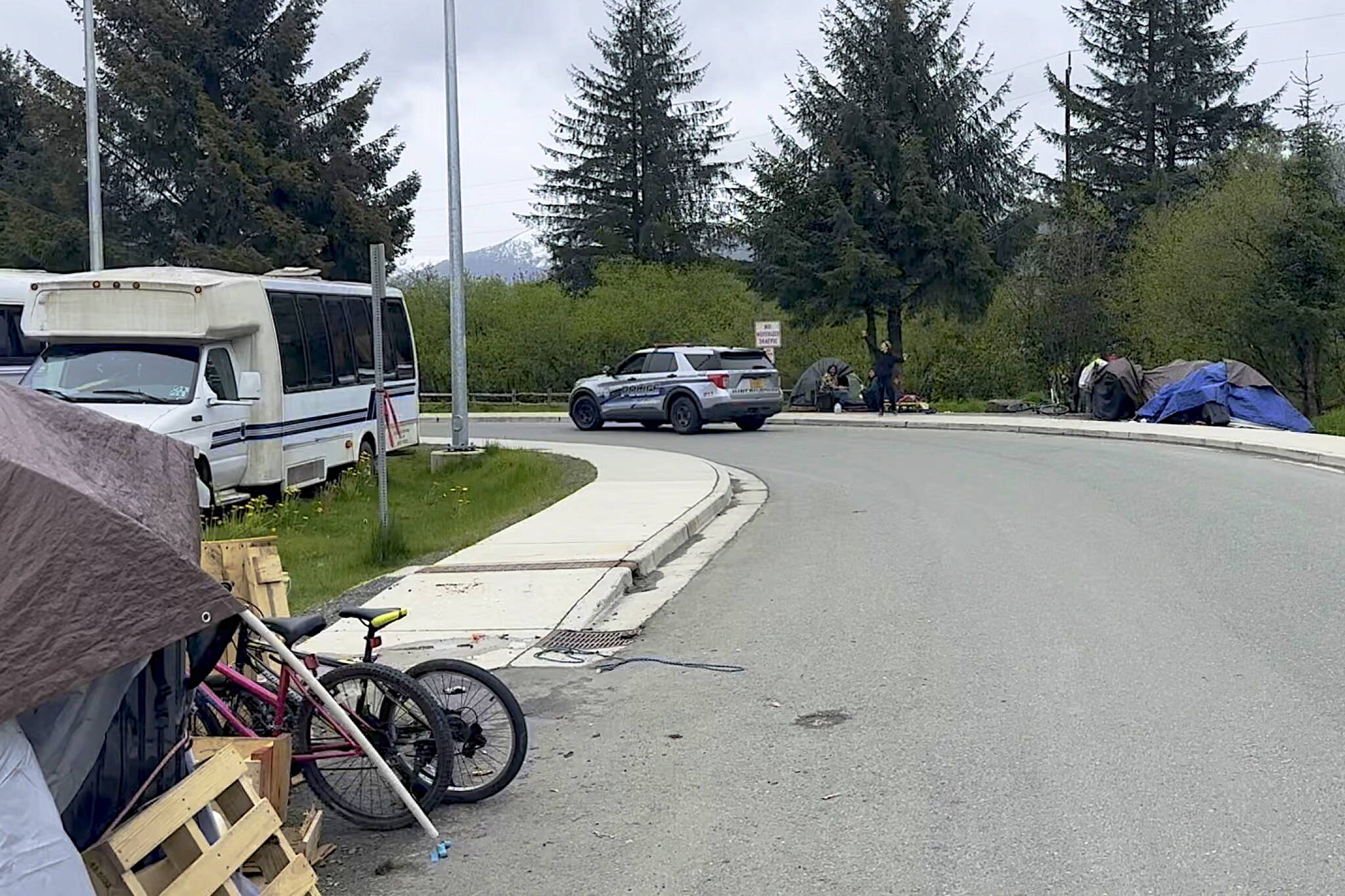
A Juneau Police Department vehicle patrols a neighborhood near Juneau International Airport after warning a person camped along the side of the road they need to move their campsite on Saturday, May 24, 2025. (Mark Sabbatini / Juneau Empire)
Among the “haves” planning to take matters into their own hands — but targeting local leaders, rather than the “have nots” — is Scott Jenkins, who owns business property in the neighborhood.
“It is my intention that in a month’s time we will start with collecting garbage, junk cars and the like, and we will deposit them in appropriate locations on CBJ property that will get our city’s attention,” he told Assembly members on Monday.
Jenkins and others offering public testimony at the meeting said they’re being told by police there are legal limits on enforcement actions that can be taken — and often when a person is arrested they’re back on the street within a day or two.
“Our police officers are maxed out trying to manage an unenforceable problem,” he said. “They need our city support to enforce and clean this up.”
Similar sentiments were expressed by Marty McKeown, owner of the Vintage Food Truck Park lot about a mile away that’s adjacent to two senior housing complexes along the Mendenhall River.
“Not all homeless people are doing bad things, but a lot of these people are,” he said. “There’s needles and human feces, and all that garbage. We’ve had our food trucks broken into. A couple weeks ago I left my office on Friday and there was a guy with a knife…hacking on one of my neighbor’s beautiful trees — sitting there hacking on it and he told me he could do whatever he wanted. It’s scary stuff. The seniors in the senior housing, they’re not comfortable going outside and going for a walk along this beautiful, pristine business park that we all paid big bucks for in property tax. And so I think the police should be empowered to handle the situations.”
The problem exists in troubling locations throughout town, said Josh Anderson, who told Assembly members Monday he owns several properties as well as his own business.
“I’m also a good dad who picks up his kids and delivers their kids to the pools and the libraries every day, and I’m seeing a big uptick in undesirables hanging around out there,” he said. “They’re milling around outside doing strange things and panhandling. And they have access to the locker rooms because they go in there and use the facilities. So it’s hard to see, especially growing up here in Juneau.
“I’m also extremely appalled at all of the trash downtown and in the Valley. I see those guys rummaging through dumpsters and leaving and stuff in the parking lot. They’re laying all over the sidewalks downtown, leaving their food and their trash that they’re rounding up in the entryways to businesses. Every morning I go out there and clean it up. I see other business owners cleaning it up. I see CBJ staff cleaning it up almost every day. I’d like to quantify the cost in dollars, time and resources consumed by this problem.”
McPhail, speaking as someone who’s part of the “problem,” said those dollars, time and resources can be much better spent helping people get back on their feet.
“There’s multiple of us females in this community that are only here because we wound up losing our kids because of either addiction or spousal issues,” she said. “We need services for the elderly and severely disturbed. Closing down Rainforest (Recovery Center) was not the answer. Being more mental health aware and less of the ‘Sit down, shut up and just deal with it’ — that alone would cause a big difference in both the levels of addiction and employers being able to hire.”
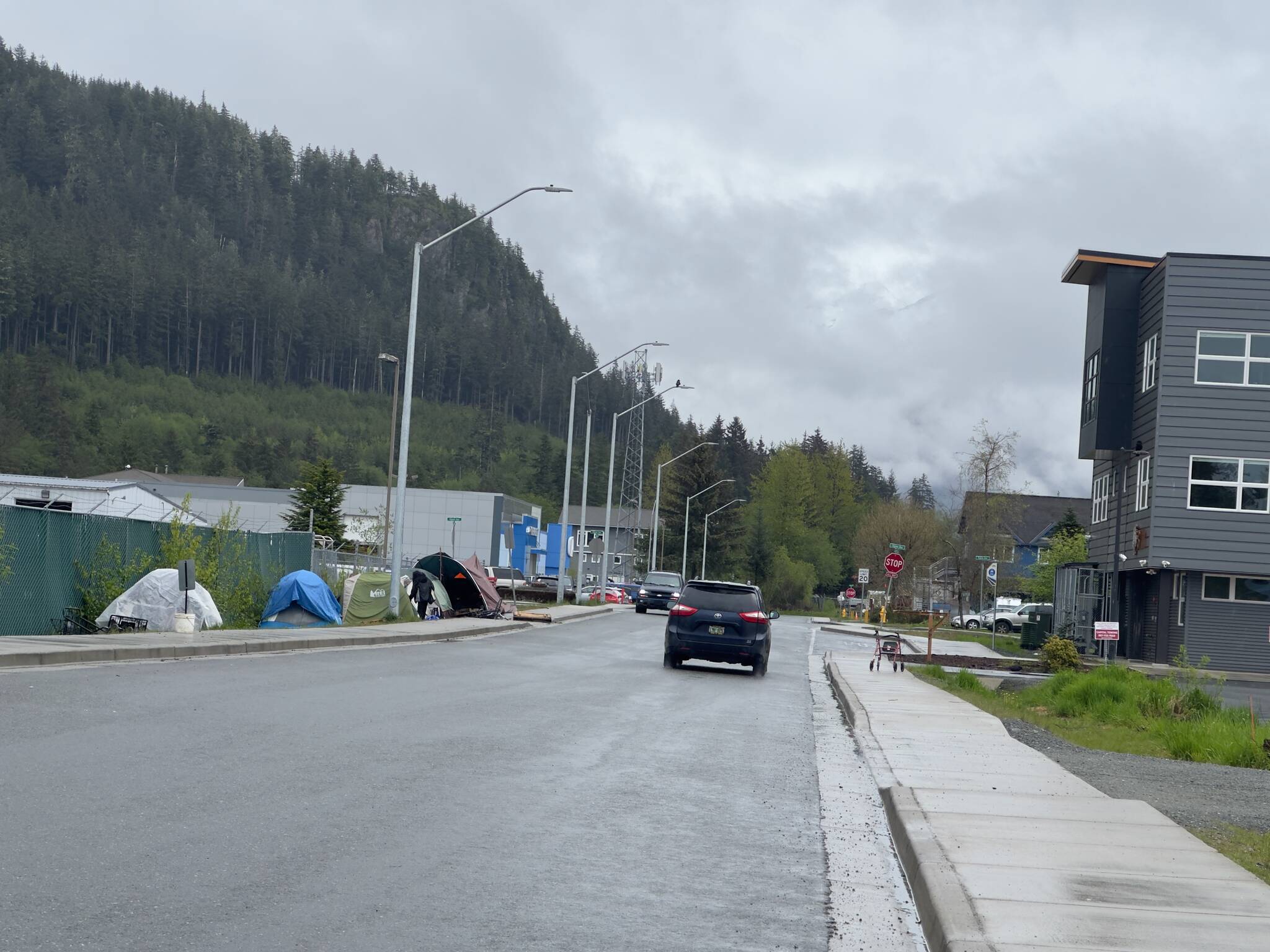
A row of tents where people experiencing homelessness are living is set up along Teal Street on May 24, 2025. (Mark Sabbatini / Juneau Empire)
Police have during the past year broken up large encampments on multiple occasions in certain locations, including a parcel of forested city property between Teal Street and Juneau International Airport that was a popular spot when the dispersed camping policy first took effect. City Manager Katie Koester told Assembly members authorizing the break up of camps requires taking into account the rights of the housed and unhoused alike.
“The manager’s office has offered guidance to all of our departments that interact with the unsheltered population that was carefully crafted to try to strike that balance between allowing people to be on public lands — as long as they’re not harming others or threatening others — and also being able to move and break up those camps when the number of people or the impact becomes such that it has a disproportionate negative impact,” she said. “And that’s a very difficult balance to strike, and it’s very objective and different people have different interpretations of that. But that is the guidance that our officers, and our parks rangers and others, are operating under. And so it is definitely difficult.”
Similarly, just because an unhoused person is carrying a knife or other weapon doesn’t mean police can automatically make an arrest, Municipal Attorney Emily Wright said.
“People in Alaska we have a right to open carry guns,” she said. “We can have guns, we can have knives, we can have weapons — whether we’re homeless or not, we’re treated exactly the same. But it’s the behavior with those items that will get someone in trouble. So if someone is threatening or if someone is intimidating we would encourage them to call the Juneau Police Department immediately — not an hour later, immediately — and the police can come and hopefully deescalate the situation and refer charges if necessary.”
Wright said the frustration with seeing people who are arrested quickly back on the street is understandable, but that doesn’t mean local police and other officials aren’t taking action seeking to reduce the community impacts.
“I would just encourage you to remember the homeless population is very, very visible,” she said. “I too have walked past Teal Street. But just because 20 or 30 people are visible doesn’t mean that the police aren’t doing something (and) prosecutors aren’t doing something. The criminal justice system is woefully inadequate at responding to homelessness. And so we’re happy to continue doing what we’re doing, but I do think it’s important for me to advocate for both JPD and my staff that we are pursuing actions when we can.”
One problem out of everyone’s hands at the local level is funding cuts at the federal and state levels to services that can assist people experiencing homelessness to reestablish stable lives and keep at-risk people from ending up on the streets. Assembly member Paul Kelly, for example, noted Monday that federal cuts by the Trump administration is delaying Gastineau Human Services’ construction of 51 units of long-term housing for low-income people recovering from substance abuse and other disorders.

Residents wait to address the Juneau Assembly about homelessness and other matters of concern during a meeting at City Hall on May 19, 2025. (Mark Sabbatini / Juneau Empire)
The report card after the first summer of dispersed camping was the policy was an improvement over the situation that existed at the official campground the previous summer, Deputy City Manager Robert Barr told Assembly members last fall. However, after several residents emphasized Monday the current situation is worse than city leaders seem to realize there was acknowledgement further evaluation is needed.
“We’ll continue this discussion another day because it’s far from over,” Mayor Beth Weldon said.
Tullis, who spent part of Saturday gathering materials to help McPhail construct a camping platform for them to move to by Monday, said it may be worth trying an official campsite again now that everyone knows the impacts without one.
“The issue is there’s quite a few homeless people in Juneau and there’s just not enough spots,” he said. “If they actually even had any kind of spot that we could go I think we all would go there and try to do it better than last time.”
• Contact Mark Sabbatini at mark.sabbatini@juneauempire.com or (907) 957-2306.
