
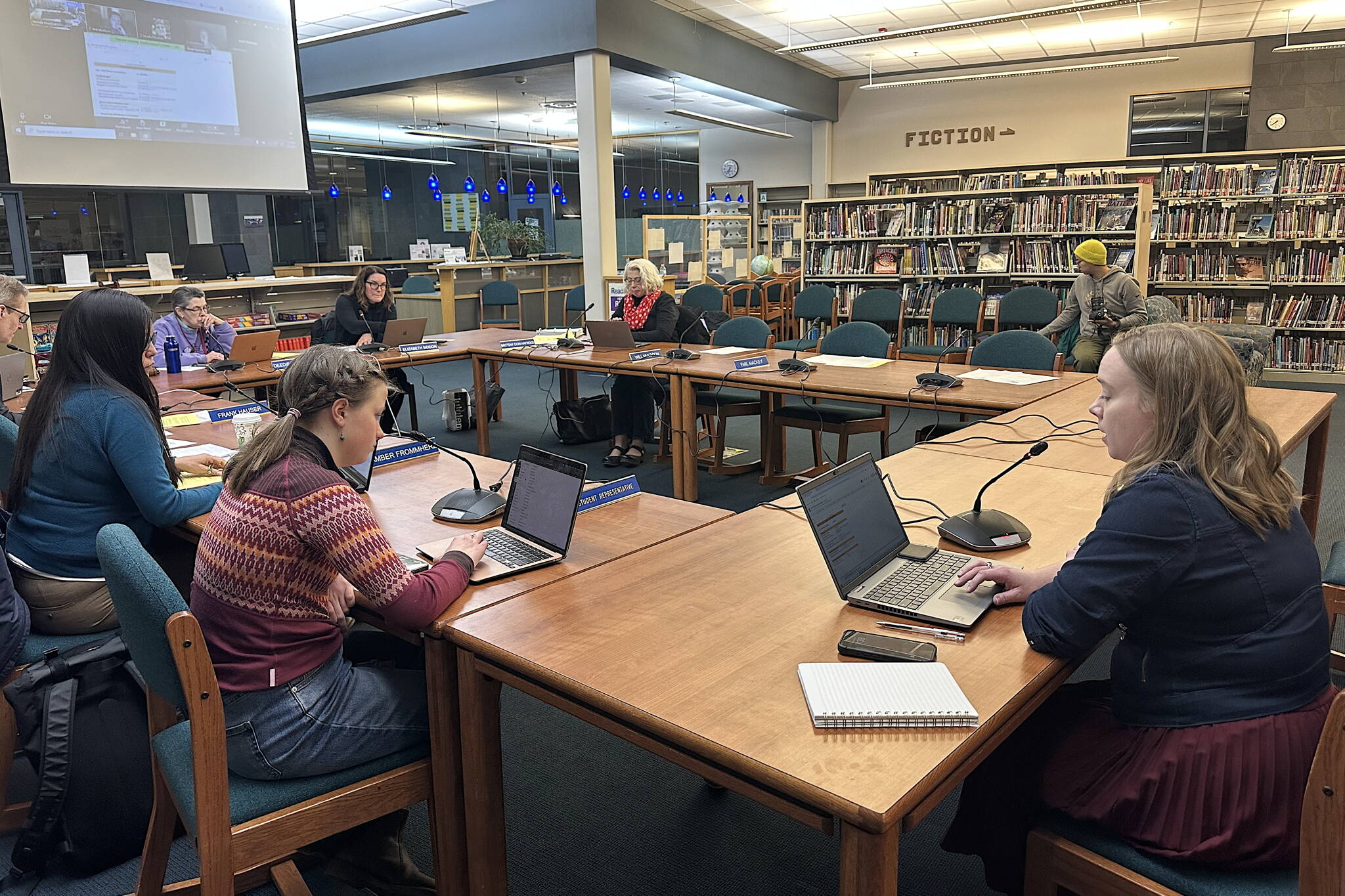
A year after the Juneau School District went through a cataclysmic budget process and restructuring — which districts in Anchorage and Fairbanks are now going through — the school board is looking to finish a comparatively tranquil budget process by patching a relatively small deficit before passing a budget for the coming year on Thursday.
District leaders need to trim about $737,000 so its books for the current fiscal year and next year’s proposed $78 million operating budget balance. But there’s a strong possibility it will be an unnecessary exercise since next year’s proposed budget assumes no staff vacancies — a $2.1 million extra cost compared to assuming the historical trend of a 3% vacancy rate will continue — as well as less state funding than legislators are currently supporting.
The budget also assumes state lawmakers will approve an increase of $400 in the Base Student Allocation, while an increase of at least $680 is being supported by the majorities in both the House and Senate — roughly a $2 million difference for the Juneau School District. The House on Wednesday passed a bill increasing the BSA by $1,000, while Senate leaders are drafting a budget that assumes a $680 increase.
“We’re taking a conservative approach,” Britteny Cioni-Haywood, chair of the Juneau Board of Education’s Finance Committee, said Wednesday.
The school board spent about two hours during a meeting Tuesday night reviewing and making adjustments to the proposed budget, including approving the zero-vacancy presumption. The board also asked district administrators to come up with possible trims in the current year’s budget that will allow the savings to carry over into a balanced spending plan for the coming year.
A $680 BSA increase next year — the same amount previously approved by state lawmakers on a one-time basis for the current year— would give the school board additional funds for staff and programs according to a priority list crafted by district officials in anticipation of that possibility.
However, school district leaders have also said they’re keeping an eye on unexpected and unknown factors that could affect the fiscal picture. Those include wholesale firings and cuts at the federal government level since, while federal funds are a small sliver of the district’s funding, they could adversely impact various grants as well as the state’s funding capability if it tries to make up for large cuts to programs such as Medicaid.
The school board is scheduled to vote on a “final” district budget during a special meeting at 5:30 p.m. Thursday at Thunder Mountain Middle School, so that the spending plan can be submitted by March 15 to the Juneau Assembly for review and approval. However, further adjustments to next year’s budget are likely before the fiscal year starts July 1, as well as during the fiscal year to deal with contingencies and corrections that arise.
Key provisions of the proposed budget, according to financial documents presented to the school board:
● Reducing the pupil-teacher ratio for grades 4-6 to 28:1 instead of 30:1, by adding five full-time equivalent staff positions at a cost of $584,505.
● An assumed enrollment of 3,831 K-12 students, a 3.1% decline from this year, resulting in corresponding drops in per-pupil funding and staff.
● Assumes a 2.5% pay increase for instructors.
● Assumes the City and Borough of Juneau will continue providing the maximum allowed under state law. CBJ is projected to provide about $35 million, an increase of $572,674, compared to about $36 million in state funds (with a $400 BSA increase) and $327,000 in federal funds. However, CBJ would not fund “shared services” maintenance for buildings used by both the municipality and school district, after providing about $1.65 million for the current year and $3.9 million last year as part of the district’s efforts to emerge from its financial crisis.
The district also plans to spend about $6.1 million from its fund balance — money that exists due to this year’s extra BSA funding, an unexpectedly high staff vacancy rate triggered by last year’s school consolidations and other factors. That surplus marks a drastic turnaround from a scenario presented in January of 2024 when the district was facing a nearly $10 million projected deficit.
The turmoil that affected Juneau’s school system last year has been occurring in districts statewide, which educators say is largely due to state funding that has remained relatively flat since 2011.
The Anchorage School District, facing a deficit of more than $110 million, approved a budget at the end of February that eliminates all middle school sports and some high school sports, language-immersion and gifted-student programs that about 7,500 students are enrolled in, and hundreds of staff positions. Fairbanks North Star Borough School District leaders have voted to close three schools next year and are proposing cutting nearly 170 staff positions.
• Contact Mark Sabbatini at mark.sabbatini@juneauempire.com or (907) 957-23o6.
