
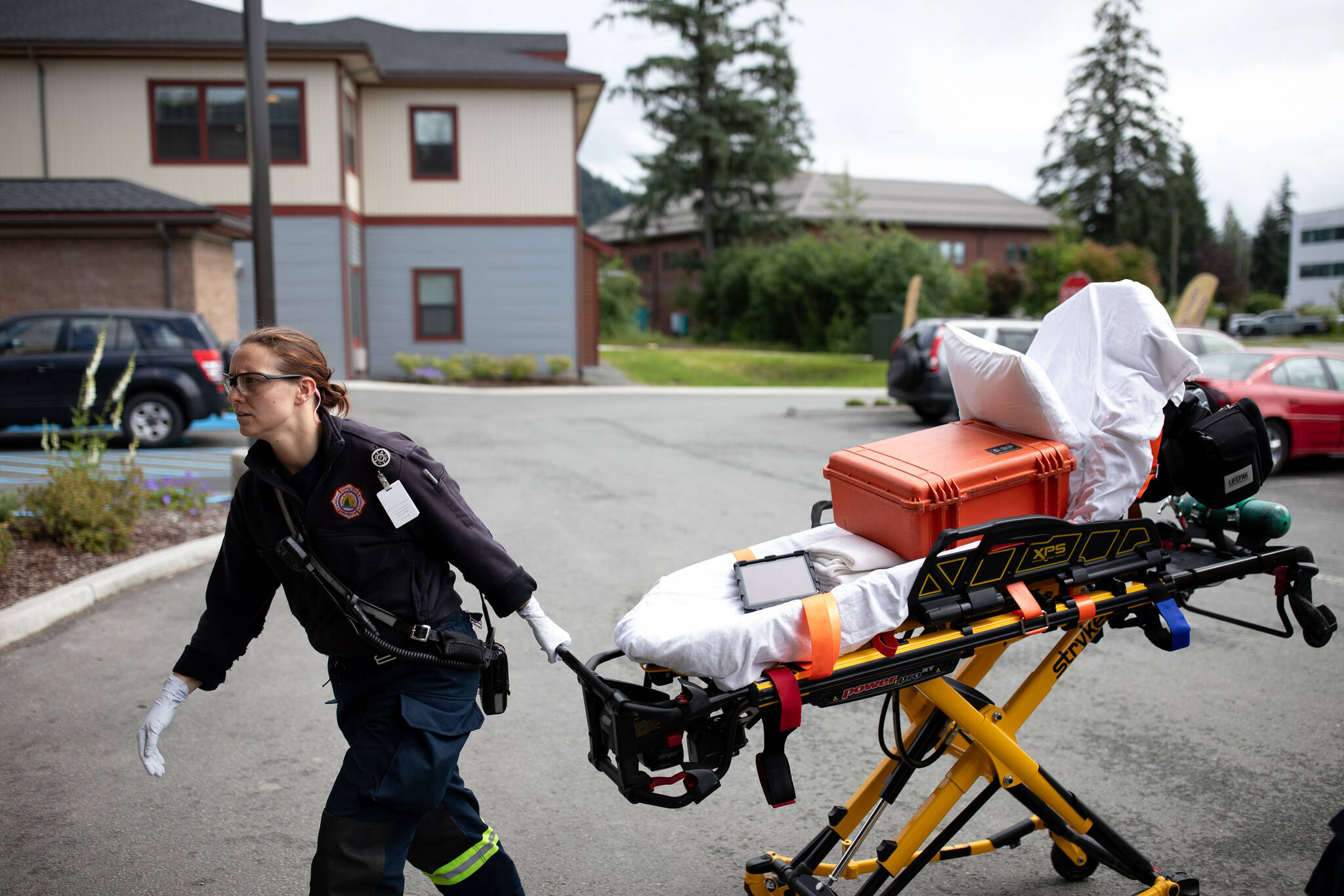
Staffing shortages at Capital City Fire/Rescue could threaten public safety, union representatives say.
But recruiting and retaining staff depend on higher wages, and CCFR salaries fall in the 20th to 25th percentile of the range of pay firefighters receive in the Pacific Northwest, according to a city study. Cheyenne Sanchez, vice president of Juneau Career Firefighters, IAFF Local 4303, took the issue to the Juneau Assembly in January just before contract negotiations began with the City and Borough, which are ongoing.
The city’s summer call volume has surged in the past 17 years, driven by a 60% increase in cruise ship passengers since 2007, according to an April 24 press release issued by the firefighters’ union.
Union president Logan Balstad said the department’s emergency medical response capabilities have regressed to levels that are no longer sustainable for the volume and complexity of calls. With six expected vacancies in a department of 42 full-time positions, CCFR will likely only be able to staff two ambulances during Juneau’s busiest season.
Every day, CCFR guarantees the 24-hour availability of two ambulances, two fire engines, and two airport engines.
However, the Federal Aviation Administration mandates the airport fire engines, which means they are geographically limited to the airport and not available to the general public. A third ambulance is staffed when personnel levels allow, dependent on overtime to fill one or two additional positions.
“In our ideal world, we’d have four ambulances year-round in Juneau,” Balstad said. “To be a little more realistic, we’d have four through the summer and we’d have three the rest of the year. The goal would be to have enough people working here to have at least the third ambulance staffed all the time, so we can do better for the public.”
Balstad said the third ambulance was staffed for 43% of the 2024 cruise season, with employees working overtime.
“A third of the tourist season required overtime to staff it, so that required somebody, at least one person, and up to two people, working 48-hour shifts instead of their normal 24s in order to staff that,” he said. “Only 12% of the time were we able to staff it without overtime, so I expect that we will have to have more overtime to staff the same ambulance.”
In addition to the staffing shortage, the department has five personnel on family medical leave, which limits its ability to staff the third ambulance consistently.
Balstad said that was the case for most of April.
“We just expect it to happen more frequently through the summer with the greater population,” he said. “Certainly some of that happened in the month of April, where we have what we call stacked calls, meaning if the ambulance that would normally respond to you is already busy on a call, either an ambulance has to come from across town to help you or you have to wait until one of the ambulances is in service.”
He said working overtime can sometimes be detrimental to morale, and community members and city leadership need to recognize the severity of the situation, and work toward immediate solutions to restore adequate staffing and protect public safety.
“We, the firefighters, want to provide the best service that we can,” he said. “We need people to do it. We want the city to work towards having enough people working here to get the job done, to do it in a timely manner.”
Fire Chief Rich Etheridge said approximately 16% of the calls in 2024 were stacked. Although an ambulance was not immediately available, fire engines carrying advanced medical equipment responded. All personnel are certified at a minimum as EMTs or paramedics.
“The engine still responds, starts to care, and then they wait for the ambulance to do the transport,” he said. “Unless we have a big, large working fire, we typically try and have somebody respond to at least start care, start doing some assessment. A lot of the calls that are non-emergent, it’s okay if somebody waits for a few minutes. It’s those critical, time-sensitive calls that we try to put all the resources towards.”
Within the stacked calls last year, 3% of the time, no ambulance or engine was immediately available. In these cases, Etheridge said, a chief or EMS officer responded. That will continue this summer.
“When this happens, we initiate a tiered response: off-duty personnel, volunteers, and chief officers are paged,” he said. “The duty officer evaluates the nature of the call — if it’s deemed an emergency, an all-call is toned out. If it is a non-emergent request, the caller is placed in queue until the next available unit clears.”
Etheridge said call volumes increase approximately 10% during the summer compared to winter, further straining resources and increasing the likelihood of stacked calls.
“Understanding these dynamics is critical as we assess staffing levels, plan for seasonal surges, and evaluate system capacity,” he said. “These figures reinforce the importance of maintaining advanced life support capabilities on our engines and a flexible, responsive staffing model to meet our community’s needs.”
Etheridge said most of the unfilled positions are EMTs. The department gives a $25,000 retention bonus to paramedics who commit to a certain number of years, and CCFR pays for most of the expense of sending people through paramedic school.
“We’ve had a lot of success with taking EMTs in our department and turning them into paramedics,” he said.
He said the department will have information about new hiring incentives in the coming weeks.
“We’re really focusing on some of the younger folks here in Juneau, trying to build careers for people that are born and raised here, and have roots in Juneau, and want to stay in Juneau,” Etheridge said. “Because we do hire a lot of people from out of state and they’re more likely to end up going somewhere else, whereas, if all their families are here in town, they’ve got stronger ties to stay in the community.”
• Contact Jasz Garrett at jasz.garrett@juneauempire.com or (907) 723-9356.
