
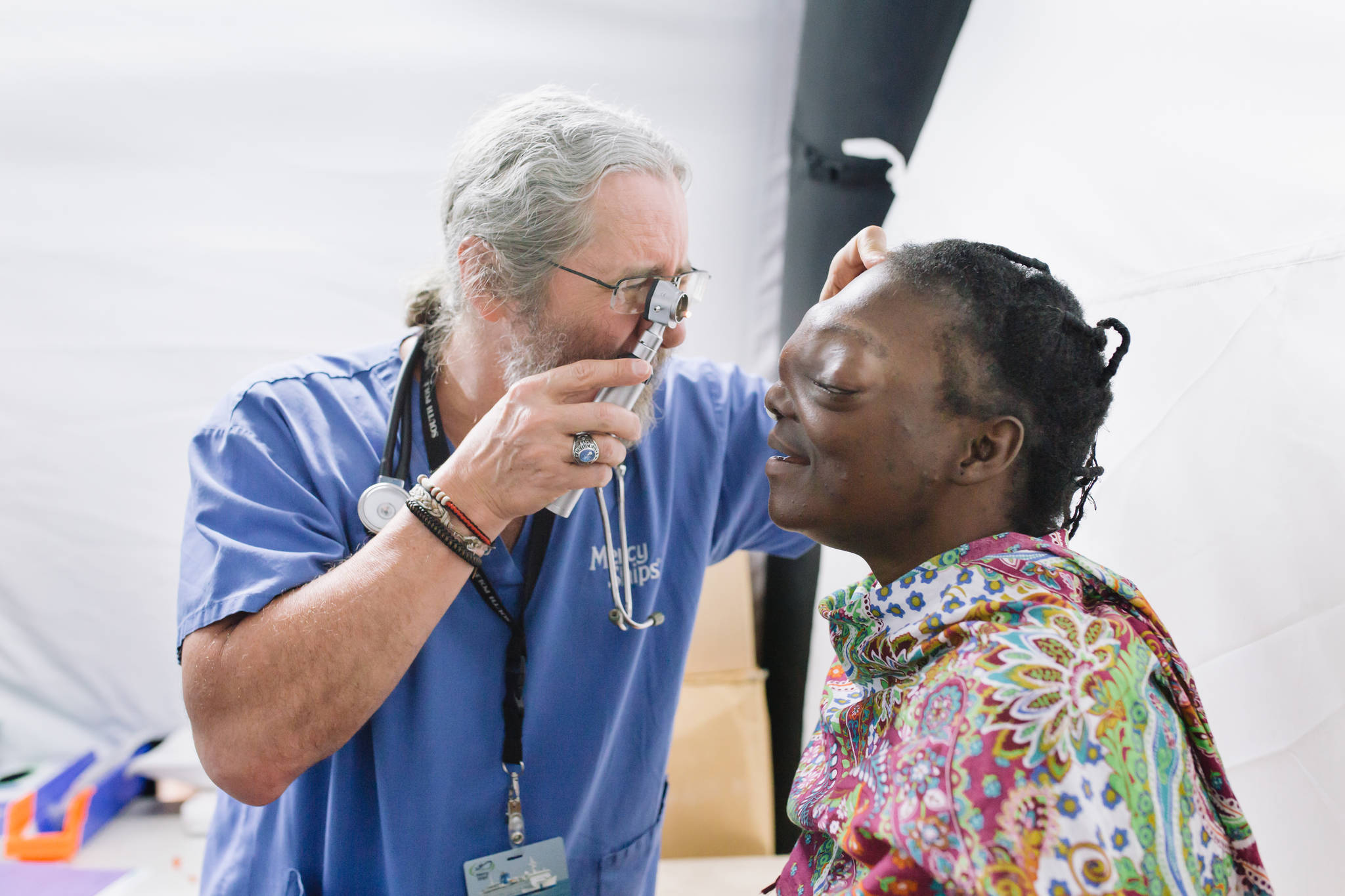
Stationed on a floating hospital off the coast of Cameroon, Dr. Mark Peterson witnesses extreme transformations on a regular basis.
Peterson is a longtime Juneau resident who is currently serving with Mercy Ships, an international charity organization that provides free health care to some of the world’s poorest nations.
Some people have enormous facial tumors or goiters removed. Some have their entire faces reconstructed after losing their nose or cheek to a gangrenous infection called noma. The transformations that stand out the most, Peterson said, are the ones he sees in children.
One of the most common operations on board is cataract surgery, and some of the children who undergo the surgeries have never been able to see normally. Peterson said it’s “heartwarming” to unwrap the bandages after surgery and see the children’s reactions as they see the world clearly for the first time.
“You take the bandages off their eyes and it’s like watching a flower go from a bud to blooming within seconds,” Peterson said.
Peterson, who worked as a physician for the Southeast Alaska Regional Health Consortium (SEARHC) in Juneau for 27 years before his retirement in 2010, has worked all over the world. He’s done mission trips like this before, and also worked for a time as a doctor at McMurdo Station in Antarctica.
He applied for a position with Mercy Ships in 2017, and was selected as one of the about 400 volunteers to board the hospital ship. Allison Holisky, the director of recruiting for Mercy Ships, said there were more than 3,400 applications in 2017. About 8 percent of those applicants were for surgeons or physicians, she said, and roughly half of the people on the ship are not medical professionals.
After being accepted into the program, Peterson began working on the ship (called the Africa Mercy) in January and is now about halfway through his three-month stay.
The volunteers are from 40 countries, making for an interesting mix of languages and approaches. Peterson said it’s especially entertaining right now, as he watches the Winter Olympics alongside people from Norway, Ireland, Canada and the Netherlands all rooting for their countries.
Peterson, who turns 63 next month, works closely with a surgeon from Norway and a plastic surgeon from South Africa. They’ve learned from each other about their different medical approaches and about what life is like in their respective countries.
Together, they help treat patients for a wide variety of ailments. Burns from cooking fires are common, Peterson said, as are cataracts, malaria and tumors.
Some of the patients are social pariahs because of their physical deformities or disorders, Peterson said, and treating those problems can totally change a person’s life. He recalled one woman he treated recently who had a pineapple-sized tumor removed from her jaw.
Peterson said you could spend an entire career at a prestigious medical center such as the famed Mayo Clinic without seeing the kinds of issues he and his colleagues see daily in Cameroon.
“This is just an amazing place,” Peterson said. “For the problems they deal with, it’s almost like a little Mayo Clinic stuck here in Sub-Saharan Africa.”
One of those problems is noma, the gangrenous infection that eats away at a person’s face. Many people die from it, Peterson said, but those who survive it are left without parts of their face. Plastic surgeons perform facial reconstruction surgery on these patients to rebuild their faces. It’s a disease that is normally only prevalent in impoverished countries.
There’s a great deal of research that goes into this, Peterson said. Two years before going to a country, Mercy Ships representatives go to that country and conduct research. They interview residents and government officials and identify patients for when the ship arrives. The ship goes from country to country, Peterson said, spending about 10 months in each one before refitting, resupplying and moving on to the next one.
One of the more impressive and valuable services that Mercy Ships provides, in Peterson’s view, is education. Doctors on board help train medical professionals in the villages and the communities to better care for the residents, introducing them to sterilization techniques and other strategies. They also help build clinics, supply equipment and train people in how to use them.
The goal, Peterson said, is to leave the countries better places than when they arrived.
“The ship will be moving on,” Peterson said, “but the needs will still be there.”
• Contact reporter Alex McCarthy at 523-2271 or alex.mccarthy@juneauempire.com. Follow him on Twitter at @akmccarthy.
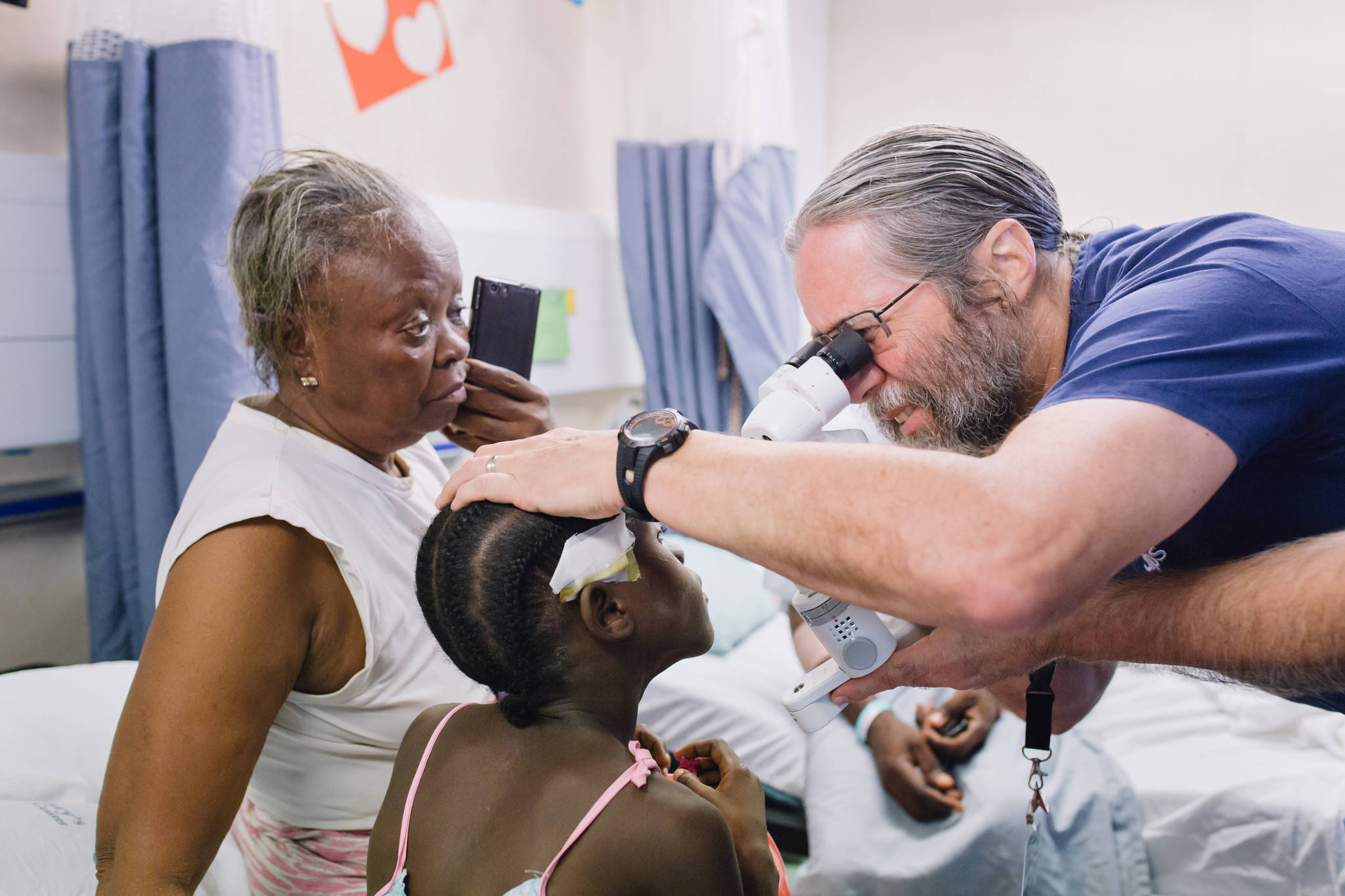
Dr. Mark Peterson checks Monique’s eyes after having her patches removed following surgery by a volunteer surgeon at Mercy Ships. (Shawn Thompson | Mercy Ships)
