
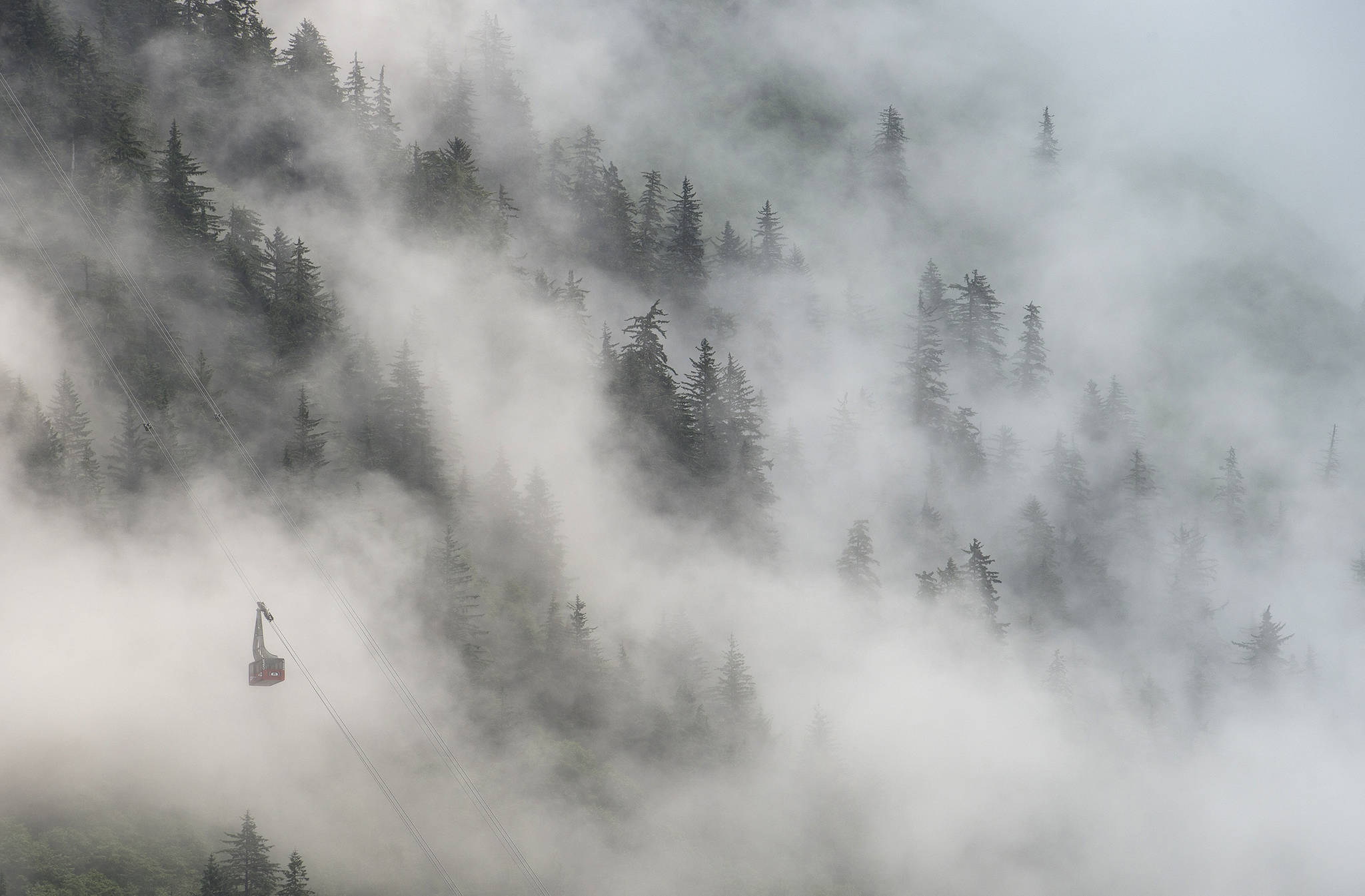
A car from the Mount Roberts Tramway rises through the mist above downtown Juneau on Monday, July 17, 2017. (Michael Penn | Juneau Empire)

A car from the Mount Roberts Tramway rises through the mist above downtown Juneau on Monday, July 17, 2017. (Michael Penn | Juneau Empire)

July’s weather was a busted summer, but forecasters are optimistic for August

Lead forecaster Rick Fritsch of Juneau’s National Weather Service office said it best.

“July of 2017 was in many respects ‘the summer that wasn’t,’” he wrote in a summary of the month’s weather.

Clouds dominated Juneau skies for 28 of 31 days last month, and the three remaining days were partly cloudy by the Weather Service’s guidelines.

July finished as the 10th wettest since recordkeeping began at the airport in 1936, with more than 7 inches reported at the measuring station there. The July normal is 4.6 inches of rain.

“It was a wetter than average month as a whole for a lot of Southeast Alaska and specifically in Juneau,” forecaster Jacob Byrd said on the first day of August. “Basically, our weather pattern — it was not nearly as sunny as normal, and we had a lot of systems that were giving us a lot of rainfall over the area.”

It could have been worse: Just two years ago, Juneau had a record-breaking drenched July with 10.4 inches of rain. Three years ago, 8.26 inches of rain fell in July, the third-most on record for the month. July 2016 was drier and sunnier than normal, however, and judging by the grumbling that could be heard on Juneau sidewalk and online, it reset expectations.

This year’s gloomy July owed a great deal to what Byrd and lead forecaster Joel Curtis call “marine stratus.”

That’s a particular type of cloud formation that comes to Juneau from the Gulf of Alaska.

As Curtis explained, when the Gulf of Alaska sees a bubble of high-pressure conditions, it can create airflow from the Gulf toward Juneau. That flow carries a great deal of humidity because it’s coming over the ocean.

If there are high-pressure conditions high in the atmosphere, that humid air can be compressed into clouds.

“When you have that, and you have the wind blowing inland, you’ll see these low clouds that form up and then they’ll start pouring in every gap,” Curtis said. “Then, when we’re having a real good event, all of the panhandle will just get solid low overcast.”

Those overcast conditions contributed to cooler-than-normal temperatures across Southeast Alaska. In the capital city, July temperatures averaged 55.5 degrees, a fact that might appeal to numerologists but was 1.4 degrees below normal.

Only twice did temperatures reach 70 degrees: On July 6, the thermometer hit 73 degrees, and on July 31, it reached 70 degrees.

While the word for July was “gloomy,” conditions are looking much better for the first week of August, Byrd said.

The latest Weather Service forecast calls for sunny skies and temperatures in the mid-60s or higher by Friday and continuing through the weekend.

“We actually have a chance over the next few days to get some warmer temperatures,” he said.


• Contact reporter James Brooks at james.k.brooks@juneauempire.com or call 523-2258.


More in News

The northern lights are seen from the North Douglas launch ramp late Monday, Jan. 19. A magnetic storm caused unusually bright northern lights Monday evening and into Tuesday morning. (Chloe Anderson/Juneau Empire)
Rare geomagnetic storm causes powerful aurora display in Juneau

The northern lights were on full display Monday evening.

teaser
Juneau activists ask Murkowski to take action against ICE

A small group of protesters attended a rally and discussion on Wednesday.

Cars pass down Egan Drive near the Fred Meyer intersection Thursday morning. (Clarise Larson / Juneau Empire file photo)
Safety changes planned for Fred Meyer intersection

DOTPF meeting set for Feb. 18 changes to Egan Drive and Yandukin intersection.

Herbert River and Herbert Glacier are pictured on Nov. 16, 2025. (Mari Kanagy / Juneau Empire)
Forest Service drops Herbert Glacier cabin plans, proposes trail reroute and scenic overlook instead

The Tongass National Forest has proposed shelving long-discussed plans to build a… Continue reading

A tsunami is not expected after a 4.4-magnitude earthquake northwest of Anchorage Wednesday, Feb. 4, 2026. (U.S. Geological Survey)
No tsunami expected after 4.4-magnitude earthquake in Alaska

U.S. Geological Survey says 179 people reported feeling the earthquake.

ORCA Adaptive Snowsports Program staff member Izzy Barnwell shows a man how to use the bi-ski. (SAIL courtesy photo)
Adaptive snow sports demo slides to Eaglecrest

Southeast Alaska Independent Living will be hosting Learn to Adapt Day on Feb. 21.

Cars drive aboard the Alaska Marine Highway System ferry Hubbard on June 25, 2023, in Haines. (Photo by James Brooks)
Alaska’s ferry system could run out of funding this summer due to ‘federal chaos problem’

A shift in state funding could help, but a big gap likely remains unless a key federal grant is issued.

Photo by James Brooks/Alaska Beacon
U.S. Sen. Dan Sullivan stands with acting Coast Guard Commandant Adm. Kevin Lunday during the after the commissioning ceremony for the Coast Guard icebreaker Storis on Sunday, Aug. 10, 2025, in Juneau, Alaska.
Coast Guard’s new Juneau base may not be complete until 2029, commandant says

Top Coast Guard officer says he is considering whether to base four new icebreakers in Alaska.

Students from the Tlingit Culture Language and Literacy program at Harborview Elementary School dance in front of elders during a program meeting in 2023. (Clarise Larson / Juneau Empire file photo)
Sealaska adds more free Tlingit language courses

The new course is one of many Tlingit language courses offered for free throughout the community.

Most Read