
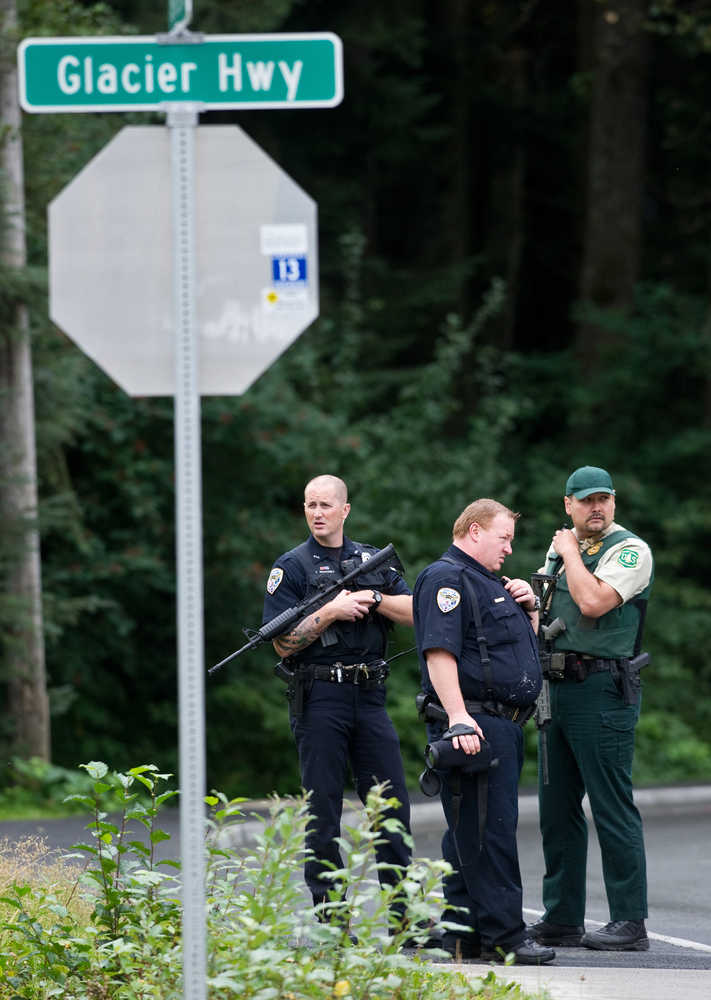
Last year, Juneau Police Department officers used force in about 2.7 percent of all arrests, down from 2013. That rate was lower than in many other police departments, JPD Chief of Police Bryce Johnson said during the city Assembly work session Monday evening.
“We try to be very transparent in our use of force rates,” Johnson told Assembly members before delving into his recently compiled use-of-force report. Of the 1,414 arrests JPD offices made in 2014, 39 involved the use of force, which Johnson defines as anything more than a “control hold.” A control hold, he said, is when an officer takes hold of a suspect, in a nonviolent manner, usually to apply handcuffs. Anything beyond that becomes a tally in Johnson’s use-of-force statistics.
“To count as a use of force, I’m taking that control hold and bringing them to the ground,” Johnson said, explaining his standard of measurement to Assembly members. “I’m striking them. I’m pushing them. I’m using my pepper spray. There are all types of use of force”
On the whole, Johnson said JPD officers are less inclined to use force than their counterparts from the Lower 48. Though he doesn’t know of a single reliable national statistic regarding the rate of arrests that involve the use of force, Johnson said that JPD was below the national average, which he found to be at about 3 percent based on research he conducted for this report. Johnson’s research, he told Assembly members, included talking to police departments in other municipalities from around the country.
In his report, Johnson presented JPD’s use-of-force statistics from the past five years. Though the overall number of arrests and instances in which officers used force are both trending down, the number of arrests has fallen faster — from 1,822 arrests in 2010 to 1,414 in 2014. This means that the use-of-force rate is trending slightly upward. Interesting though it may be, this data set is too small to reveal any long-term changes.
Johnson said during his presentation that the three employees who used force most frequently in 2014 are no longer with the department. He did not elaborate on the reason for their departure.
With a little more than a month left to go, this year is on track to have the least uses of force in the past six years. So far, JPD officers have used force in 29 arrests in 2015.
After Johnson’s presentation, Assembly member Jerry Nankervis, a retired JPD officer, pointed out that Juneau police are authorized to use force more frequently than they have. Though Johnson said he had no “hard numbers” to support this claim, he agreed with Nankervis and said that anecdotal evidence corroborates it.
Johnson said that one of JPD’s newest officers, a former law enforcement officer from New Orleans, was surprised to see how “slow” Juneau police are to use force. Lt. David Campbell, a JPD spokesperson, said he too has heard this from the former Louisiana officer. Both Campbell and Johnson said that this comment is fairly common coming from officers who have worked in the Lower 48 before joining JPD.
“I’ve always kind of chalked it up to the fact that this is a small town, and we do have to live with the people we’re dealing with,” Campbell told the Empire on Tuesday.
In many departments down south, officers don’t actually live in the communities they police, which isn’t the case here, Campbell said. “When you don’t live in the place you work, you can be rude or mean or resort to force quicker without having to worry about running into the people you interact with in the grocery store or coaching on the baseball field.”
Johnson explained Juneau’s lower use-of-force rates similarly Monday night.
Assembly member Karen Crane asked Johnson if JPD officers will be required to wear body cameras any time soon. She also asked how officers felt about wearing cameras. Johnson said that he is looking for cameras right now, and JPD will be wearing them as soon as he finds one the department likes. He said that the majority of his staff are looking forward to having cameras.
“After Ferguson (Missouri), a lot of officer’s opinions changed,” he said. “Attitudes have changed since the national debate started, and officers see cameras as a source of protection for them.”
