
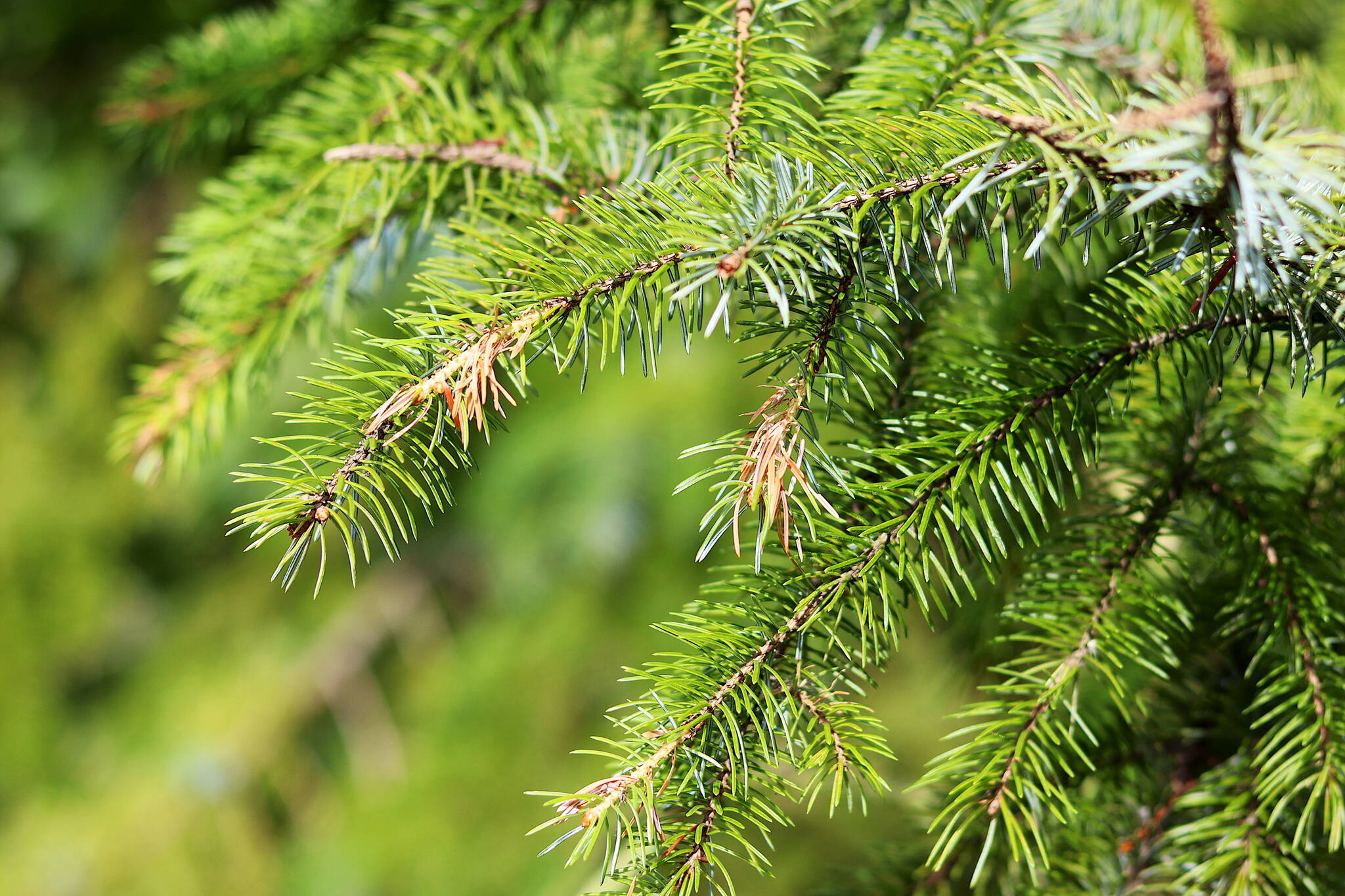
Pine needles on a tree in the Mendenhall Valley show aftermath of western blackheaded budworms damage Thursday. U.S. Forest officials said an outbreak that started a few ago in Southeast Alaska is declining in most places, but Juneau still has a high infestation rate that is expected to drop off next year. (Mark Sabbatini / Juneau Empire)

Pine needles on a tree in the Mendenhall Valley show aftermath of western blackheaded budworms damage Thursday. U.S. Forest officials said an outbreak that started a few ago in Southeast Alaska is declining in most places, but Juneau still has a high infestation rate that is expected to drop off next year. (Mark Sabbatini / Juneau Empire)

It’s not easy being evergreen in Juneau, as infestation of budworms lingers

Outbreak in Southeast Alaska since 2020 mostly tapering off elsewhere, officials say.

An outbreak of western blackheaded budworms that’s been damaging trees in Southeast Alaska for the past few years is tapering off in most places, but a large infestation is still occurring in Juneau because the larvae arrived here later than some other parts of the region, U.S. Forest Service officials said Thursday.

Such outbreaks have been a normal occurrence every 30 years or so for at least the past century, typically lasting two to three years, and are triggered by “certain environmental conditions,” said Elizabeth Graham, a Forest Service entomologist, during an online press conference. The budworms, which are the larval stage of budworm moths, feed on spruce, hemlock and other trees, leaving the damaged needles with a brownish appearance.

“It can make hillsides look like they’re dying,” she said. “The reality is they’re just feeding on new growth, so in most cases the trees have been able to recover.”
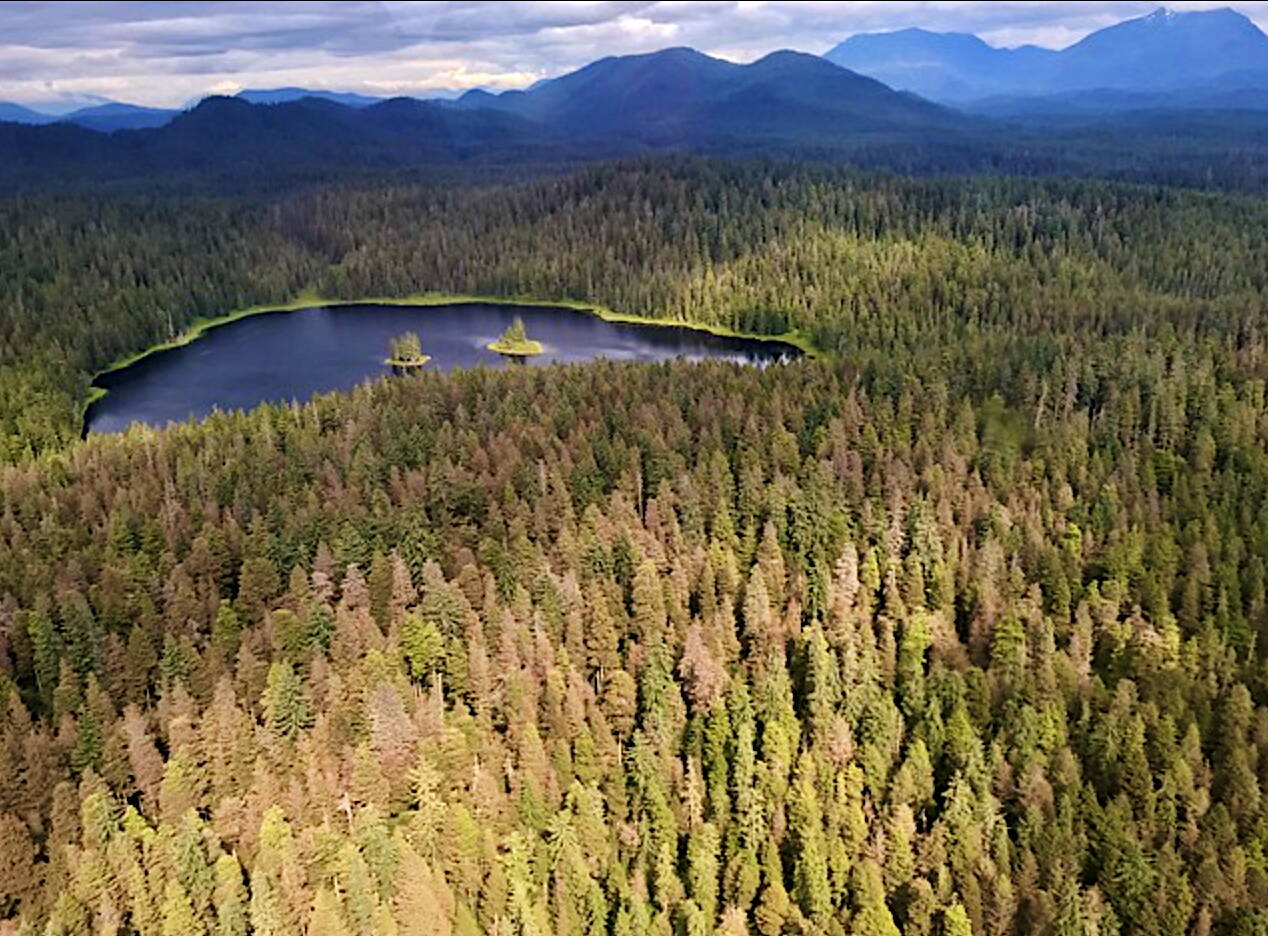
Widespread damage from western blackheaded budworms is seen on Admiralty Island in July of 2021. (Robin Mulvey / U.S. Forest Service)

Widespread damage from western blackheaded budworms is seen on Admiralty Island in July of 2021. (Robin Mulvey / U.S. Forest Service)

Also, even infestations severe enough to kill some trees can be beneficial to the forest’s overall health in the long run, said Molly Simonson, a Forest Service silviculturist, during Thursday’s press conference.

“Trees do die, whether it’s clusters of them during a particular event or individually during forest development,” she said. “Having that scattered among the forest is not a bad thing.”

An update at the forest service’s website, based on data still being collected, states defoliation occurred most heavily in 2021 and 2022, with the worst damage occurring on Admiralty, Kupreanof, Mitkof, and Wrangell Islands, as well as several locations on the mainland. Aerial surveys indicate about 685,000 acres of forest suffered damage — with “mortality” damage consisting of about 73,500 acres of western hemlock in 2022.

Juneau is an outlier in the region, however, since areas ranging from downtown to Echo Cove have significant defoliation occurring, Graham said.

“Mostly it’s because Juneau is really on the fringe of the outbreak,” she said. “We really just started seeing some of the damage here last year.”

But while infestations are peaking in some areas of Juneau, Graham said she expects activity to taper off considerably by next year.

While infestation cycles every few decades have been normal, Graham said climate change may be a factor in the current outbreak.

“If we have fewer frost-free days that tends to be an association with triggering an outbreak,” she said. The outbreaks didn’t extend to British Columbia, she added, “maybe because it was too warm.

“It could be we’re in this perfect little climate window right now for outbreaks,” she said.

But Graham emphasized other variables also are involved — and after outbreaks end due to parasitism, predation, disease and starvation among the budworms “there’s also a time variable to building up that population” again.

• Contact Mark Sabbatini at mark.sabbatini@juneauempire.com or (907) 957-2306.

More in News

The northern lights are seen from the North Douglas launch ramp late Monday, Jan. 19. A magnetic storm caused unusually bright northern lights Monday evening and into Tuesday morning. (Chloe Anderson/Juneau Empire)
Rare geomagnetic storm causes powerful aurora display in Juneau

The northern lights were on full display Monday evening.

teaser
Juneau activists ask Murkowski to take action against ICE

A small group of protesters attended a rally and discussion on Wednesday.

A female brown bear and her cub are pictured near Pack Creek on Admiralty Island on July 19, 2024. (Chloe Anderson for the Juneau Empire)
Pack Creek permits for bear viewing area available now

Visitors are welcome from April 1 to Sept. 30.

Cars pass down Egan Drive near the Fred Meyer intersection Thursday morning. (Clarise Larson / Juneau Empire file photo)
Safety changes planned for Fred Meyer intersection

DOTPF meeting set for Feb. 18 changes to Egan Drive and Yandukin intersection.

Herbert River and Herbert Glacier are pictured on Nov. 16, 2025. (Mari Kanagy / Juneau Empire)
Forest Service drops Herbert Glacier cabin plans, proposes trail reroute and scenic overlook instead

The Tongass National Forest has proposed shelving long-discussed plans to build a… Continue reading

A tsunami is not expected after a 4.4-magnitude earthquake northwest of Anchorage Wednesday, Feb. 4, 2026. (U.S. Geological Survey)
No tsunami expected after 4.4-magnitude earthquake in Alaska

U.S. Geological Survey says 179 people reported feeling the earthquake.

ORCA Adaptive Snowsports Program staff member Izzy Barnwell shows a man how to use the bi-ski. (SAIL courtesy photo)
Adaptive snow sports demo slides to Eaglecrest

Southeast Alaska Independent Living will be hosting Learn to Adapt Day on Feb. 21.

Cars drive aboard the Alaska Marine Highway System ferry Hubbard on June 25, 2023, in Haines. (Photo by James Brooks)
Alaska’s ferry system could run out of funding this summer due to ‘federal chaos problem’

A shift in state funding could help, but a big gap likely remains unless a key federal grant is issued.

Photo by James Brooks/Alaska Beacon
U.S. Sen. Dan Sullivan stands with acting Coast Guard Commandant Adm. Kevin Lunday during the after the commissioning ceremony for the Coast Guard icebreaker Storis on Sunday, Aug. 10, 2025, in Juneau, Alaska.
Coast Guard’s new Juneau base may not be complete until 2029, commandant says

Top Coast Guard officer says he is considering whether to base four new icebreakers in Alaska.

Most Read