
WOOD HEAT: PART 1 – HOW TO COOK WHEN THE FUEL RUNS OUT
BY DICK CALLAHAN
For the Capital City Weekly
Forty percent of humanity still cooks and heats with solid fuel (wood, dung, agricultural waste, coal, etc.) over open fires or leaky stoves. Deforestation ruins the land. Pollution inside the home kills more than million people per year, the majority of them women and children. In poor countries women do most of the gathering, which can average 16 pounds of wood per day. A substantial part of their lives are consumed with the hard work of gathering wood, and it’s dangerous because gathering exposes women to attack while they’re alone in the forest. Until this generation, that’s just how it was.
Enter Larry Winiarski. Back in the 1970’s this guy saw the need and went to work on a super efficient stove that could be made by poor people from locally sourced materials. He built lots and lots of experimental stoves. For this he is called the Grandfather of Rocket Stoves. Winiarski and his low-tech development group, the Aproveho Research Center, are still at it today, tweaking the ratios of getting the most heat onto the cooking surface without choking the fire while, at the same time, burning off most of the harmful particulate matter. With the end of petroleum in sight, people in rich countries look at people in poor countries who use rocket stoves and say, “We should have one of those for a back-up.”
What’s a rocket stove?
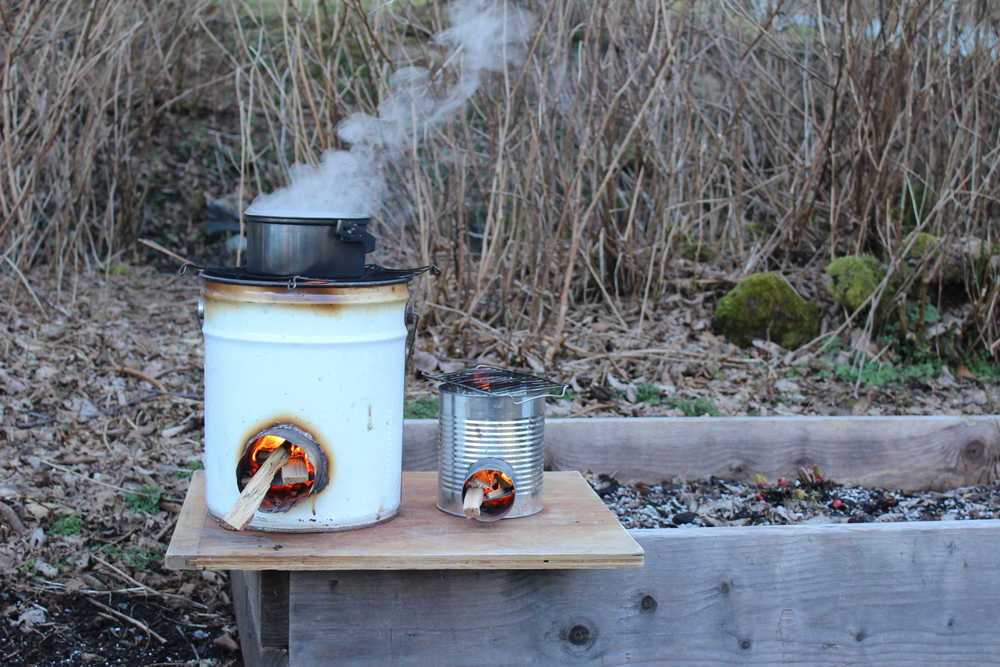
A rocket stove is a J shaped pipe, surrounded by an insulating material, which is surrounded by a container to keep the insulation in place. The pipe can be clay, fire brick or metal. The name comes from a whooshing sound caused by heat drafting up the pipe. In addition to outdoor cooking, there are rocket stoves and ovens for indoor cooking that vent to the outside. There are rocket stoves that heat the whole house, or bath or laundry water. They can fire a steam box for bending wood and some can even get hot enough to forge metal.
Wood is fed horizontally into the bottom of the J. Long. Slender (thumb width or smaller), sticks and kindling work best. If the wood is too large or too much, it decreases efficiency. Simply lay some sticks in the L, put some newspaper or wood shavings in the chimney and light. The ends of the horizontal sticks catch fire. Heat is pulled up the chimney. Unlike a campfire, where the whole stick burns at once, with a rocket stove only one end of the sticks burn. That’s why it’s so efficient. Nearly all the energy in the fuel is concentrated into the small area of the chimney right under the cooking pot. The cook pushes sticks further in, and adds new sticks, as the wood is consumed. To see if it works, it’s easy to make one from a gallon coffee can and two soup cans with wood ashes for insulation. These little stoves can boil two cups of water in about five minutes. It’s a fun, useful project for kids and parents to build together.
Make a rocket stove from recycled cans
1 gallon can, with top off, bottom on
1 regular size soup can, both ends off
1 tall soup can a bit wider than the other can, top end off, bottom end on
Aluminum foil
Ashes or perlite (perlite is that light, pea-size, white puffy volcanic rock they use for loosening up garden soil. Some brands have chemicals added for gardening. I would avoid those and go for straight perlite.)
On the side of the gallon can, about an inch above the bottom, cut out a circle the diameter of your smaller soup can using a saber saw with a metal cutting blade (some people use tin snips). Next cut a hole the same size just above the bottom of the bigger soup can. Slide smaller can into that hole so the soup cans are at 90 degrees. At this point you can wrap them with aluminum foil along the joint so it doesn’t leak heat. Put cans inside the gallon can. Push free end of short can through the circle you cut in gallon can. It should fit snugly. The open end of the bigger can should be almost at the top of the gallon can. Fill space between soup cans and gallon can with perlite or wood ashes. That’s it. There are lots of how-to videos on YouTube for soup can rocket stoves. Most of them would work.
Make a rocket stove in a five gallon metal bucket
1 clean metal bucket (they used to be everywhere but they’re getting hard to find)
2 pieces of 4 inch diameter stainless steel stove pipe, one about 4 ½ inches long, one about 6 inches long. Stainless steel is more expensive than galvanized but galvanized metal gives off toxic fumes at high temperature so get stainless, especially if you’re going to be cooking with it.
1 4 inch 90 degree stainless steel elbow.
4 ½ gallons of perlite (The reason you want light insulation instead of dense stuff like dirt or concrete is that dense stuff absorbs heat instead of sending it up the chimney.)
Make sure the bucket is clean — that is, no toxic residues inside. On the side of bucket draw a 4 diameter inch circle 1 ¾ inch above bottom. Cut the circle out. The easy way to do that is drill a starter hole on the inside of line and cut the circle out using a saber saw with metal cutting blade. Save the circle. Put small pipe into the hole you cut in bucket with the male end facing in. Attach elbow and taller piece. Taller piece should be about an inch below bucket rim. Fill bucket around pipe with perlite. Take the metal circle you saved and lay it inside the intake pipe as a shelf. Your wood will go on top. Air for combustion will flow below it. Put crumpled newspaper and maybe a few twigs in the chimney. Light that baby off. You are now a rocket scientist.
Twelve Good Things About a Rocket Stove in a 5 gallon metal bucket
1) You can make it yourself in two hours—for cheap.
2) Doesn’t rely on petroleum or the grid.
3) You can cook on it, forever, for free.
4) It won’t burn a hole in the yard or burn down into the turf.
5) Little to no smoke.
6) Will boil water with less wood than you’d usually use just to start a cooking fire.
7) If it starts to rain you can pick it up and move it to a protected spot.
8) If the wind shifts, a rocket stove doesn’t burn the leaves of your trees and high bushes like a campfire would.
9) Helps keep mosquitoes and no-see-ums away.
10) You can bring it camping. When you’re done it cools down in a few minutes while you’re breaking camp and you can bring it home.
11) You can adapt it to many projects.
12) You can store it in the shed.
Two closing thoughts:
1) Portable rocket stoves are for sale online. Most of them are made in China. Better than nothing but compared to making one yourself, commercial stoves are expensive and use more resources to manufacture and ship than making your own with what you can fish out of the recycle bin.
2) Aproveho provides plans for emergency rocket stoves to places hit by earthquakes and tsunamis. We haven’t had a tremendous earthquake in Alaska since Good Friday, 1964 and hopefully we’ll never need emergency stoves. If we do though, and there’s a Hurricane Katrina type government goat-rope, then rocket stoves can keep the whole neighborhood cooking their stews and making their mochas until the powers that be get the power back on.
