
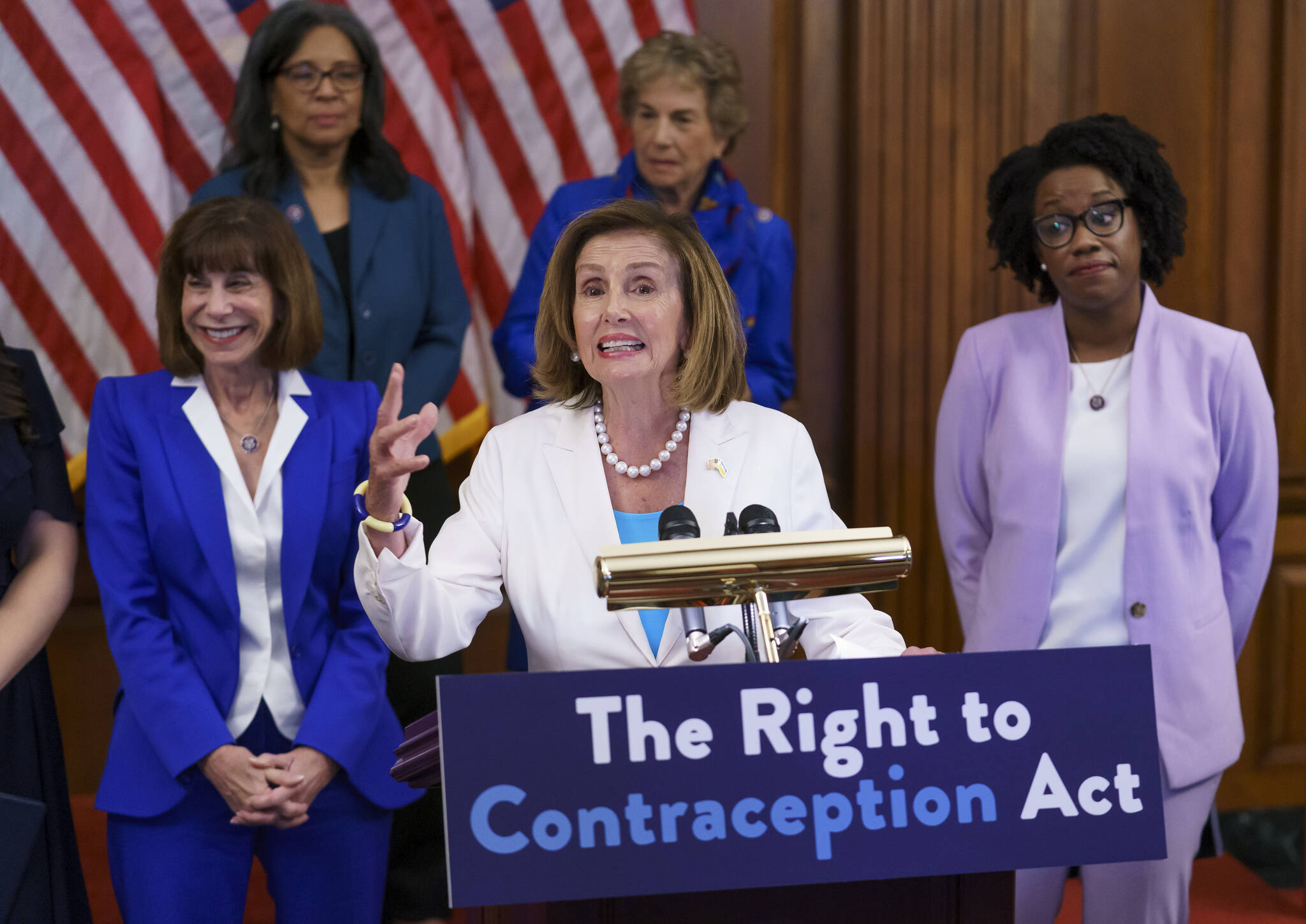
WASHINGTON — The right to use contraceptives would be enshrined in law under a measure that Democrats pushed through the House on Thursday, their latest campaign-season response to concerns a conservative Supreme Court that already erased federal abortion rights could go further.
The House’s 228-195 roll call was largely along party lines and sent the measure to the Senate, where it seemed doomed. The bill is the latest example of Democrats latching onto their own version of culture war battles to appeal to female, progressive and minority voters by casting the court and Republicans as extremists intent on obliterating rights taken for granted for years.
Democrats said that with the high court recently overturning the landmark Roe v. Wade decision from 1973, the justices and GOP lawmakers are on track to go even further than banning abortions.
“This extremism is about one thing: control of women. We will not let this happen,” said Rep. Kathy Manning, D-N.C., who sponsored the legislation. All of the bill’s nearly 150 co-sponsors are Democrats. Addressing fellow lawmakers, she added, “Women and girls across this country are watching you, and they want to know: Are you willing to stand up for them?”
In his opinion overturning Roe last month, Justice Clarence Thomas wrote that the court should now review other precedents. He mentioned rulings that affirmed the rights of same-sex marriage in 2015, same-sex intimate relationships in 2003 and married couples’ use of contraceptives in 1965.
Thomas did not specify a 1972 decision that legalized the use of contraceptives by unmarried people as well, but Democrats say they consider that at risk as well.
Republicans said the bill went too far. They said it would lead to more abortions, which supporters deny, allow the use of drugs not yet fully approved by the Food and Drug Administration and force health care providers to offer contraceptives, even if that contradicted their religious beliefs.
“Women deserve the truth, not more fear and misinformation that forces an extreme agenda on the American people,” said Rep. Cathy McMorris Rodgers, R-Wash.
Every Democrat supported the legislation, while Republicans overwhelmingly opposed it by 195-8. The House Democrats’ campaign committee quickly jumped on that disparity, with spokesperson Helen Kalla saying her party will “fight to protect women’s freedoms from the GOP’s sinister agenda.”
The measure seemed destined to become a campaign issue and not law. Minutes after House passage, Republicans blocked quick Senate approval of a similar bill. Support by at least 10 GOP senators would be needed to reach 60 votes, the threshold required for most legislation to pass in that chamber, which is divided 50-50.
The contraception bill explicitly allows the use of contraceptives and gives the medical community the right to provide them, covering “any device or medication used to prevent pregnancy.” Listed examples include oral contraceptives, injections, implants like intrauterine devices and emergency contraceptives, which prevent pregnancy several days after unprotected sex.
The bill lets the federal and state government, patients and health care providers bring civil suits against states or state officials that violate its provisions.
House Democrats have begun forcing votes on several issues related to privacy rights, hoping for long-shot victories or to at least energize sympathetic voters and donors and force Republicans from competitive districts into difficult spots.
The House voted last week to revive a nationwide right to abortion, with every Republican voting no, and voted largely along party lines to bar prosecuting women traveling to states where abortion remains legal. Neither is expected to survive in the Senate.
Yet the House voted Tuesday to keep same-sex marriage legal, with 47 Republicans joining all Democrats in backing the measure. Though 157 Republicans voted no, that tally raised expectations that the bill could win enough support for GOP senators to pass, sending it to President Joe Biden for his signature.
Nearly all adults, 92%, called birth control “morally acceptable” in a Gallup poll in May. A PRRI poll in June showed about 8 in 10 said they opposed laws that restrict what types of birth control can be used to prevent pregnancy.
Even so, anti-abortion groups and Republican leaders oppose the contraception legislation, and there was no immediate sign that significant numbers of GOP senators would be willing to defy them. In contrast, same-sex marriage has such firm public acceptance and is such a clear-cut issue that growing numbers of Republicans have been willing to vote for it.
Susan B. Anthony Pro-Life America said the contraception legislation “seeks to bail out the abortion industry, trample conscience rights, and require uninhibited access to dangerous chemical abortion drugs.” The National Right to Life Committee said it “goes far beyond the scope of contraception” and would cover abortion pills like RU486, which supporters said was incorrect.
The measure drew a mixed reaction Wednesday from two of the Senate’s more moderate Republicans.
Sen. Susan Collins, R-Maine, said she was “most likely” to support the measure. Sen. Lisa Murkowski, R-Alaska, demurred, saying she was working on bipartisan legislation that she said would codify the rights to abortion and perhaps for contraception.
There are few state restrictions on contraceptive use, said Elizabeth Nash, who studies state reproductive health policies for the Guttmacher Institute, a research organization that supports abortion rights.
Nash said she was concerned that there will be efforts to curb emergency contraceptives and intrauterine devices and to help providers and institutions refuse to provide contraceptive services.
