
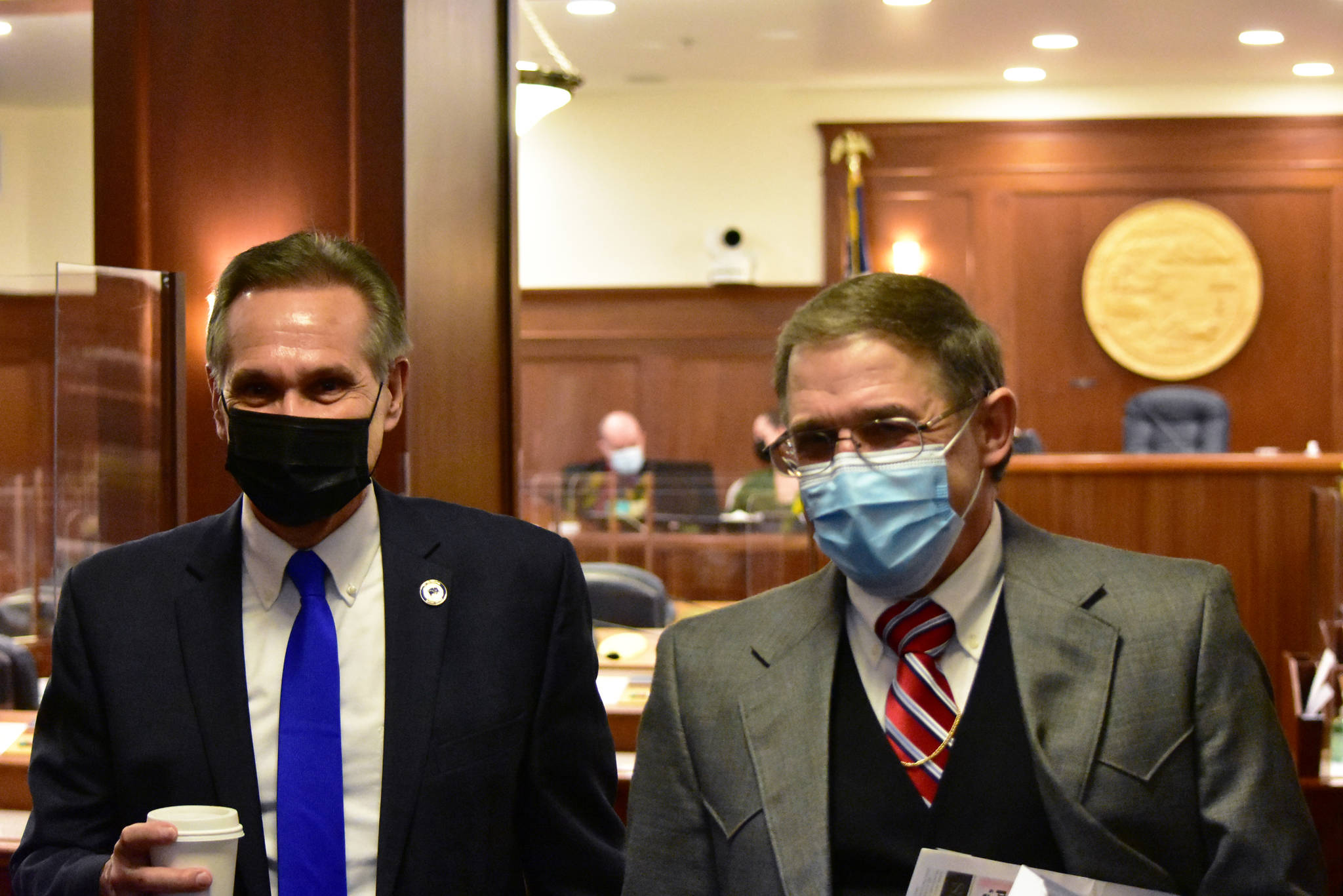
The Alaska House of Representatives again failed to organize leadership for the body, stalling legislative work until at least Monday when lawmakers will meet again.
In an extremely brief floor session Thursday Morning, Lt. Gov. Kevin Meyer, still presiding over the body until a speaker is chosen, was met with silence when he called for nominations for a temporary speaker.
“Not everyone stand at once here,” Meyer said to lawmakers.
Unable to reach a decision, the House adjourned to 10 a.m. Monday, Jan. 25, 2021.
In interviews, lawmakers from both parties said each side was still trying to figure the other out.
Rep. George Rauscher, R-Sutton, said lawmakers were still trying to sort out priorities for their own districts while trying to form a caucus.
[State House remains unorganized after first day]
“In that process it takes time,” he said, adding that he felt the two sides were coming to some understanding.
Rep. Adam Wool, D-Fairbanks, said Democrats had unified around core principles.
“I don’t see that changing,” he said.
Wool suggested House Republicans were less unified, and that many of them wanted a speaker of the house from their own party.
“But Bryce is the man for the job,” he said, referring to last session’s House Speaker Bryce Edgmon, I-Dillingham.
In a statement Thursday afternoon, the bipartisan coalition said it would support policies that protect the Permanent Fund.
“Our coalition’s founding principle is that the Permanent Fund belongs as much to future generations as it does to Alaskans today,” the statement said. “The only way to achieve this goal is by adhering to a fiscally conservative management approach to the use of the Fund’s earnings.”
The House is currently split 20-20 between Republicans and a blended coalition of mostly Democrats, independents and one Republican. In the last session, several Republicans joined Democrats and Independents, creating a coalition majority with an independent Speaker.
But many of those Republicans were voted out in primary races, and there is less willingness to caucus with Democrats this year, said Rep. Steve Thompson, R-Fairbanks.
Thompson was in the coalition majority, as was fellow Fairbanks Republican Rep. Bart LeBon, but without more backing from other party members there wasn’t the same willingness to caucaus with Democrats.
Asked what changed policy wise, Thompson said not much.
“Nothing really. There was six or seven of us that moved over two years ago. a lot of them aren’t back,” he said. “We want to stick as Republicans and we can’t see where we’re going to move forward with the Democrats. We have no intention of going over there this time.”
[Senate organizes, elects Micciche as president]
Without leadership, committee assignments can’t be given and thus bills can only move so far through the legislative process. The Alaska State Senate was able to organize and assign committees, legislation must be moved through both bodies before they can be passed.
Lawmakers who spoke to the Empire all said there were numerous conversations taking place with colleagues to find common ground.
“I want to protect the Permanent Fund and I think that means different things to different people,” said Rep. Andi Story, D-Juneau.
Members of both groups stressed the desire for unity and mande similar statements about finding ways to work toward mutual goals.
“We have to work to agree. We work to agree and disagree,” Thompson said. “I’m optimistic all the time, we’ve got to do the state’s business. I think we’re real close to being in agreement on a lot of things. There’s a lot of civility between the two groups, and I think we’re on the right track.
• Contact reporter Peter Segall at psegall@juneauempire.com. Follow him on Twitter at @SegallJnuEmpire.
