
When children are taken out of their homes due to neglect or abuse, they’re under the responsibility and jurisdiction of the State Office of Children’s Services.
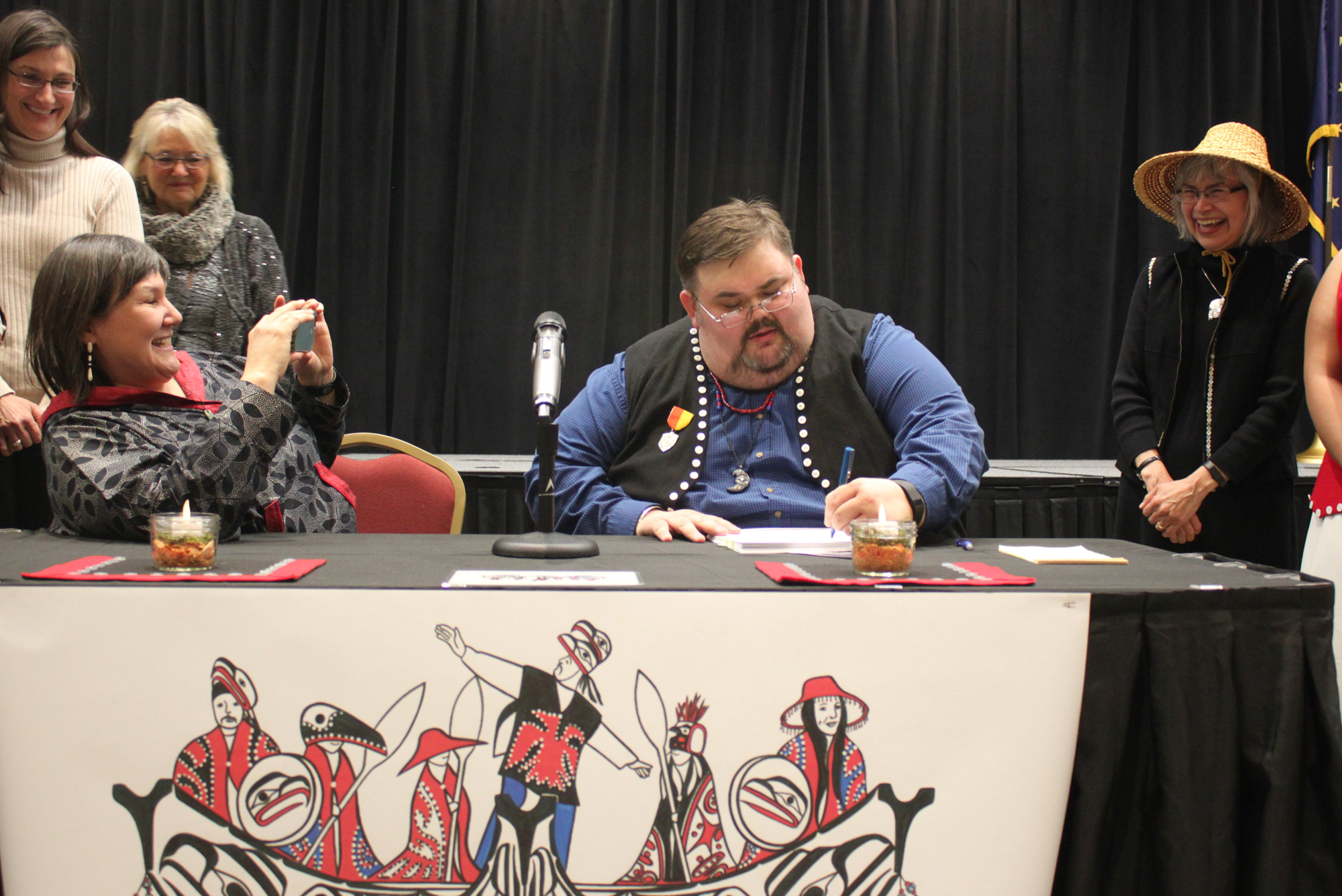
Now, through an agreement signed Wednesday night at the Elizabeth Peratrovich Hall between the State of Alaska and Central Council of the Tlingit and Haida Indian Tribes of Alaska, the Central Council will be able to take over child welfare cases of tribal children.
Instead of going through the state court system, these cases will go through the tribal court system. Instead of state workers overseeing the cases, tribal case managers will work with families. Instead of the state licensing the foster homes, Central Council will recruit and license tribal foster homes and be reimbursed by the state for the cost of foster care placement. “This truly is a government-to-government agreement that recognizes that tribes are uniquely and supremely and ultimately qualified to be able to meet the needs of tribal families,” said Valerie Davidson, Department of Health and Social Services Commissioner. “That’s not new. And quite frankly — if I may as an Alaska Native — we have known that for thousands of years.”
Barbara Dude is a child welfare specialist with Central Council’s Tribal Family & Youth Services. She said parents trying to get their children back will have a better working relationship with a tribal entity than with the state, and be more successful at reunification.
“Families are just more willing to work with us because we’re the tribal workers. They’re more willing to sit down with us and help their case plans,” Dude said.
She also noted that tribal court “is just a friendlier environment.”
President Richard Peterson said Central Council has been working toward the agreement for 16 years and thanked the Office of Children’s Services for working collaboratively. He said Alaska Native families continue to work through issues stemming from historical trauma and the agreement “will begin putting our families back together.”
Central Council will start by taking just a few Juneau cases from the state. Right now, 24 Tlingit and Haida children are in foster homes, the majority of which are in Juneau, according to the Office of Children’s Services. Francine Eddy Jones, director of Central Council’s Tribal Family & Youth Services, said it’s important to be methodical and cautious.
“It’s a process of learning together — Office of Children’s Services, the tribe, the state court and tribal court — to figure out what that handoff looks like,” she said.
Jones said Central Council hopes to provide a lot of support and encouragement to families who’ve had children taken away and tribal foster families, many of whom don’t trust the state.
“It really means taking care of our own,” Jones said. “It means being responsible and respectful and honoring them with the values of the tribe, making sure we’re holding up those families whatever that situation is for why their children are removed, embrace them and provide them the support and services they need to get back on their feet, and hopefully be reunited with their children. That’s our commitment.”
This is only the second such agreement between the state and a tribe. The first was with the Tanana Chiefs Conference in 2013.
• Contact reporter Lisa Phu at 523-2246 or lisa.phu@juneauempire.com.
