
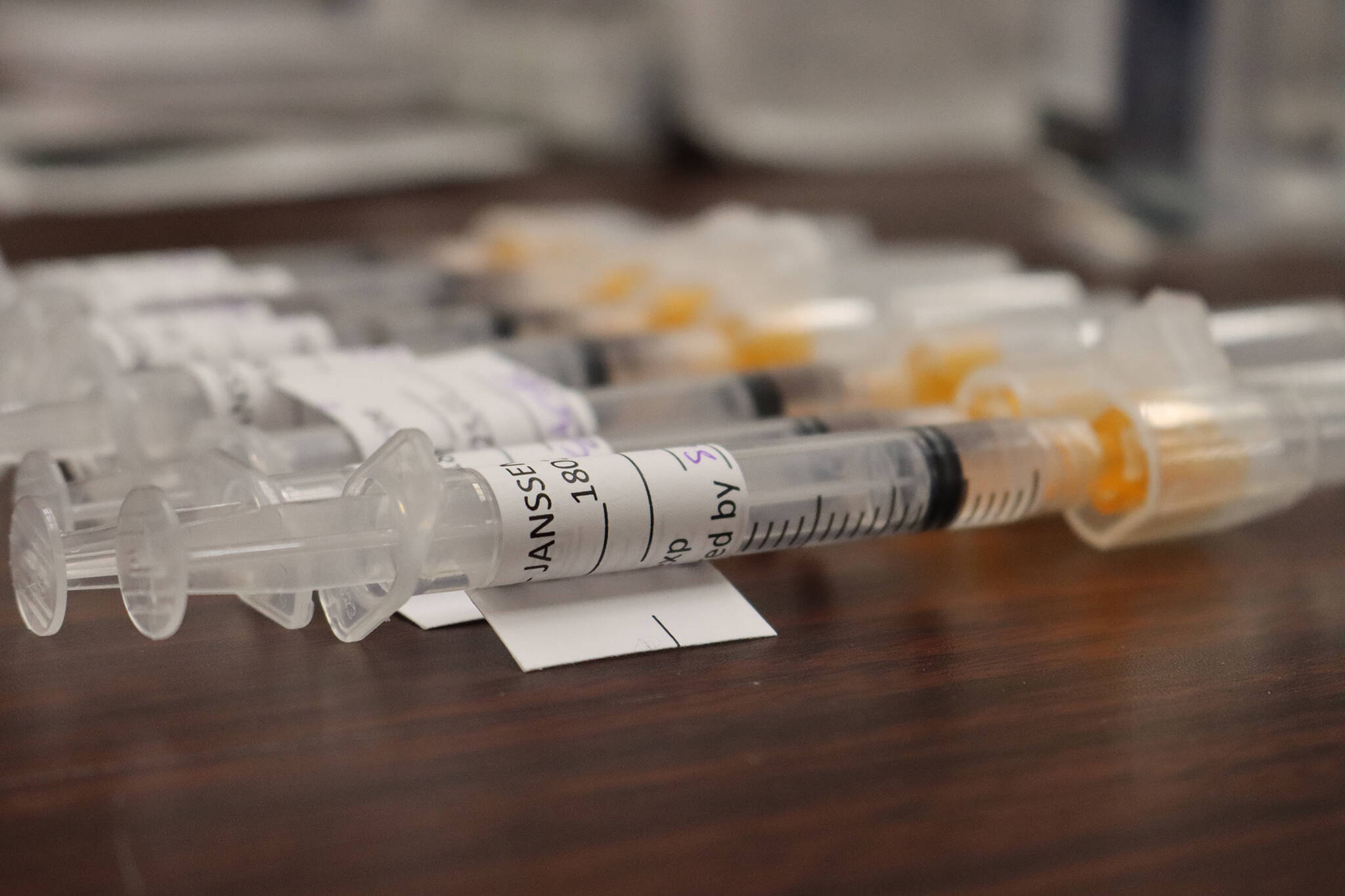
State health officials announced record numbers of COVID-19 cases and deaths Friday, but said the high numbers were the result of a data reporting backlog and needed context.
Alaska reported 1,735 new COVID-19 cases, and 44 new deaths, but Department of Health and Social Services officials said most of those numbers were not recent but a bulk of cases reported as department staff work through a backlog of data reporting.
Emphasizing that COVID-19 was present in Alaska and putting immense stress on the state’s health care system, DHSS Commissioner Adam Crum said some of the cases reported Friday went back several months.
“We are trying to do the current cases while at the same time they’re trying to add and work through this backlog,” Crum said via videoconference.
Of the 44 deaths, 41 were residents, said Dr. Anne Zink, the state’s chief medical officer, and came from a variety of age groups. According to DHSS, 514 Alaskans have died of COVID-19 since March, 2020.
Crum and other DHSS officials said reporting cases is a time-consuming process that requires a lot of work including potentially interviewing patients. As the pandemic progressed, the number of cases DHSS staff were able to report reached a breaking point, according to Dr. Louisa Castrodale, epidemiologist with DHSS. Castrodale noted Alaska has a very high testing rate, which accounts for both the high number of cases reported by health authorities and the data input backlog.
State Epidemiologist Dr. Joe McLaughlin, said looking at the reported onset date portrayed a more accurate depiction of the COVID situation in the state. However, officials stressed that the daily reported numbers were far higher than what the state was actually experiencing, COVID-19 was straining Alaska’s health care.
[Bartlett to search for interim CEO]
The City and Borough of Juneau uses an average daily case rate over seven days to determine what level of risk the city is at for COVID-19, and Castrodale said that number was a fairly accurate representation of the virus situation. Positive test numbers are reported quickly according to Castrodale, and not as affected by data-reporting backlogs.
“Red is red,” Castrodale said.
DHSS data show the state’s average daily case rate at 973.9 cases per 100,000 people, and Juneau’s at 837.2 per 100,000 people. According to the Centers for Disease Control and Prevention, the U.S. average daily case rate is 247.
Both the city and state are experiencing their highest levels of COVID since the beginning of the pandemic, Zink said, and the majority of the cases requiring hospitalization were among unvaccinated people.
“It’s a reminder that we’re not powerless,” Zink said, urging people to get the vaccine if they haven’t already.
Booster doses for the Pfizer vaccine have been approved for certain populations by the CDC, Zink said, and the state will begin administering those doses soon.
Locally, CBJ announced booster doses will be available to eligible residents at Juneau Public Health Center on Tuesday, Sept. 28. The city will also host another mass-vaccination clinic at Centennial Hall, Oct, 1-2, for booster shots. First and second doses will also be available for anyone aged 12 and up.
Sign-up for the Sept. 28, clinic is currently available at juneau.org/vaccine, CBJ said in a release, and sign-up for the October clinic begins Sept. 27, at noon.
McLaughlin said that while those who had caught and recovered from COVID-19 did have some immunity, studies were showing the natural immunity fades over time and is not as effective as the vaccines. Furthermore, McLaughlin said studies were showing that even COVID-positive individuals who were asymptomatic were not immune from long-term side-effects of the virus.
Fully vaccinated people do still get COVID-19 and some have even died, McLaughlin said, but the vast majority of vaccinated people who test positive experience no symptoms at all.
Monoclonal antibody treatment is available at clinics throughout Alaska, but Zink said that treatment was highly dependent on timing. According to the Food and Drug Administration, “monoclonal antibodies are laboratory-made proteins that mimic the immune system’s ability to fight off harmful pathogens such as viruses.”
The antibodies are administered to unvaccinated people who’ve tested positive for COVID-19, but before the virus has progressed to a serious point. Alaska was one of the first states to make that treatment available, Zink said, and it had shown to reduce the risk of hospitalization in COVID-positive patients.
“The great thing is you can make your own antibodies by getting vaccinated,” Zink said.
• Contact reporter Peter Segall at psegall@juneauempire.com. Follow him on Twitter at @SegallJnuEmpire.
