
This article has been updated with additional information.
An executive order giving the governor full control of the Alaska Marine Highway Operations Board got skeptical treatment from members of the state Senate, while state transportation officials argued it will result in a less contentious and more accountable board.
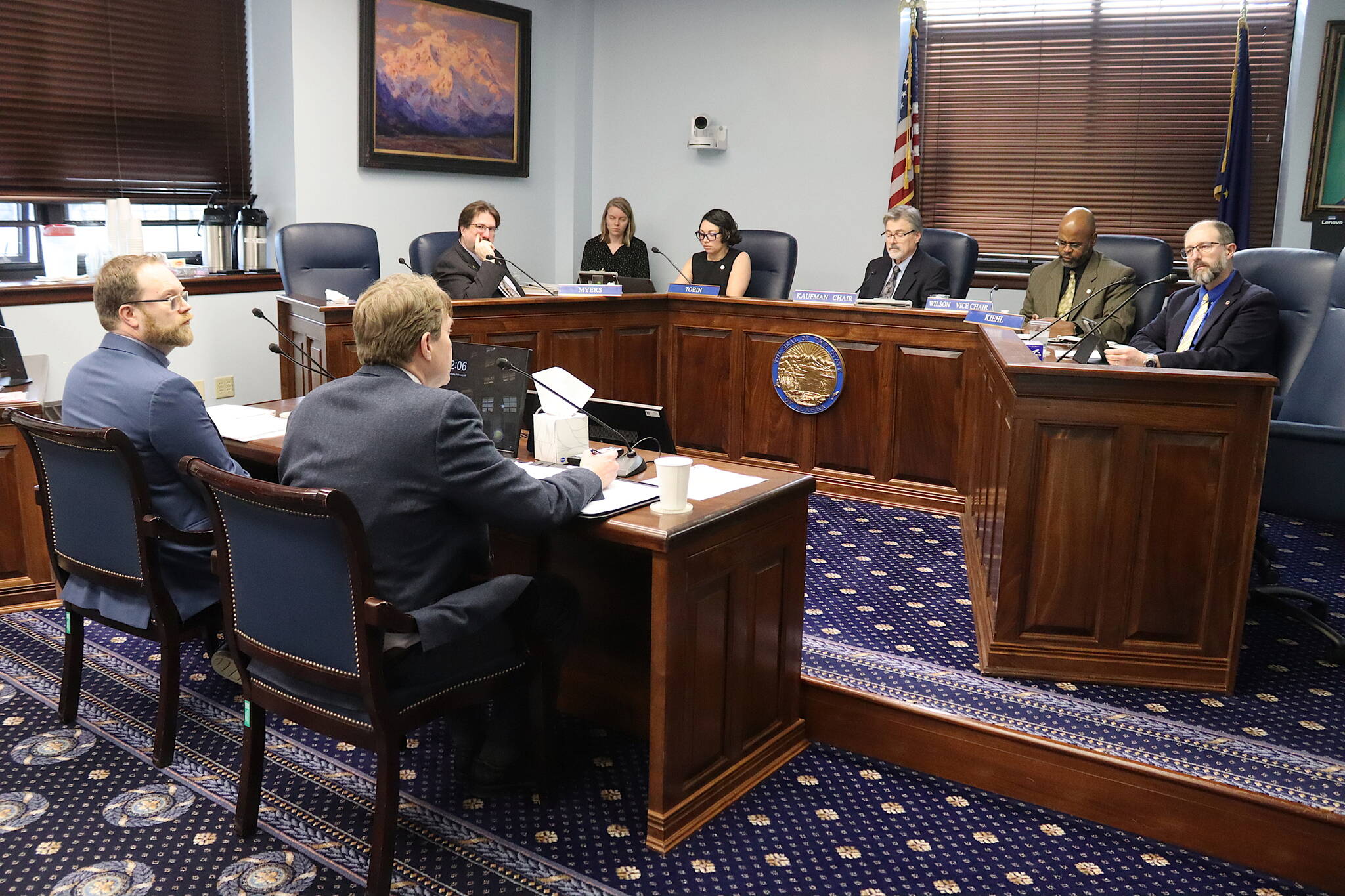
The bipartisan Senate majority, comprised of 17 of the Senate’s 20 members, is taking up resolutions to reject most or all of a dozen executive orders introduced by Gov. Mike Dunleavy on the opening day of this year’s legislative session. A resolution rejecting the order for the marine highway operations board was advanced by the Senate Transporation Committee on Thursday, following a longer discussion with administration officials Tuesday.
The executive orders can be rejected by a majority vote of the Legislature in a joint session within the first 60 days of the session.
Many of the orders, including the one for the ferry system’s operation’s board, give the governor more control over a policymaking body. The operations board has nine members, five of whom are currently appointed by the governor, and two apiece by the Senate president and House speaker.
Dunleavy, in a Feb. 7 press conference, said having an operations board that’s in sync with the administration is why he’s seeking to take control of the seats now appointed by legislative leaders. The order gives him the authority to appoint all nine members, including replacing those with time remaining on their six-year terms, on July 1.
“If they’re at odds with the (transportation) commissioner or the executive, if they want to go one direction or another, we may not be able to fix the problems with the marine highway system,” he said.
“The framers of the (state) Constitution wanted a very strong executive. And in many cases for that reason they wanted decisions made and things executed. I believe if they’re awake today, if they were with us today they’d be somewhat shocked at the lack of problems that have been solved in this state over the decades. And so we’re trying to solve issues. Are there some people that aren’t gonna like it? Of course.”
References to adversarial and awkward “dynamics” among current board members were referred to by leaders of the state Department of Transportation and Public Facilities during the Senate Transportation Committee hearing on Tuesday.
“I think the word ‘dynamics’ is in a lot of ways tied to the interpersonal interactions on the board,” said Commissioner Ryan Anderson. “It can be tied to what has been worked on the board, and how individuals and board members may be contributing to that work. It just appears ‘alignment’ is a word that I think of quite a bit when we’re talking about these boards — that boards that are aligned, that come together, move things forward quickly in my experience.”
Sen. Jesse Kiehl, a Juneau Democrat, questioned the philosophy of having an operations board designed to be in lockstep with the administration.
“I will say that over the last two-and-a-half decades or so I have often seen marine highway system leadership closely aligned, and blowing whichever way the wind blows on a given day,” he said. “Making tens or hundreds of millions of dollars of decisions, sometimes in ways that have turned out to be inefficient, sometimes in ways that have turned out to be failures. Quickly achieving alignment may not be in the best interest of the system at all.”
The legality of Dunleavy’s executive order was also debated during the meeting. Parker Patterson, a senior assistant attorney general for the state Department of Law, said appointment power of departments and governing boards belongs to the executive branch, although the legislative branch does have confirmation power for some of those.
However, some legislators noted the committee is an advisory board rather than one with authority to enact policies. Megan Wallace, director of legal services for the Legislative Affairs Agency, said that while Dunleavy’s ability to give himself power over all of the board’s appointees is a legal gray area, the Legislature definitely has the legal authority to reject the executive order granting him that power.
Dunleavy came under heavy criticism for his policies and actions related to the Alaska Marine Highway after taking office in late 2018. He proposed cutting to the ferry system’s budget by two-thirds and appointed a task force to consider options including privatizing it. He subsequently vetoed large amounts of funding approved by the Legislature during his initial years, and more recently he has essentially proposed flat funding each year in his budgets.
However, Kiehl said he has seen encouraging actions during the past year, including leadership at DOT and AMHS who are working toward improvements of the ferry system using a large infusion of federal funds and other means. However, he also expressed concern how giving the governor full authority of the operations board could be problematic “if we end up with a governor I don’t have deep trust in.”
“I think the current structure is important to this board functioning at a high level, and thus the ferry system moving forward as the most effective and efficient system we can provide Alaskans,” he said.
• Contact Mark Sabbatini at mark.sabbatini@juneauempire.com or (907) 957-2306.
