
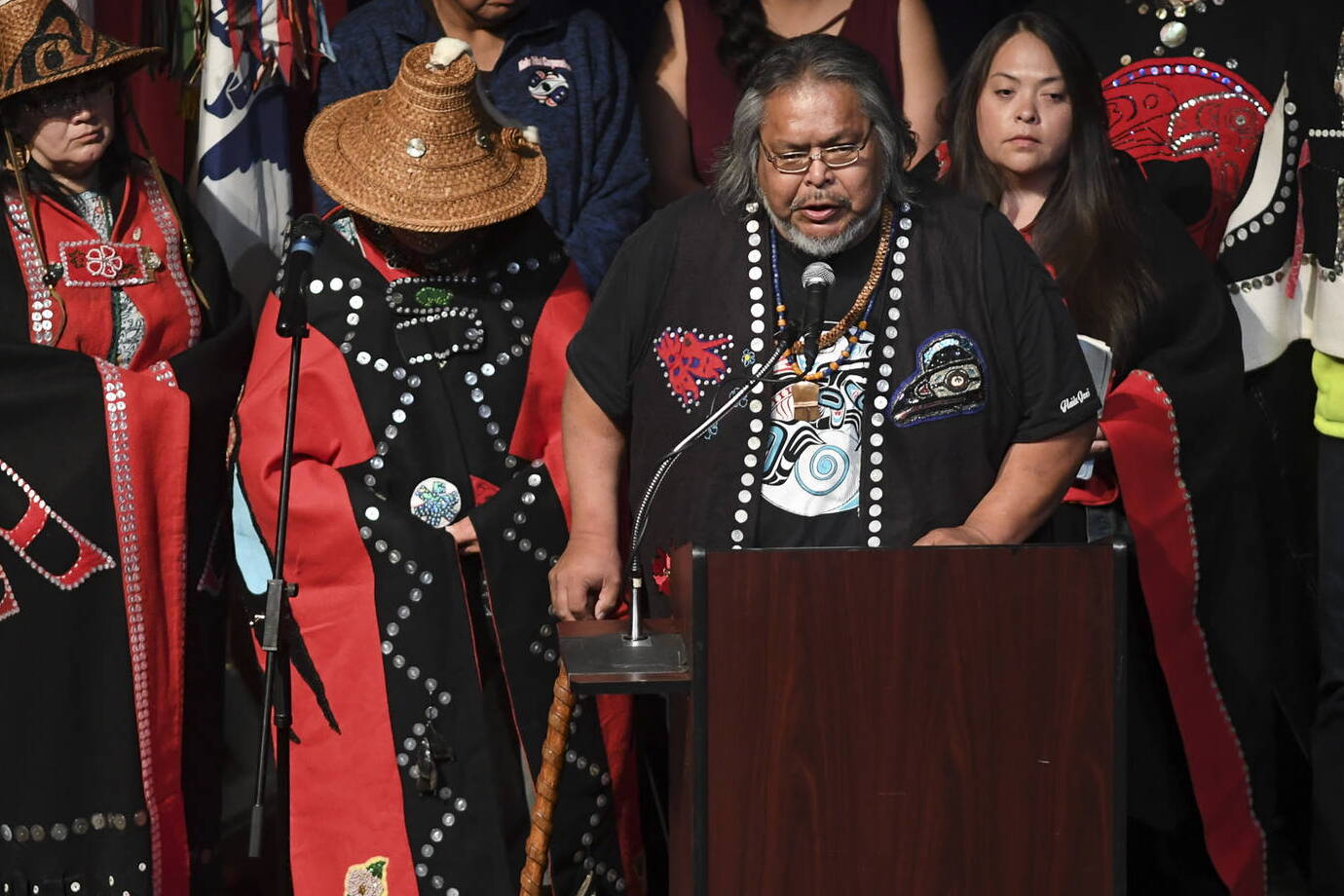
An ominous headline about Alaska Native women suffering the worst of the worst when it comes to violence served as a launching point for three days of discussions as U.S. Attorney General Merrick Garland and other top national and tribal leaders, opened the Government-to-Government Violence Against Women Tribal Consultation on Wednesday.
The annual summit, in its 17th year, the first since 2019 due to the COVID-19 pandemic, is the first in Alaska, Garland said in remarks delivered by video from Washington, D.C., to an estimated 600 attendees in Anchorage.
“It comes at an especially important moment,” he said. “Earlier this year the reactivation of the Violence Against Women Act recognized expanded criminal jurisdiction for Alaska villages and created a pilot program for villages to exercise this jurisdiction. This year’s consultation will allow us to hear from the tribal communities most affected by this new provision.”
Members of the public wanting to watch the summit remotely can register for free at https://www.ovwconsultation.org/Attend/Register
The conference began a day after Alaska was again found to be the state with the highest or second-highest rate of women killed by men, a trend that has persisted for the past decade, according to a report by the Violence Policy Center based on data from 2020. The group based in Washington, D.C., also found an especially high death rate for Alaska Native women killed by men in Alaska, with the 12.63 per 100,000 women about 3.5 times the rate for all women in Alaska and 10 times the rate for white women.
That study and others with similar findings were mentioned at the onset of the conference by Allison Randall, acting director of the Justice Department’s office of violence on women.
“One study found more than half of American Indian and Alaskan Native American women have been exposed to violence by a partner,” she said. Furthermore, “Alaskan Native American women are five times as likely to experience violence by the hands of a partner who is of a different race and three times likely to experience sexual violence by a perpetrator of a different race.”
Most of the summit is devoted to testimony by various tribal leaders and members across the country about problematic situations, with federal officials providing some updates about existing assistance efforts and announcement of new or proposed measures.
The bleakness of the situation — and lengthy futility of trying to get Alaska’s and federal leaders to help — was described in a haltingly emotional speech by Joel Jackson, president of the Organized Village of Kake. He recounted the local terror and seeming state indifference following the murder of Mackenzie Howard, 13, in 2013, saying her body lay in the rear entrance of a church across the street from his house for 16 hours before Alaska State Troopers showed up.
“After I testified about that I brought up the fact that if a moose or a deer is killed out of season there’s probably six to a dozen fish and game officials that come in and it doesn’t matter what the weather is like, they’ll find a way to get there within two hours,” he said.
When two Village Public Safety Officers visited Kake in response to Jackson’s public outcry about the murder “they gave us the same story: ‘We don’t have the people to cover rural Alaska.’ That’s the story I’ve heard time and time again.”
While federal and state officials in recent years have pledged assistance, Jackson said it hasn’t translated into results. For instance, when former Attorney General Bill Barr visited Alaska he pledged $10 million in law enforcement infrastructure assistance.
“I’ve never seen a penny of it and I’ve asked tribal leaders across the state if they seen anything,” he said. “So where did the money go?”
The opening day of the summit included the announcement of the latest of multiple recent federal allocations that include Alaska Native assistance, with Randall stating more than $246 million in grants to American Indian and Alaska Native communities to improve public safety and serve crime victims. Jackson’s reaction to the announcement about federal assistance is “I want to see it go directly to the tribes. I do not want it to go to the state.”
The most recent interaction with state officials occurred earlier this year when Alaska Department of Public Safety created a new Missing and Murdered Indigenous Persons investigator. But Jackson said his conversation with Alaska State Troopers visiting after the announcement did little to sooth his discouragement.
“I brought up the past, what we went through,” he said. “And one trooper said ’why do you bring up the past?’ I said ’because it is still the present. It is not the past. We are still living it.’”
Among the featured presenters from across the country during first day of the summit was Violette Capoeman, 17, the current Miss Quinault Indian Nation, who said she attends a girls’ boarding school in Tacoma, Washington, where her peers represent a multitude of nationalities and races. But she is the only Native American in her class and “my friends come from various backgrounds such as Korean, African-American, Caucasian. I am the only Native American in my class. And I believe in my entire school.”
“My friends walk freely around the city, unbothered by the people that exist and could lurk around every corner,” she said. “My fear and anxiety being a target for potential abduction to sex trafficking or other violent crimes does not rest with them — not to resignation with them. I am always looking over my shoulder and it feels like it is not fair to live in such fear.
“There are even some days where I fear to acknowledge my heritage, wearing anything that may give me away, from regalia to Native jewelry, as to not draw unwanted attention to myself for fear of what might be insight. As a young indigenous woman my testimony is to help all of you understand that the playing field is not the same for minors.”
The summit is scheduled to continue through midday Friday. Other Southeast Alaska leaders offering government-to-government testimony — both on Thursday afternoon — are Gloria Burns, a tribal council member of the Ketchikan Indian Community, and Catherine Edwards, third vice president of the Central Council of Tlingit and Haida Indian Tribes of Alaska.
• Contact Mark Sabbatini at mark.sabbatini@juneauempire.com
