
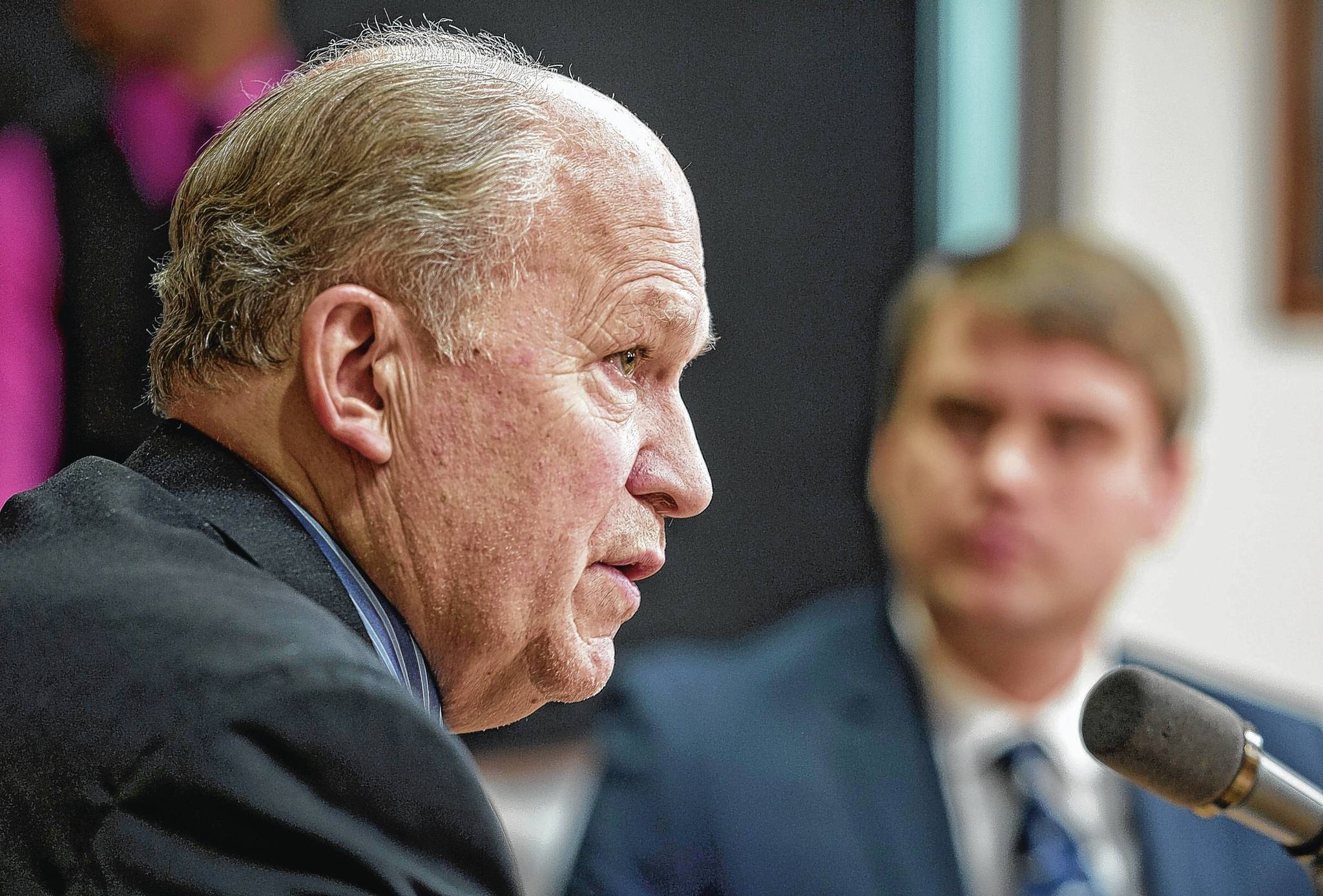
Gov. Bill Walker on Friday unveiled his plan for a $10.6 billion state budget that includes spending from the Alaska Permanent Fund’s earnings reserve to cope with a continuing multibillion-dollar annual deficit.
In his press conference and in documents released alongside the budget, Walker said he is prioritizing public safety and jobs.
“We need to put Alaskans back to work. We need to fix that part of our economy,” Walker said.
Walker unveiled his Fiscal Year 2019 budget proposal in an Anchorage press conference. Fiscal Year 2019 begins July 1, and Alaska’s governor is required by law to propose a budget no later than Dec. 15. Alaska’s legislators will convene Jan. 16 in Juneau and have the final say on that budget. In most years, the budget is greatly rewritten by the Legislature.
The FY19 proposal is about $400 million more than the budget approved by the Legislature for the current fiscal year, which ends June 30. Walker is also proposing more than $700 million in supplemental spending that will be booked in the current fiscal year.
The governor is proposing a temporary 1.5 percent payroll tax that would last three years and generate about $800 million to pay for maintenance projects at state buildings, a move intended to create construction jobs, Walker said. Additional spending is earmarked for other projects across the state.
Walker said the spending is necessary to lower Alaska’s unemployement rate, which at 7.2 percent is the highest in the country, according to the U.S. Bureau of Labor Statistics. Alaska’s job growth rate is also 50th in the nation.
“To stand by and watch our economy continue to spiral downward, to watch our unemployment continue to rise, is unacceptable,” Walker said.
The tax is similar to one proposed by Walker during the latest special session; it would tax poorer Alaskans at a higher rate than wealthier Alaskans.
“I don’t like any form of taxes … but I’m also not a fan of what’s happening in our economy,” Walker said.
Walker’s budget includes a $34 million increase to public safety spending. That money would hire additional police and prosecutors, and boost substance abuse treatment programs.
The Permanent Fund Dividend would also be higher under Walker’s proposed budget, which endorses the idea behind Senate Bill 26. That bill was passed in differing forms by the Alaska Legislature earlier this year.
If signed into law, it would divert a portion of the fund’s value each year to government services. Under the version of SB 26 envisioned in Walker’s budget, $1.9 billion would flow from the Permanent Fund to the state’s regular accounts. Another $818 million would be reserved for dividends. That’s enough for a dividend of $1,216 per person.
Since 2016, when Walker capped the dividend at $1,000, the amount of the dividend has been a touchy political topic. In 2017, Walker didn’t have to cap the dividend — the Legislature did that itself, setting a payment of $1,100. A dividend cap is seen as necessary under most scenarios where the Permanent Fund is also used for state services. Walker’s proposed 2018 dividend is based on a compromise between different versions of SB 26. Without a cap, the dividend — which is ordinarily based on the success of investments rather than the price of oil — would be more than $2,200.
Other portions of the budget will be covered with the state’s normal revenue, about $400 million from the Constitutional Budget Reserve and $77 million from the Statutory Budget Reserve.
If Walker’s budget is approved, it would mark a major shift in state policy. Since the Alaska Permanent Fund was established in 1976, its proceeds have never been used on a regular basis for anything but the Permanent Fund Dividend.
Walker also proposes to spend more on Medicaid, make a down payment on the state’s pension deficit, and create a bond program to cover tax credits owed to North Slope oil and gas drillers.
In addition, the governor is suggesting a change in the way the state does its budgeting. Rather than do a budget every year, he suggests the state should do one every other year, and penalize lawmakers by withholding their pay if they fail to approve a budget within 90 days.
“I’m a big believer that there should be consequences about what you do or don’t do,” Walker said.
That last element is similar to an idea within a ballot initiative proposed by Rep. Jason Grenn, I-Anchorage, and Rep. Jonathan Kreiss-Tomkins, D-Sitka.
Walker’s budget relies on the Alaska Legislature to pass several monumental pieces of legislation, including SB 26. The budget also expects lawmakers to pass a hike in the state’s gas tax, enact a payroll tax, reform the state budget process, and create a new oil and gas credit program atop the budget bills that pass the House and Senate in a normal year.
• Contact reporter James Brooks at james.k.brooks@juneauempire.com or call 523-2258.
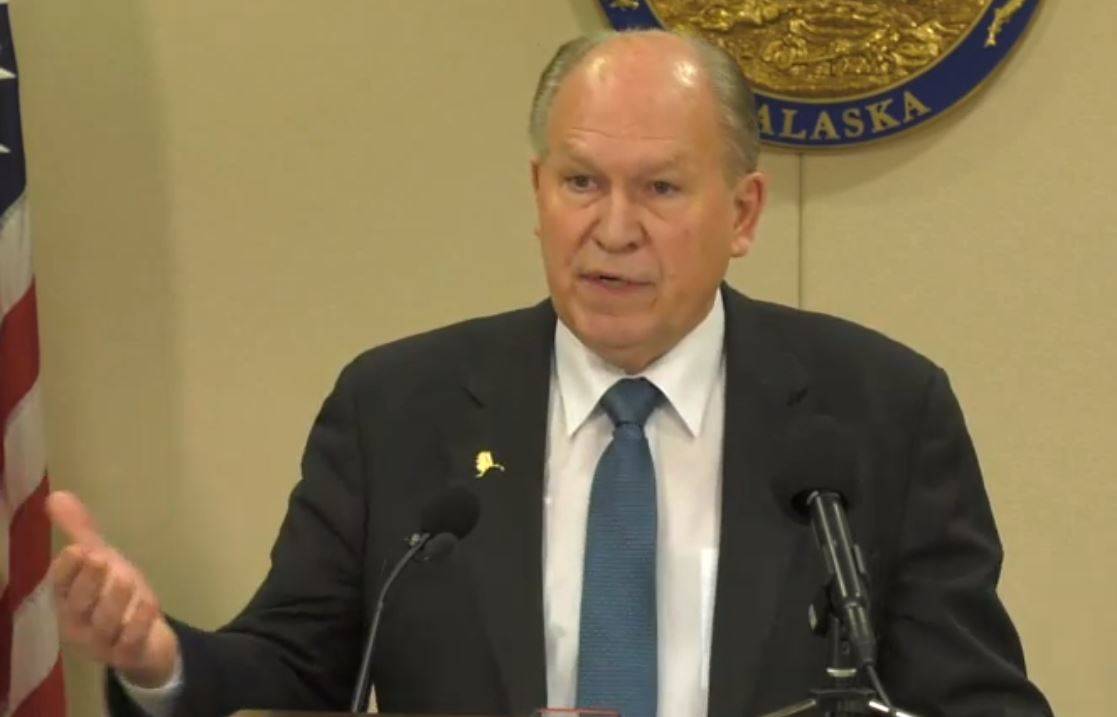
Gov. Bill Walker speaks Friday, Dec. 15, 2017 during a press conference unveiling Alaska’s FY19 budget. (Video capture)
