
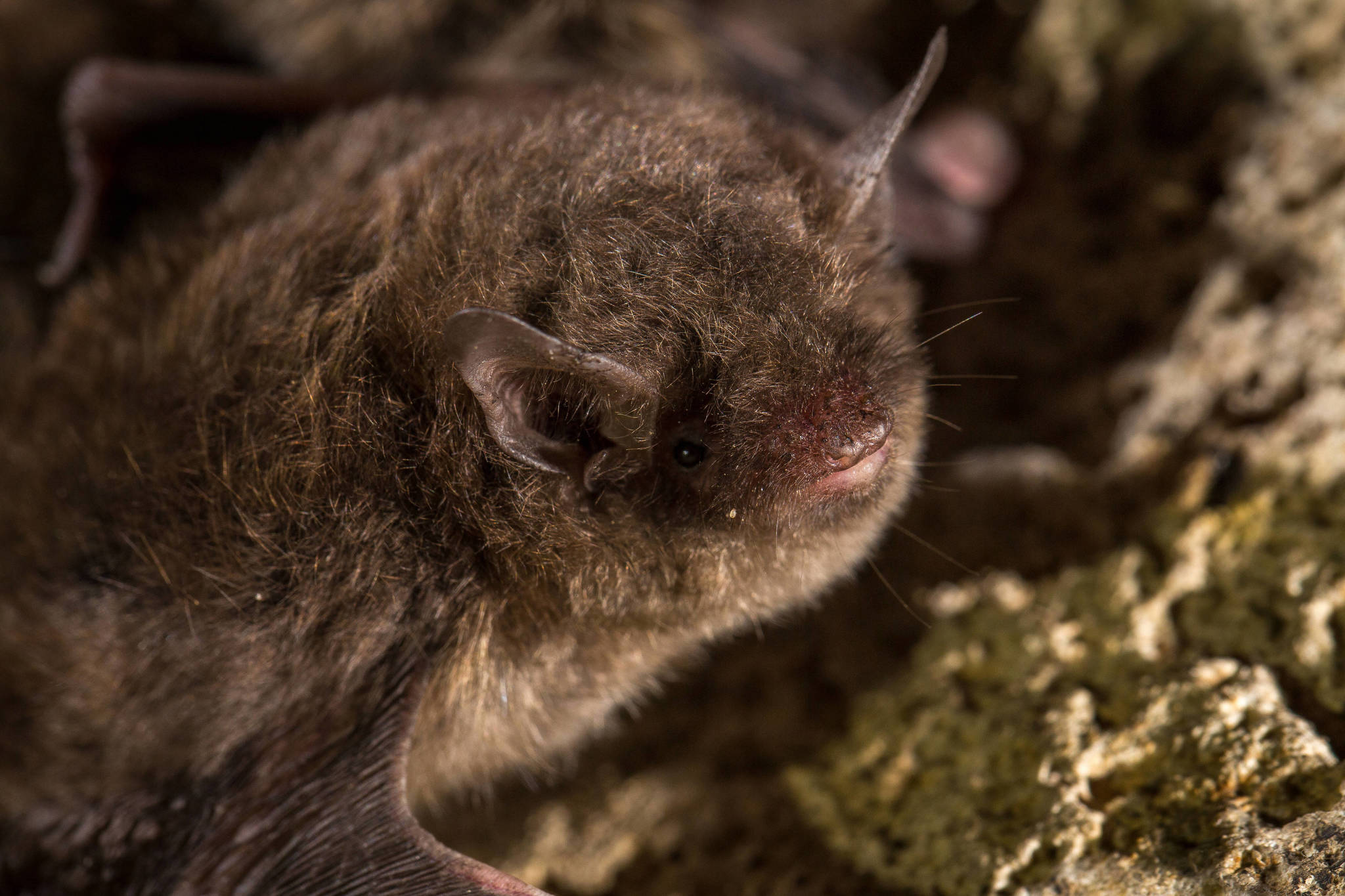
Bats, like the one pictured, are expected to be hibernating for the next couple of weeks. (Courtesy Photo | Alaska Department of Fish and Game)

Bats, like the one pictured, are expected to be hibernating for the next couple of weeks. (Courtesy Photo | Alaska Department of Fish and Game)

Going to bat for Juneau’s winged mammals

Researchers want to know more about where they hibernate

A fast-spreading and deadly-to-bats fungal disease hasn’t been seen in Juneau’s bats, but it’s not that far away.

Karen Blejwas, biologist for Alaska Department of Fish and Game, said white-nose syndrome, which has killed millions of North American bats east of the Rocky Mountains, popped up in Western Washington in 2016.

“That was a little unexpected, and it’s not close to where else it’s been detected,” Blejwas said.

[Bat weekend uses fun to teach about winged mammals]

Aside from that odd instance, white-nose syndrome has generally been a concern relegated to Eastern and Midwest states.

“We’re not entirely sure how it got there, but it really caught western bat biologists off guard,” Blejwas said.

That’s why she and other researchers have been studying bats in Southeast Alaska, and that research was the subject of Friday night’s Fireside Lecture at the Mendenhall Glacier Visitor Center.

Blejwas’ talk brought the series of free talks to a close for this year and mostly focused on what little brown bats do after their pups have been weaned.

“It’s a relatively under-studied period,” Blejwas said.

While bats mate in the fall, Blejwas said females store sperm until spring. Then they will ovulate, and in 50 to 60 days a single pup will be born.

By July or mid-August those pups are weaned and mama bats are able to go do bat things, which as Blejwas detailed, mostly means sleeping and eating before hibernating.

Since bats hibernate for about half the year, Blejwas said it’s important for them to put on enough weight to survive from about October until April.

Blejwas shared some data that suggests bats in Southeast Alaska may not vary much in weight throughout the year possibly because the ambient temperature in the places they hibernate may be fairly close to the ideal internal temperature for hibernation.

“When they’re not eating or mating, bats are mostly sleeping,” Blejwas said.

[Tracking Juneau’s endangered bats]

She said in some cases bats were observed spending as many as 22 hours per day in their roosts sleeping.

Researchers have found about 10 hibernacula — places bats hibernate — in the Juneau area. Blejwas said most of them have been found in forested scree slopes around North Douglas and Admiralty Island.

Blejwas said the hope is to find more hibernation spots, and there are a couple of different programs that could help with that.

This summer, Blejwas said a scent detection dog will be trained and used to detect bats.

“There should be plenty of scent for the dogs to detect,” Blejwas said.

The Alaska Citizen Science program could also be helpful.

People can volunteer to drive a survey route with a special bat monitor attached to their vehicle. The acoustic monitoring can even allow researchers to identify bats by their species, Blejwas said.

She said Juneau’s survey route takes about 90 minutes to drive.

This year, monitors will be available to check out at the Mendenhall Glacier Visitor Center , but volunteers need to call ahead because the center will be closed for the month of April. The number is 789-0097.

A driving survey volunteer agreement can also be found online through the department of fish and game’s website. Completed agreements should be emailed to dfg.dwc.bats@alaska.gov.

“The Citizens Science program has become even more important in this era of budget cutting,” Blejwas said.


• Contact reporter Ben Hohenstatt at (907)523-2243 or bhohenstatt@juneauempire.com. Follow him on Twitter at @BenHohenstatt.
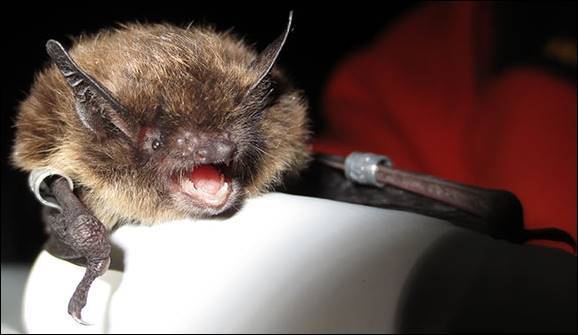

Little brown bats are found throughout Southeast Alaska. So far, none have been found with the deadly white-nose syndrome, but some bats were found with it in Western Washington in 2016. (Courtesy Photo | Alaska Department of Fish and Game)

Little brown bats are found throughout Southeast Alaska. So far, none have been found with the deadly white-nose syndrome, but some bats were found with it in Western Washington in 2016. (Courtesy Photo | Alaska Department of Fish and Game)

More in News

CBJ sign reads “Woodstove burn ban in effect.” (City and Borough of Juneau photo)
CBJ issues air quality emergency in Mendenhall Valley

All woodstove and fireplace burning in the valley is prohibited until further notice.

A dusting of snow covers the Ptarmigan chairlift at Eaglecrest Ski Area in December 2024. (Eaglecrest Ski Area photo)
Update: Waterline break forces closure at Eaglecrest Friday, Saturday

The break is the latest hurdle in a challenging opening for Juneau’s city-run ski area this season.

Patrick Sullivan stands by an acid seep on July 15,2023. Sullivan is part of a team of scientists who tested water quality in Kobuk Valley National Park’s Salmon River and its tributaries, where permafrost thaw has caused acid rock drainage. The process is releasing metals that have turned the waters a rusty color. A chapter in the 2025 Arctic Report Card described “rusting rivers” phenomenon. (Photo by Roman Dial/Alaska Pacific University)
Ecosystem shifts, glacial flooding and ‘rusting rivers’ among Alaska impacts in Arctic report

NOAA’s 2025 report comes despite Trump administration cuts to climate science research and projects

The U.S. Capitol in Washington, D.C., on Oct. 1, 2025. (Photo by Jennifer Shutt/States Newsroom)
Moderate US House Republicans join Dems to force vote on extension of health care subsidies

WASHINGTON — Republican leaders in the U.S. House will face a floor… Continue reading

The National Weather Service Juneau issues a high wind warning forDowntown Juneau, Southern Douglas Island and Thane due to increased confidence for Taku Winds this afternoon. (National Weather Service screenshot)
Taku winds and dangerous chills forecast for Juneau

Gusts up to 60 mph and wind chills near minus 15 expected through the weekend.

Chloe Anderson for the Juneau Empire
Fallen trees are pictured by the Mendenhall river on Aug. 15, 2025. Water levels rose by a record-breaking 16.65 feet on the morning of Aug. 13 during a glacial outburst flood.
Lake tap chosen as long-term fix for glacial outburst floods

The U.S. Army Corps of Engineers and Juneau leaders agreed on the plan.

Gift card displays, such as this one in a CVS in Harlem, N.Y., have been a source of concerns for lawmakers hoping to combat gift card fraud. “Card draining,” or stealing numbers from poorly packaged cards, is one of the costliest and most common consumer scams, and states are trying to combat it with consumer alerts, arrests and warning signs on store displays. (Photo by Robbie Sequeira/Stateline)
Alaskans targeted by scammers posing as government officials, FBI warns

The FBI reports Alaskans lost over $26.2 million to internet-based scams in 2024, with $1.3 million of those losses due to government impersonation scams

A buck enters the view of an Alaska Department of Fish and Game trail camera on Douglas island in November 2020. (Alaska Department of Fish and Game courtesy photo)
Douglas deer: The island’s hunt faces calls for new rules

Board of Game is seeking public comment on regulation changes that would affect Juneau.

A cat says hello at Juneau Animal Rescue in February 2025. (Jasz Garrett / Juneau Empire file photo)
New animal shelter site approved by Juneau Assembly

Juneau Animal Rescue secures eight-acre lease, but fundraising remains.

Most Read